
Soil degradation has become a major environmental concern. Today, 62% of European soils are affected by at least one degradation process, largely driven by land sealing and unsustainable farming practices (Mason et al. 2023; EUSO 2024). Conservation Agriculture (CA) is often promoted as a promising alternative, combining sustainable production with improved soil quality (Chabert et Sarthou 2020; Thierfelder et al. 2017).
CA is built on three pillars: minimizing mechanical soil disturbance, maximizing soil organic cover, and diversifying crop species. Together, these pillars aim to reduce soil erosion and compaction and to improve soil structure, biodiversity, and fertility.
But does CA always deliver the same soil benefits — regardless of how it is implemented?
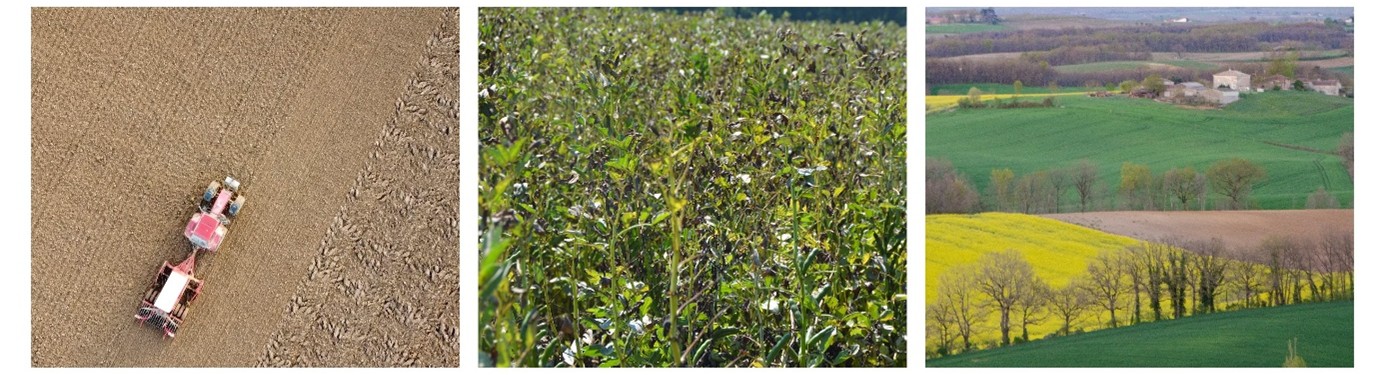
Figure 1 The picture on the left shows a cereal seedling with no-till on the left and plowing on the right. The middle image shows a cover crop consisting of several associated species. The image on the right illustrates the diversity of crops grown in Wallonia. Photos credited to Philippe Baret.
Why we looked deeper
Despite growing interest in CA, important knowledge gaps remain:
- Limited evidence on soil quality outcomes. Compared to conventional or organic farming, CA systems remain relatively understudied.
- Partial implementation in research. Most studies focus primarily on tillage reduction, often neglecting soil cover and crop diversification.
- The forgotten diversity of practices. CA encompasses a wide range of practices, shaped by the local pedo-climatic context and farmers’ objectives, constraints, and resources.
These gaps raise a key question: Are all CA fields equivalent when it comes to soil quality?
Comparing four CA-types in Wallonia
To address this, we compared four CA-types in the Walloon Region (Belgium) that represent contrasting combinations of CA practices. These ranged from strict no-till systems dominated by industrial crops (e.g., potato, sugar beet, vegetables), to crop sequences including temporary grasslands with occasional plowing.
Soil quality was evaluated using three indicators:
- Soil structural stability, measured by the QuantiSlakeTest method, to estimate soil erodibility and resistance to compaction.
- The SOC:Clay ratio, reflecting soil organic status and soil structural quality resilience.
- Labile carbon content, used as a proxy for soil biological activity.
Which practices have the greatest impact on soil quality?
Our research demonstrated that temporary grasslands emerged as the most decisive factor for soil quality, even when occasional plowing was used to destroy them. In contrast, the CA-type dominated by industrial crops showed lower soil structural stability and quality, despite strict no-till management.
These findings challenge simplistic narratives such as “no-till is always good” and “tillage is always bad”. Instead, they highlight the importance of looking at farming systems as a whole. Tillage, carbon inputs, and crop rotation are deeply interconnected and largely shaped by the farm’s productive orientation, which ultimately drives soil management decisions and soil impacts.
Would you like to learn more about this topic? We invite you to read our scientific paper: https://soil.copernicus.org/articles/12/79/2026/
References
Chabert, Ariane, et Jean-Pierre Sarthou. 2020. « Conservation agriculture as a promising trade-off between conventional and organic agriculture in bundling ecosystem services ». Agriculture, Ecosystems & Environment 292 (avril): 106815. https://doi.org/10.1016/j.agee.2019.106815.
EUSO. 2024. « EUSO Soil Health Dashboard ». décembre 13. https://esdac.jrc.ec.europa.eu/esdacviewer/euso-dashboard/.
Mason, Eloise, Sophie Cornu, et Claire Chenu. 2023. « Stakeholders’ point of view on access to soil knowledge in France. What are the opportunities for further improvement? » Geoderma Regional 35 (décembre): e00716. https://doi.org/10.1016/j.geodrs.2023.e00716.
Thierfelder, Christian, Pauline Chivenge, Walter Mupangwa, Todd S. Rosenstock, Christine Lamanna, et Joseph X. Eyre. 2017. « How climate-smart is conservation agriculture (CA)?–its potential to deliver on adaptation, mitigation and productivity on smallholder farms in southern Africa ». Food Security 9 (3): 537‑60. https://doi.org/DOI 10.1007/s12571-017-0665-3.
Written by:
Manon Ferdinand
Manon holds a PhD in agricultural science (UCLouvain, Belgium), supervised by Pr. Philippe Baret and with the funding from a FNRS-FRIA grant. Her thesis focused on the study of the diversity of Conservation Agriculture practices and the impact of this diversity on soil quality indicators. Since April 2024, she works as a research assistant in the Sytra team (Earth and Life Institute – UCLouvain) on projects relating to the transition of agricultural practices, taking into account the diversity of production systems (https://sytra.be/member/
