
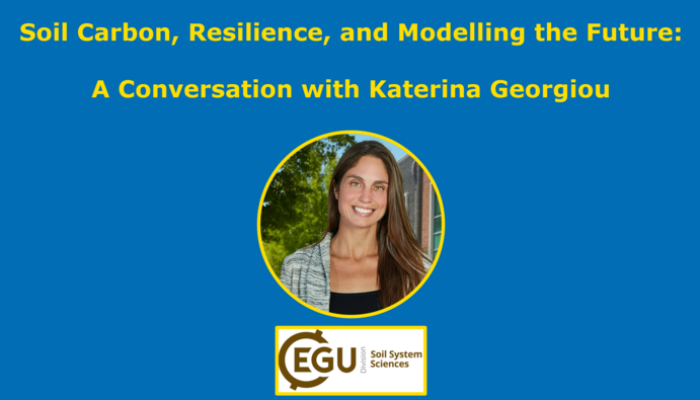
Soils play a central role in climate change mitigation and adaptation, with soil carbon management increasingly seen as a key pathway for enhancing ecosystem resilience—particularly in agricultural systems. At the same time, predicting how soil carbon responds to changing climate and management remains one of the major challenges in soil system science.
In this interview, we speak with Katerina Georgiou, recipient of the 2025 EGU Outstanding Early Career Scientist Award in Soil System Sciences. Her research focuses on advancing our understanding of soil carbon dynamics, with particular attention to the processes that control carbon persistence and how these insights can improve predictive models.
We asked Katerina about her scientific path, what currently excites her most in soil carbon research, and how bridging detailed process understanding with larger-scale modelling can inform climate-resilient land management. She also reflects on her experience as an early career scientist and shares advice for others navigating the field.
We began by asking Katerina about her research focus and what initially drew her to soil system science.
Congratulations again on receiving the 2025 Outstanding ECS Award in Soil System Sciences! Could you briefly tell us about your research focus and what motivated you to work in this field?
Thank you! It is a huge honor to receive this award and I’m very grateful to my nominators for their support. My research focus is broadly in the area of soil biogeochemistry, with a particular interest in improving predictive models of how the soil carbon cycle responds to changes in climate and management. I took a meandering path to find this field. My academic background is in chemical engineering, but it wasn’t until I took a course on mathematical modeling in ecology and biogeochemistry in graduate school that I knew this was what I wanted to study! I was immediately drawn to the complexity of understanding and modeling soil structure and function, and the ability to get my hands dirty in the field.
Your work has been recognized as particularly impactful. Could you highlight one or two findings or approaches from your recent research that you are most excited about?
Most recently, my research has focused on understanding how the interactions between organic matter and soil minerals may limit the amount of carbon that can be stored in soils and its vulnerability to climate change. Using a global observational synthesis that I put together from published literature, I quantified the maximum observed capacity of mineral-associated organic carbon in soils and showed that the proximity of soils to this limit can affect carbon accrual rates under management. I also used this global dataset to explore the temperature sensitivity of mineral-associated organic carbon and develop metrics for benchmarking Earth system models. These findings are important for our ability to predict soil carbon dynamics, and for informing how and where we manage our soils.
Soil science often connects local processes with global challenges. In your view, how does your research on soil carbon management contribute to broader questions such as climate change, ecosystem functioning, or sustainable land management?
Soil organic matter is incredibly heterogeneous in its chemical composition and spatial arrangement at the micro-scale, and this complexity ultimately affects functioning at ecosystem to global scales. My research on mineral-organic matter interactions contributes to our understanding of carbon persistence and storage limits, which is critical for understanding the response of soil carbon to climate change and management.
As an Early Career Scientist, what challenges have you encountered, and how have you navigated them?
Some challenges are pervasive and affect many early-career scientists, which makes them even more important to talk about. For instance, imposter syndrome can prevent young scientists from putting themselves out there or taking risks. Trust yourself and build a support network of mentors or peers to bounce ideas off of. Try not to take failure personally, but rather see it as an opportunity for growth. Looking back at roadblocks that felt insurmountable at first, these are some of the most memorable moments where I pushed myself to grow and find strength that I didn’t know I had.
What advice would you give to other ECSs in soil science, whether about research, career development, or navigating the academic environment?
First and foremost, I would say to pursue what you’re most passionate about and have fun! Originality and connections between disciplines will advance the field and be recognized in the long run, as will being collaborative and generous in sharing ideas. Telling a story clearly and knowing your audience is also very important. To prevent burnout, reflect on what you personally need to recharge, carve out the time, and hold yourself accountable. Try not to stress about things that are beyond your control. Finally, don’t be shy to ask for help and to seek (multiple) informal mentors who you can count on.
Looking ahead, what directions or open questions in soil science excite you the most?
I’m very interested in bridging process understanding across spatial scales, and improving scale-dependent representations in models. It is exceedingly difficult to resolve the full biological, chemical, and physical complexity of soil in a model – but, what simplifications are acceptable, and when, is still an open question. Furthermore, understanding the drivers of, and limits to, soil organic matter accumulation and persistence is both a fundamental and applied area of research that I’m particularly passionate about.
We thank Katerina Georgiou for taking the time to share her experiences and perspectives, and congratulate her again on receiving the 2025 EGU Outstanding Early Career Scientist Award in Soil System Sciences.