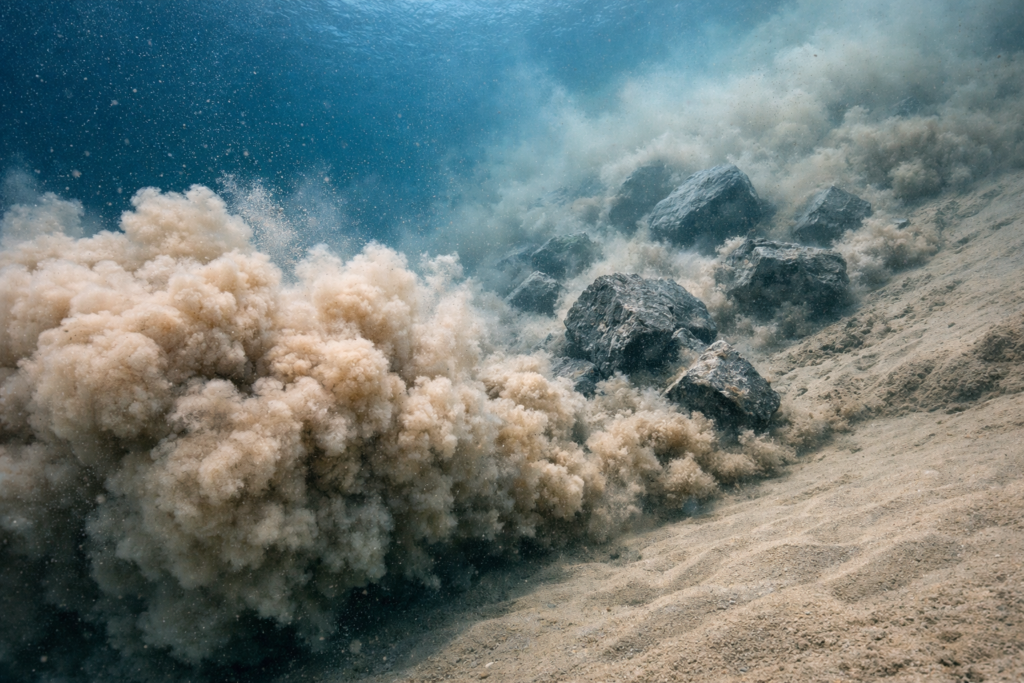
When we think about landslides, we usually picture mountain slopes collapsing after heavy rain or earthquakes. Similar phenomena, often much larger, also occur beneath the sea along continental margins and across the deep ocean floor. Geologists refer to the deposits left behind by these collapses as Mass Transport Deposits, commonly abbreviated as MTDs. When several of these deposits form part of a larger unit, they are sometimes grouped under the term Mass Transport Complexes, or MTCs.
MTDs are not rare or exceptional features. They are fundamental elements of the submarine landscape. They play a major role in shaping ocean basins, influencing geological hazards, and in some cases affecting the exploration of natural resources.
What exactly are MTDs?
An MTD is the final product of a large downslope movement of sediment on the seafloor. The term describes the deposit, not the process. The process itself is usually called a submarine landslide.
A simple way to understand this is to imagine a slope failure along a mountain road. Sometimes material moves as a relatively intact block. Sometimes it breaks into large boulders. In other cases it turns into a chaotic mixture of soil, sand, and mud that spreads across the road. The same range of behaviors occurs underwater, but with sand, mud, rock fragments, and even pieces of coral reefs. The scale can reach tens or hundreds of kilometers.
A single MTD may contain large blocks that slid downslope with limited internal deformation, chaotic zones where sediments are intensely mixed and folded, and areas where the material flowed almost like thick mud. As a result, MTDs often display highly disordered internal structures. Geologists can recognize these features clearly in seismic data.
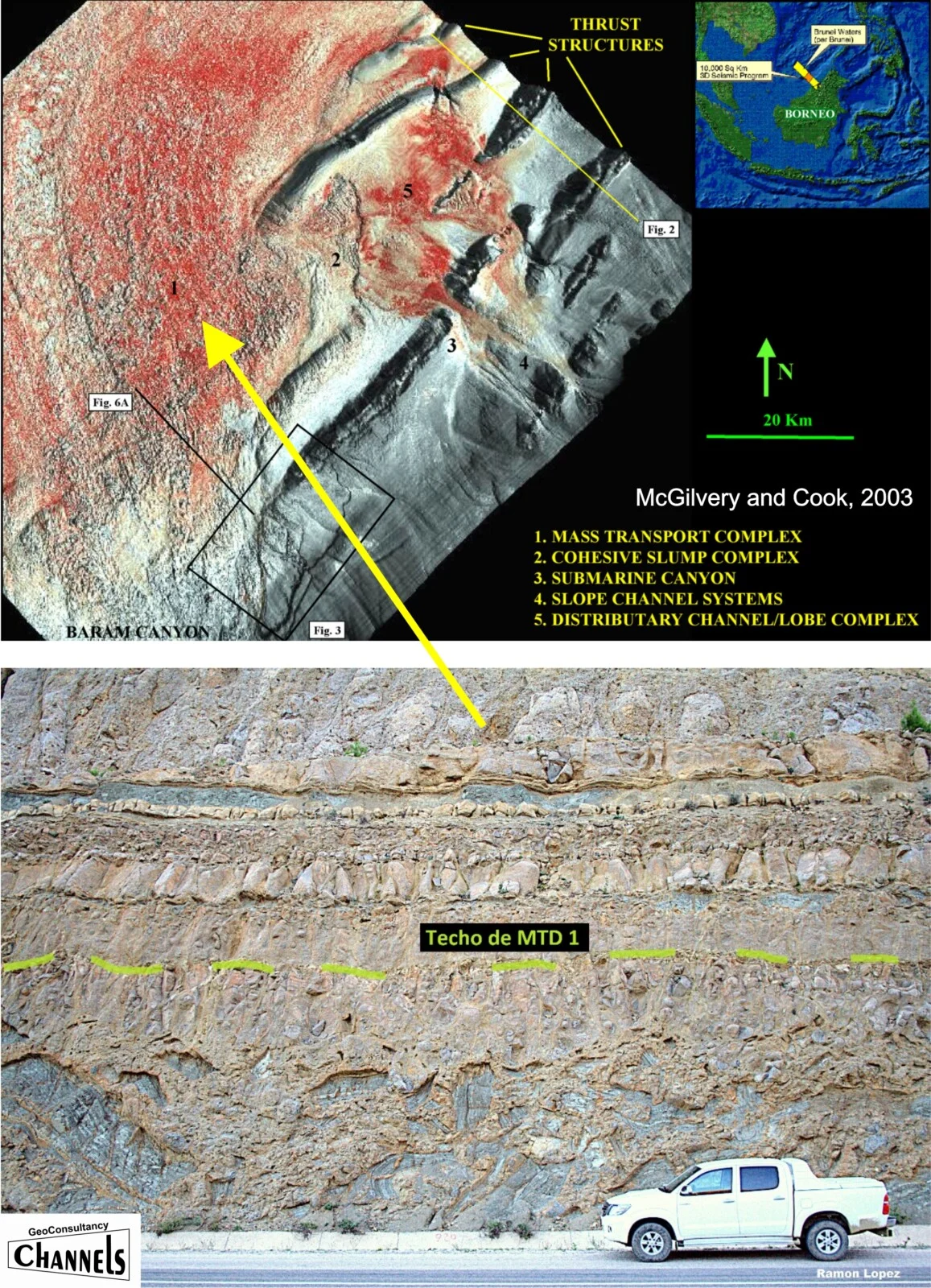
Figure 1. Upper image: plan view of MTDs offshore Brunei in a tectonically complex area with ridge-like relief that collapses repeatedly. Bottom image: outcrop in southern Turkey showing blocks of stratigraphy that differ from the surrounding material. These outcrops are interpreted as onshore analogues of the offshore examples.
Where do MTDs occur?
MTDs are found in many submarine settings, especially where large sediment volumes combine with unstable conditions. They are common along continental margins, where the seafloor descends steeply into deep ocean basins. They also occur in submarine canyons, which can be seen as the underwater equivalent of large valleys on land.
They are frequent in submarine channels and along their levees, where fine sediment transported by turbidity currents accumulates. Tectonically active regions are also favorable settings. Faults, folds, salt structures, and mud diapirs can weaken the seafloor. Glaciomarine environments represent another important setting, as they received massive sediment input during glacial periods.
One striking observation is that some MTDs develop on slopes of less than one degree. A steep gradient is not required. It is enough for the sediment to be mechanically weak.
What processes trigger them?
Two types of factors usually combine to generate an MTD. First, conditions that weaken the seabed. Second, a trigger that initiates failure.
Many continental margins are built from alternating layers of sand deposited by turbidity currents and fine mud that settles slowly from suspension. This layering can be mechanically unstable. Rapid sediment accumulation prevents proper compaction and traps pore water. High pore pressure reduces effective stress and weakens the sediment. In submarine channel and canyon systems, steep channel walls can also fail, in a way comparable to slope failures in terrestrial valleys.
Even when the system is weak, a trigger is often required. Common triggers include earthquakes, unusually rapid sediment loading, abrupt changes in pore pressure, gas destabilization, and isostatic rebound after the melting of large ice sheets.
A well documented example of earthquake triggering is the large landslide on the Laurentian Fan off eastern Canada. A seismic event initiated the collapse of a vast sediment mass that traveled more than 100 km across the ocean floor and covered an area comparable to small countries (Piper and Aksu, 1987)
Isostatic rebound is linked to the well known Storegga Slide offshore Norway. After the retreat of Scandinavian ice sheets, seismicity increased along the Norwegian margin. Glaciomarine sediments that had accumulated over long periods were poorly consolidated and overpressured. Changes in stress conditions and possible gas hydrate destabilization created the conditions for a massive collapse, likely triggered by an earthquake related to postglacial adjustment. The Storegga event mobilized roughly 3,000 to 3,500 cubic kilometers of sediment, traveled more than 800 km, and generated a tsunami that affected Norway, Scotland, and other North Atlantic coasts (Bryn et al., 2005; Walker et al., 2020).
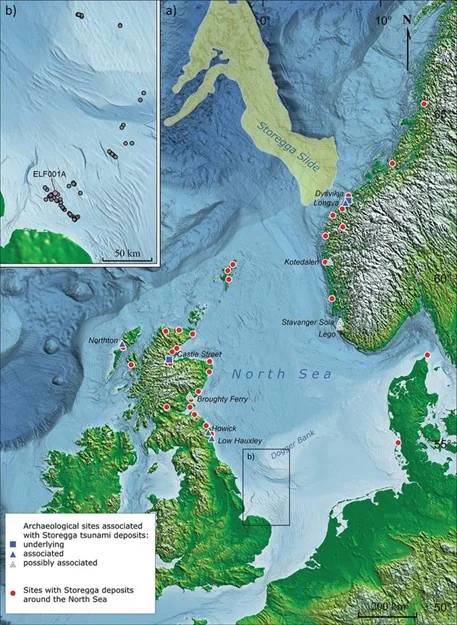
Figure 2. Map showing the extent of the Storegga Slide and its regional impact -area in yellow at the top of the map. (Credit: topography: National Oceanic and Atmospheric Administration 2009; bathymetry: EMODnet 2018; image by M. Muru).
How do submarine landslides differ from those on land?
One major difference is scale. The Storegga Slide illustrates how submarine failures can reach volumes far beyond most terrestrial examples.
Another difference lies in the internal evolution of the failure. Many subaerial landslides occur as rapid, localized events. Submarine landslides associated with MTDs are often more complex and progressive. They may begin at a specific point and then retrogress upslope, with the main scarp migrating backward over time. During this progression, the moving mass can evolve from relatively coherent sliding blocks to increasingly deformed and chaotic flows.
The Laurentian Fan provides a good example. Researchers observed that the failure did not occur uniformly. The collapse initiated in one area and propagated upslope. Material that initially moved as a coherent mass progressively fragmented, deformed, and transformed into a more chaotic flow. A single event can therefore include sliding, internal deformation, and fluid-like flow phases.
Final reflection: associated natural hazards
The ocean floor is not a quiet and static environment. Some of the largest mass movements on Earth occur beneath the sea. These events can reshape submarine landscapes in a matter of hours or days and transport hundreds or thousands of cubic kilometers of sediment.
Beyond their geological significance, MTDs represent real hazards. They can break submarine communication and power cables, damage pipelines, and create persistent seabed instability. Large and rapid failures may also contribute to tsunami generation, as documented along several continental margins.
Understanding MTDs is not only an academic exercise. It is essential for assessing geohazards, reconstructing Earth history, and interpreting sedimentary systems at basin scale.
Referencias
Bryn, P., Berg, K., Forsberg, C. F., Solheim, A., and Kvalstad, T. J., 2005. Explaining the Storegga slide. Marine and Petroleum Geology, 22(1-2), 11-19.
McGilvery, T. M., and Cook, D. L., 2013. The influence of local gradients on accommodation space and linked depositional elements across a stepped slope profile, offshore Brunei.
Piper, D.J.W. and Aksu, A.E., 1987. The source and origin of the 1929 Grand Banks turbidity current inferred from sediment budgets. Geo-Marine Letters, 7, 177–182.
Walker, J., Gaffney, V., Fitch, S., Muru, M., Fraser, A., Bates, M., & Bates, R. (2020). A great wave: the Storegga tsunami and the end of Doggerland?. Antiquity, 94(378), 1409-1425.