The contribution from Sergio León-Ríos, Associate Researcher at the Advanced Mining Technology Center (AMTC) at the University of Chile, where he does seismology research.
Introduction
Earthquakes and tsunamis are not only purely scientific geophysical phenomena. They are also deeply embedded in social memory, cultural narratives, and everyday life – especially in countries like Chile, where seismic activity is a constant presence. For the record, the strongest largest earthquake ever recorded by humanity (magnitude 9.5!) happened in Chile in 1960. While scientific research provides essential knowledge about how and why these events occur, art offers complementary ways of engaging with uncertainty, loss, resilience, and memory. When these two approaches come together, they can foster new forms of understanding and participation, helping to build more informed and resilient communities.
The exhibition Seismic Inheritance emerges from this shared space between art and science. Rather than translating scientific results into simplified messages, the project creates a dialogue between artistic practice, historical archives, and contemporary geoscience. In doing so, it invites broader audiences to engage with seismic risk not only as an abstract concept, but as a lived and remembered experience—an essential step toward long-term disaster risk reduction.
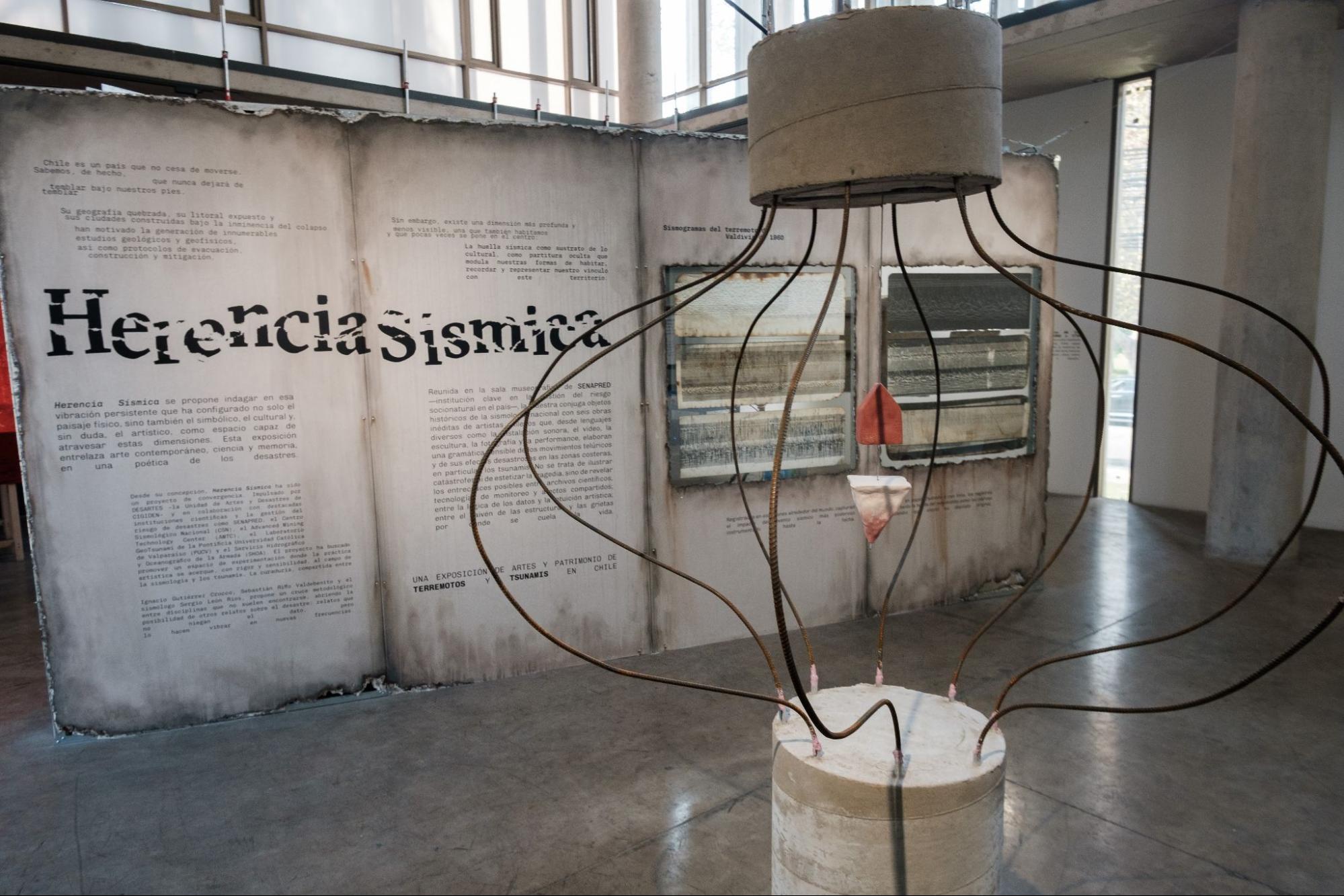
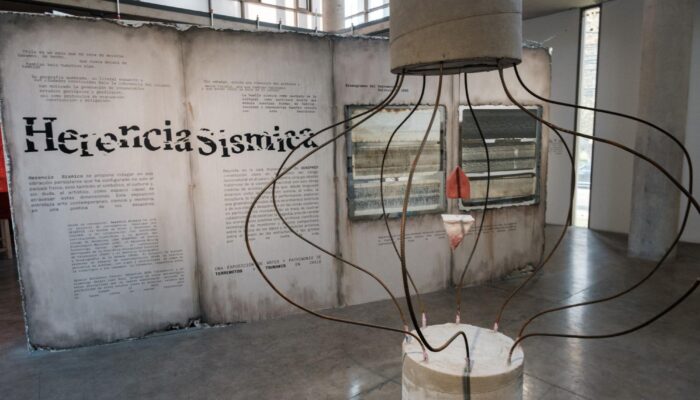
Main wall of the Seismic Inheritance exhibition.
Seismic inheritance: an art and heritage exhibition on earthquakes and tsunamis in Chile
Seismic Inheritance is a project led by artists and researchers Ignacio Gutierrez Crocco and Sebastian Riffo Valdebenito, who, through DESARTES at the Research Center for Integrated Disaster Risk Management (CIGIDEN) and their own artistic practices, have developed a sustained body of work exploring the intersection between the arts and socio-natural disasters in Chile. The project is co-directed scientifically by seismologist Sergio Leon-Rios, researcher at the Advanced Mining Technology Center of the Universidad de Chile.
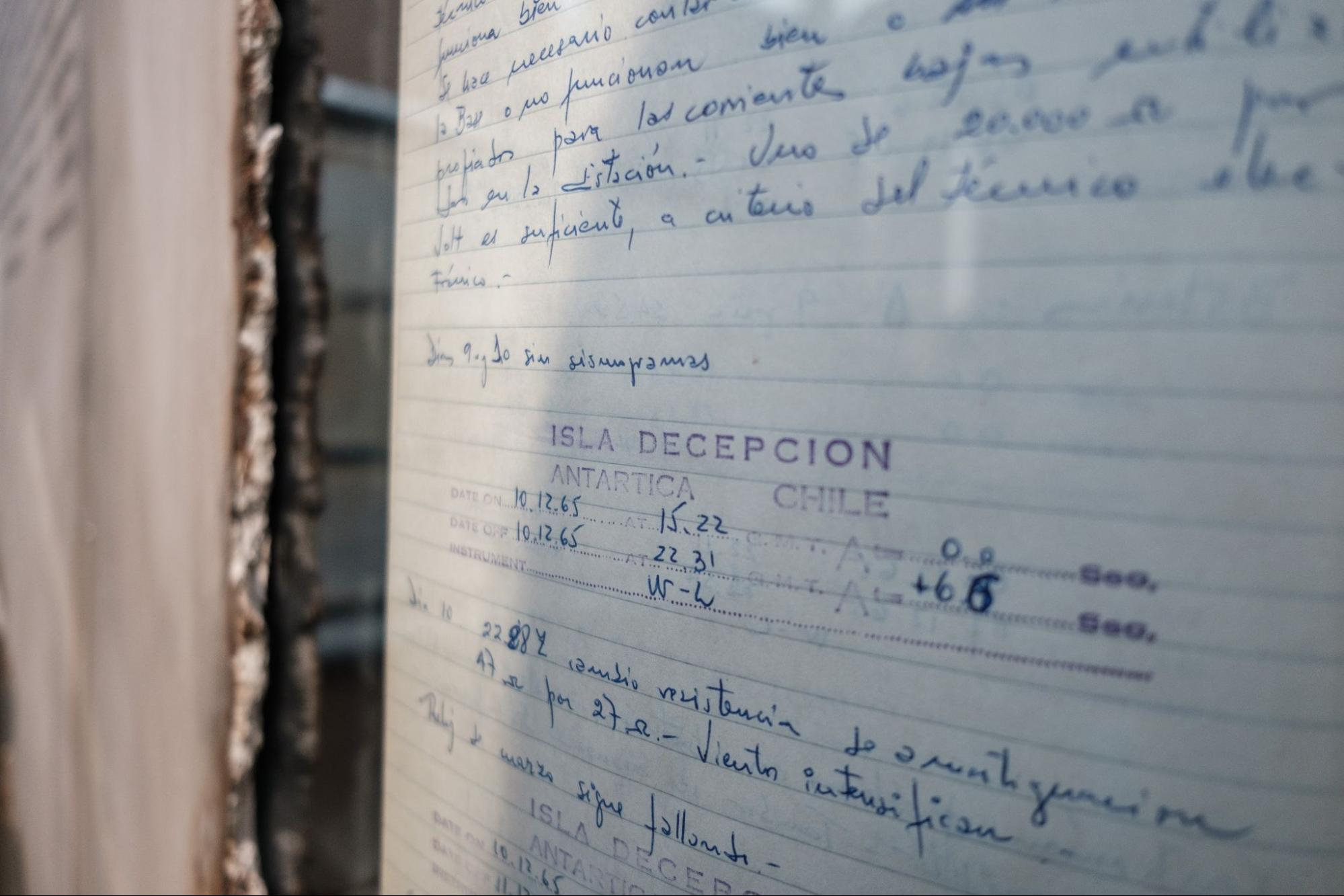
Notebook from 1965 with annotations of the seismic station in Isla Decepcion island in Antarctica.
The exhibition represents a milestone, consolidating years of work rooted in artistic practice, research, and the construction of collective memory around disasters. Thanks to funding from the National Fund for Cultural and Artistic Development (2025 call) of Chile’s Ministry of Culture, this interdisciplinary initiative expands to include new partner institutions, such as the National Seismological Center (CSN), the Geophysical Department of the Universidad de Chile, the GeoTsunami Laboratory of the Pontificia Universidad Catolica de Valparaíso, and SHOA, the Hydrographic and Oceanographic Service of the Chilean Navy.
Curated by Ignacio Gutierrez-Crocco, Sebastian Riffo-Valdebenito, and Sergio Leon-Rios, the exhibition brings together artworks created specifically for this show in dialogue with historically significant seismological and tsunami-related objects. Scientific instruments and archival materials are presented alongside contemporary artworks, creating a space where scientific knowledge and artistic interpretation intersect.
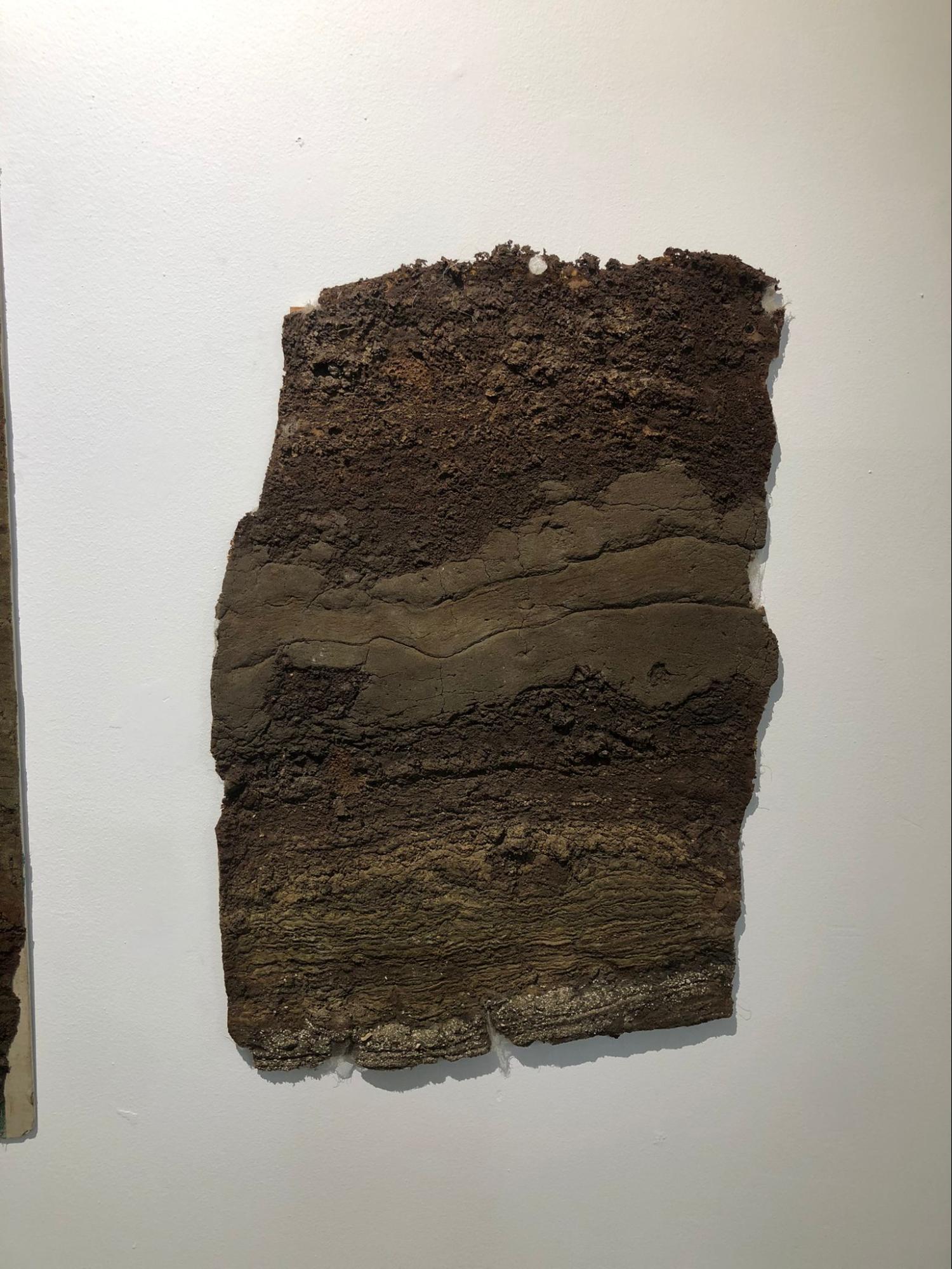
Soil peeling of the 1730 tsunami in Valparaiso, Chile occurred as a consequence of the earthquake magnitude 9.1-9.3 in Central Chile.
One of the most compelling aspects of Seismic Inheritance lies in these archival objects, drawn from the storage rooms of the collaborating institutions. Many of them have never been publicly displayed before and are now revisited through the lens of contemporary art, beyond their original scientific function. Field notebooks, filing folders, smoke and photographic cellulose seismograms from the 1960 earthquake, tide gauge records, hand-drawn diagrams exploring the relationship between lunar and solar positions and earthquakes, bulletins, correspondence, and tsunami sediments all form part of the exhibition. Exhibition design is led by Bastián Pérez, who is responsible for materializing this interdisciplinary curatorial vision and integrating the diverse elements into a cohesive spatial experience.
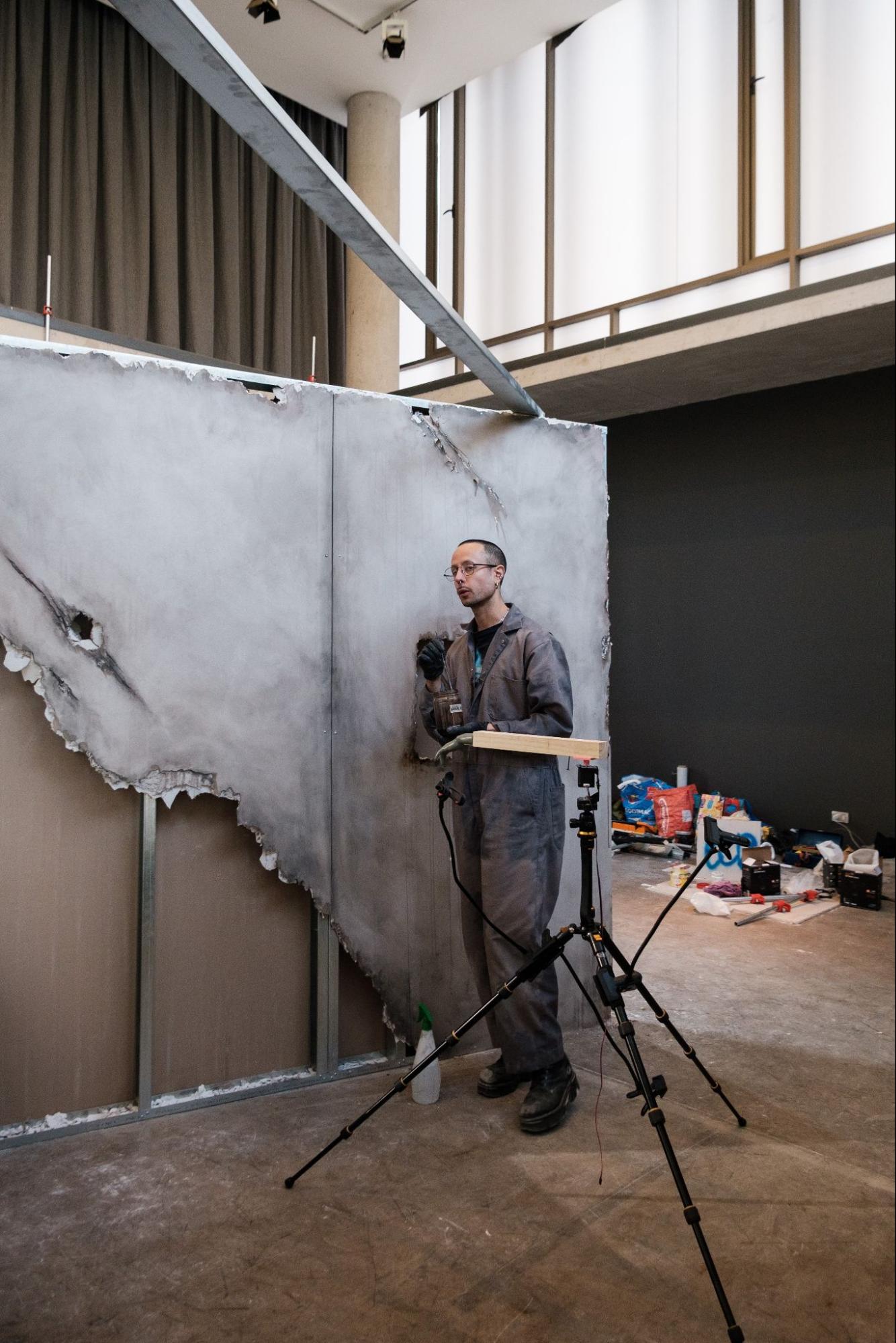
Bastian Perez, museum curator of Seismic Inheritance.
Seismic Inheritance was exhibited at the Museography Hall of the National Service for Disaster Prevention and Response (SENAPRED). This venue has previously hosted After the Fire (2025) and Post-Resilience (2024), both promoted by DESARTES, the Arts and Disasters unit within CIGIDEN. DESARTES aims to foster research, creation, and archiving of Chilean artworks linked to earthquakes, floods, tsunamis, and wildfires. Contemporary art, socio-natural disasters, scientific research, and seismological objects come together in this exhibition, which brings Chile’s seismic history and heritage into dialogue. Beyond contributing to memory and reflection, the exhibition invites audiences to engage with the subtle traces left by earthquakes and tsunamis, and with their deep presence in the country’s cultural narratives and imaginaries.
The artists
Seismic Inheritance presents six new works by artists from different generations and disciplines, each approaching seismic phenomena from distinct perspectives.
- Constanza Alarcon Tennen presents The Tremor of the Pelicans, a sound piece inspired by a bird colony affected by the 2010 tsunami, questioning anthropocentric interpretations of catastrophe.
- Rafael Guendelman Hales presents One Kilo of Beans Is Not a Failure, a video installation that confronts the official narrative of the 1985 earthquake, which occurred during Chile’s military dictatorship.
- Fernanda Lopez Quilodran exhibits Involuntary Agitation, a choreographic and textile work that translates seismic and tide-gauge records from March 22, 1960, into bodily gestures and visual scores.
- Diego Silva Rochefort, in Pangeo: Structural Failure, presents an installation activated by real-time data from the National Seismological Center, operating as a live seismograph and articulating a critique of urban negligence.
- Paloma Villalobos Danessien, in The Waves, combines video and photography from the Maule and Cahuil regions, presenting post-tsunami memory through an unstable display that makes everyday life and precarity visible.
- Natacha Cabellos Ricart creates A Prolonged Underground Noise Is Heard for Minutes, a reactive installation in which a 3D-printed hand, mounted on a rotating axis, scans the space in search of the latest earthquake—an exploration of territory, control, and technological sensitivity.
Beyond communication: building awareness and reducing risk
Projects like Seismic Inheritance show that the connection between art and science goes beyond outreach or dissemination. By opening scientific archives, instruments, and data to artistic reinterpretation, the exhibition creates spaces where knowledge is shared, questioned, and collectively experienced. Such a process helps transform abstract seismic concepts into tangible narratives, fostering curiosity, emotional engagement, and long-term awareness.
In regions exposed to recurrent natural hazards, such engagement is crucial. Disaster risk reduction depends not only on scientific advances, but also on informed and engaged communities—communities that understand hazards, remember past events, and recognize their role in preparedness and resilience. By weaving together art, science, and memory, Seismic Inheritance contributes to this broader goal, demonstrating how interdisciplinary collaboration can support both geoscience communication and the social dimensions of disaster preparedness.
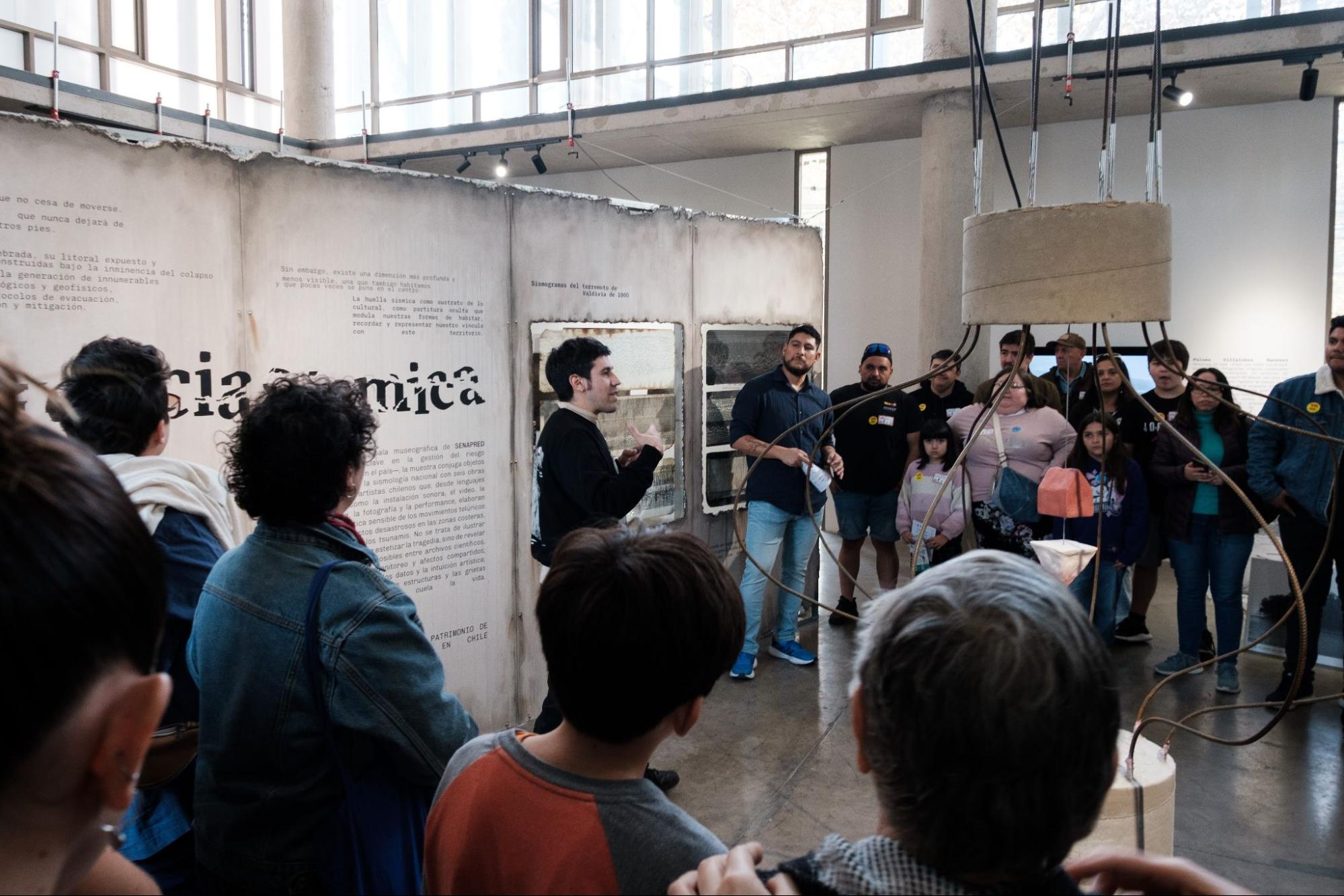
Attendance at a guided visit given by director and art curator, Ignacio Gutierrez, and seismologist and scientific curator, Sergio Leon-Rios.
Virtual visit
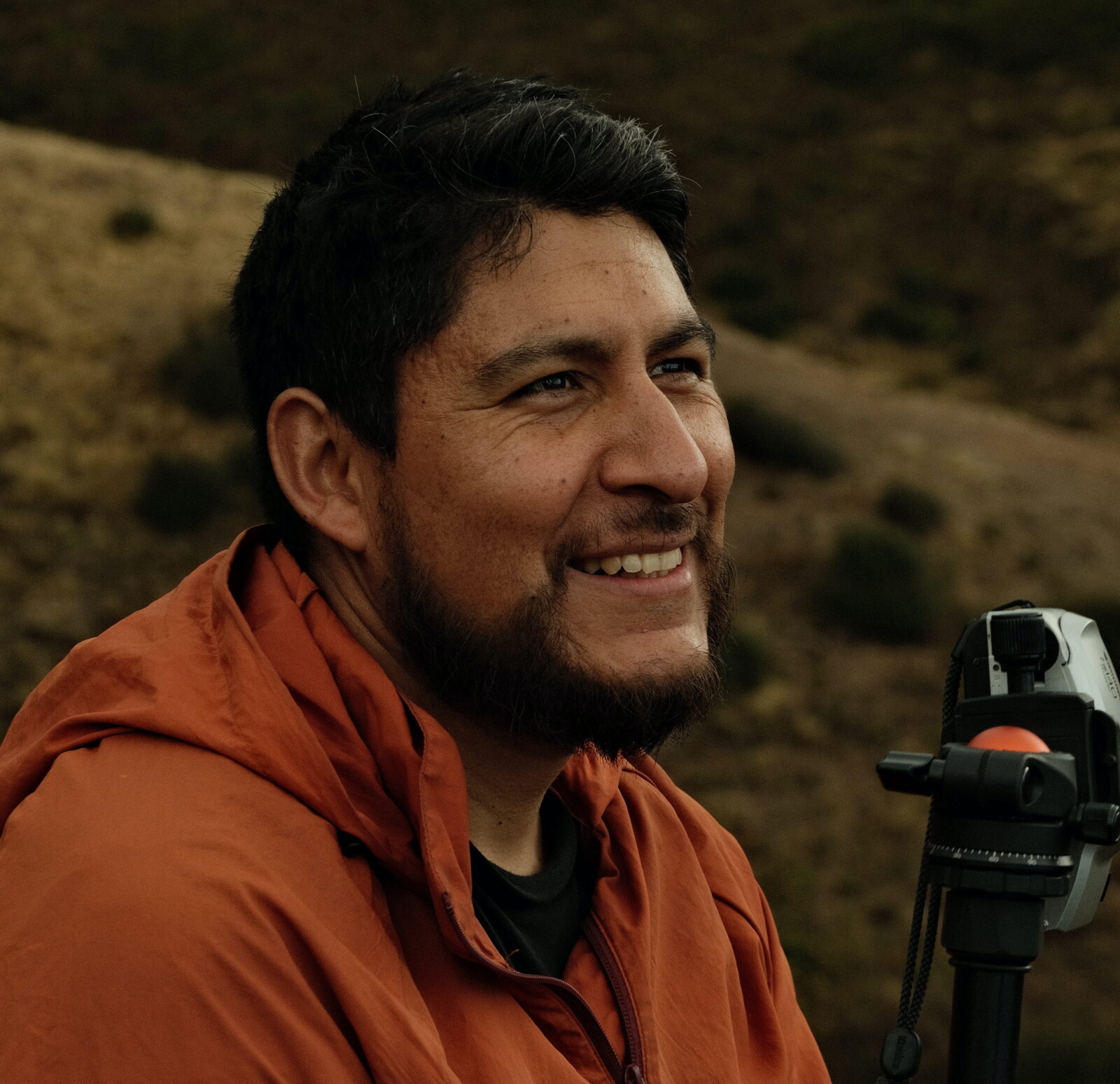
Sergio Leon-Rios
About the author
Sergio León-Ríos is Associate Researcher at the Advanced Mining Technology Center (AMTC) at the University of Chile, working on seismology and its applications to mineral exploration. He holds a PhD in Natural Sciences from the Karlsruhe Institute of Technology (KIT), Germany. His research focuses on understanding the physical behavior of active margins, including megathrust earthquakes, crustal fault systems, magmatic fields, and their relationship with the emplacement of natural resources.