

The Indian Ocean Dipole (IOD) is generally considered a seasonal mode of variability, developing and decaying within a single year. During 2021–2022, however, negative IOD conditions persisted for approximately 19 months (Figure 1, top left), making this event the longest—and among the strongest—observed since reliable records began. This unusual persistence highlights important aspects of ocean–a ...[Read More]
A Record-Breaking Indian Ocean Dipole: What Happened in 2021–2022?
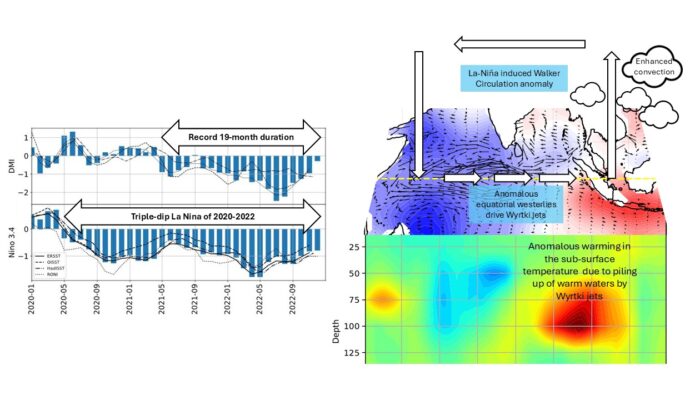
Left panel: The monthly Dipole Mode index (DMI), the Niño 3.4 index, and the relative Niño 3.4 index (RONI) from observational SST datasets: ERSST (bars), and the three-month running mean for ERSST, OISST and HadlSST (lines) for the period 2020–2022; Right Panel: A schematic illustrating the La Niña-induced anomalous Walker circulation over Indian longitudes, and the associated modulation of surface winds, Wyrtki jets and the anomalous heat content in the eastern tropical Indian Ocean.