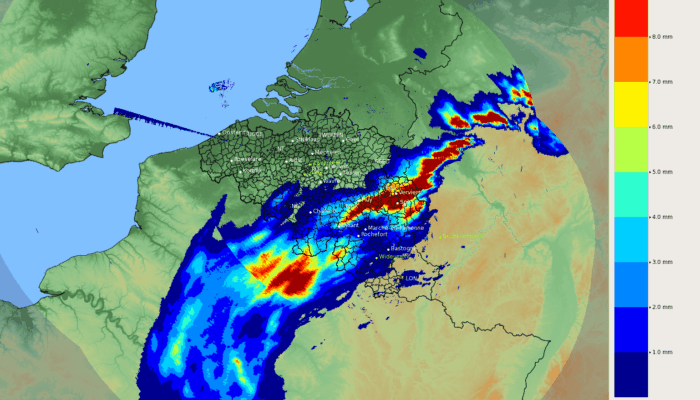
From 1–5 August 2025, the medieval hilltop town of Erice, Sicily, hosted the second UNDERPIN workshop, a meeting organised within the Nonlinear Processes in Geosciences community and dedicated to advancing the science of weather extremes. The event brought together a truly diverse group of researchers, spanning climate dynamics, attribution science, socio-economic impacts, statistical physics, and ...[Read More]
EGU NP Paper of the Month “Finite-size local dimension as a tool for extracting geometrical properties of attractors of dynamical systems”
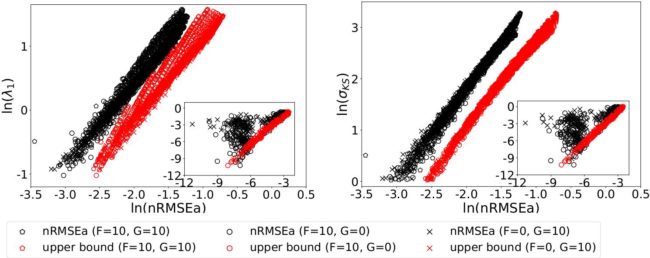
The original goal of this study was to understand how the local dimension of the attractor of a dynamical system could be used to estimate the predictability of the future state of the system, and apply this in the case of radar images of rain. The local dimension using Extreme Value Theory (EVT) has been introduced and used in Faranda et al. (2017) to infer the current predictability of different ...[Read More]
ECS SpotLight: Changes in the climate dynamics have already modified characteristics and impacts of storms in France: the case study of storm Alex 2020
Extratropical cyclones play a key role in modulating the precipitation and wind in mid-latitudes and can be responsible for extreme wet and windy events. With global warming, the dynamics and thermodynamics associated with these atmospheric systems are being affected. However, due to the complexity of modelling the climate system, a challenge arises when evaluating the influence that climate chang ...[Read More]
ECS SpotLight: Climate change on extreme winds already affects off-shore wind energy availability in Europe
Off-shore wind energy plays a key role in the transition to a renewable energy (RE) system, and its usage is expected to increase in the next few decades. Nevertheless, wind energy is one of the most variable and weather-dependent RE, because of its natural dependence on the wind speed, which can vary at different time scales, ranging from small-scale turbulence to seasonal oscillations and up to ...[Read More]
NP Interview: Federico Grazzini on Climate Change casts shadows on the present and the future of the Mediterranean Basin
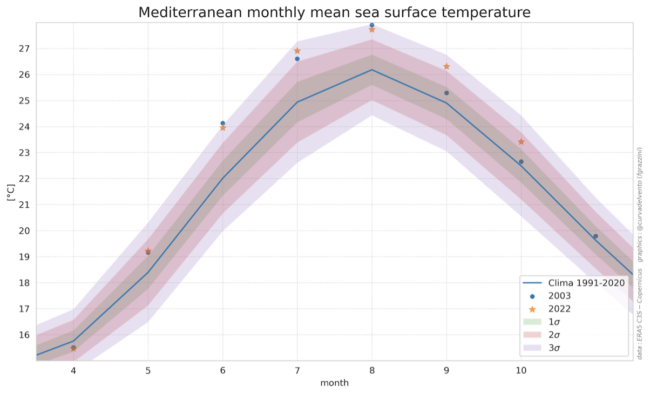
Weather extreme events in the year 2022 are really hitting the Mediterranean basin very hard. Since the beginning of the year we are observing a widespread drought, heatwaves but also severe thunderstorms. Few days before the COP meeting in Sharm-el-sheik we discussed one of the experts of Mediterranean climate, Federico Grazzini, to unveil whether these events can be linked to climate change. Fe ...[Read More]
NP Interviews: Davide Faranda (CNRS) on the topic “global warming and extreme events in Europe”
Davide Faranda is a physicist at the French National Center for Scientific Research (CNRS). His main interests are devoted to the construction of a statistical mechanical and dynamical systems framework for the study of atmospheric motions. In particular, his works aim at the characterization of the metastable states of the atmospheric circulation with simple mathematical and statistical tools, an ...[Read More]
A few reasons making the June 2022 French Heatwave too hot & too soon
Too hot, Too soon: the thermometer has reached unprecedented temperature for a month of June in France, with the 40°C mark crossed by Friday June 17 in part of France. The IPCC AR6 report now clearly states that the probability of heatwave events such as this one has increased by a factor 3 to 5 in the present climate with respect to a counterfactual world not affected by anthropogenic greenhouse ...[Read More]
ClimarisQ: A game on the complexity of the climate systems and the extreme events
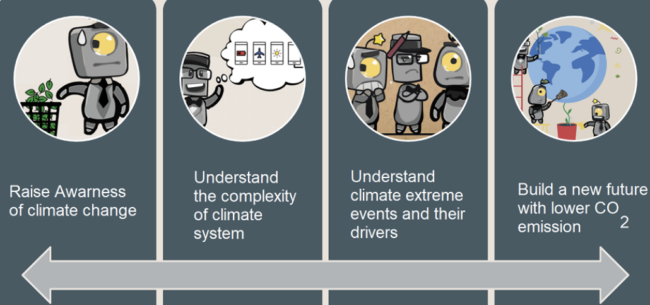
ClimarisQ is a smartphone/web game from a scientific mediation project that highlights the complexity of the climate system and the urgency of collective action to limit climate change. It is available in four languages: English, French, Spanish and Italian. It is an app-game where players must make decisions to limit the frequency and impacts of extreme climate events and their impacts on human s ...[Read More]
NPG Paper of the Month: “Inferring the instability of a dynamical system from the skill of data assimilation exercises”
The NPG paper of the month was awarded to “Inferring the instability of a dynamical system from the skill of data assimilation exercises” by Yumeng Chen, Alberto Carrassi, and Valerio Lucarini. Geophysical systems are usually described by a set of dynamical equations that are often non-linear and chaotic (Ghil and Lucarini, 2020). Errors about the initial state can grow, shrink, or sta ...[Read More]
When weather extremes meet climate change: how do scientists attribute single events to climate change?
One of the main new points of the IPCC reports AR6 with respect to the previous ones is the increased confidence that global climate change induced by anthropogenic emissions is critically affecting the dynamics of weather extremes. For summer, and specifically over Europe, the AR6 report states that we are already observing prolonged periods of extremely warm conditions with increased droughts bo ...[Read More]