
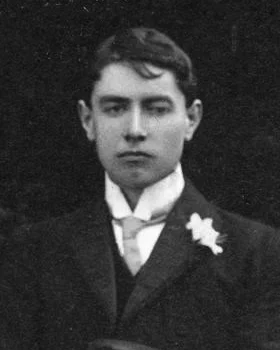
Charles Andrew Cotton, New Zealand geologist, as best man at the wedding of John Arthur Bartrum, on 3 July 1912. Photographer – Sidney George Vaile (1870–1955), Auckland Libraries Heritage Collections.
Charles Andrew Cotton (24 February 1885 – 29 June 1970) was a geologist and geomorphologist from New Zealand. He was one of the country’s greatest scientists,
and his work became the pillar of New Zealand geomorphology and understanding its landforms. He was a lecturer at the Victoria University College until he retired, where he taught geology and geomorphology in a university where he was at first the sole geosciences lecturer, and where he expanded the boundaries of his field on a national level. His knowledge and focus spanned a large range of geo-disciplines, which led to pioneering advances in geomorphology by combining, e.g., tectonics and geological knowledge in the field.
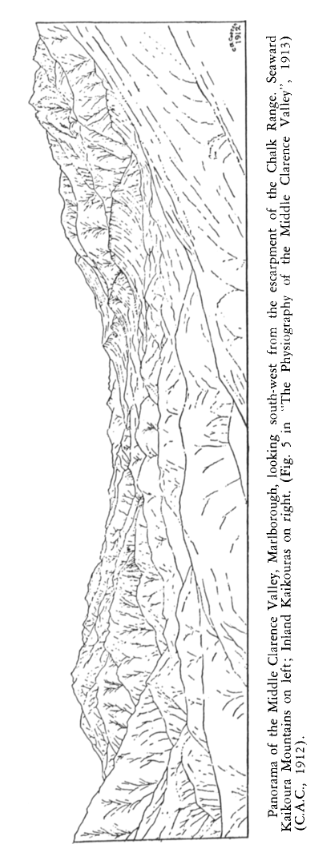
Cotton’s theories were based on landforms produced by long-term Earth movements combined with erosion. His main tools were photography, drawing and mapping. This led to organised, methodical descriptions of landscapes and their interpretation. The explanations of his work were always followed by simple but illustrative line diagrams, which provided a visual understanding to his students and readers. By combining these illustrations with geological nomenclature, problems and interpretations were well defined in a scientific framework.
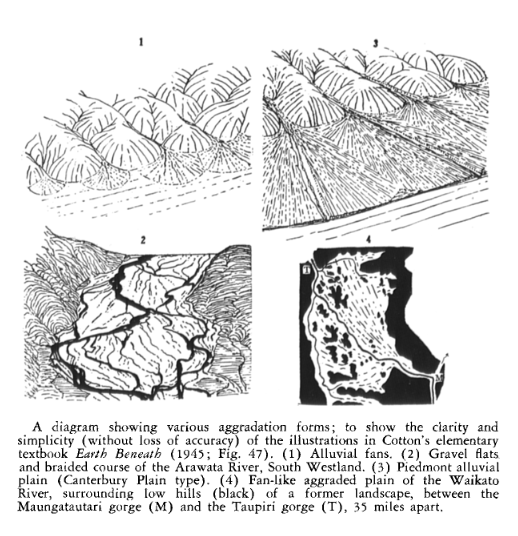
Cotton was highly influenced by Davis during his career and skilfully identified and took hold of the evolutionary geomorphology in New Zealand, making him the main actor showcasing this theory in the Southern Hemisphere. This geomorphological approach was dominant until the middle of the century, when the description of landforms was centred around cycles of erosion.
During his career, he produced several praised articles and books, with his first book in 1922 called Geomorphology of New Zealand, for which he gained international acclaim. It became the standard textbook in universities all around the world, for its skilfully written and well-illustrated approach to complex topics of geomorphology and the study of landforms, a field which was lacking qualitative English literature at the time. Reprinted multiple times, it became Geomorphology in 1942, a revised and extended edition of the first editions.
Even if sceptical about the new quantitative approaches, which gained popularity in the middle of the century, or dubious about competing theories to the Davis Cycle, Cotton represented these, e.g., by Penck or King in his later works.
While Cotton lost credibility in the 50’, because of his unwillingness to abandon the Cycle and move onto quantitative sciences, the academic assaults were on Davis and Cotton suffered collaterally. However, despite the negativity, his nicely illustrated work made a lasting impression and influence on geosciences overall.
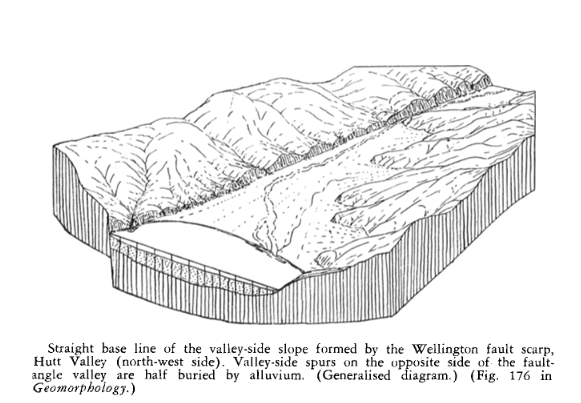
His work has been recognized with multiple awards, such as being made professor emeritus at Victoria and being awarded an honorary LLD in 1954. He was also knighted for his outstanding contribution to geosciences and services to New Zealand geology. He furthermore received the highest scientific distinctions of his country, the Hector and Hutton medals, in 1927 and 1947, respectively, and the A. H. Dumont Medaille in 1954. He was also awarded the Victoria Medal of the Royal Geographical Society of London, had an Honorary Fellowship in the Geological Society of America, and Honorary Membership in the Geological Society of Belgium.
He advanced the discipline by combining both geomorphology and geology. His work became a legacy, and geomorphologists around the world have contributed to it. His comprehensible studies, writing, and simple illustrative sketches made him a key teaching figure and science populariser of his time. Even if he may not have been as well-known as others, through his work, New Zealand’s geology became accessible and broadly recognised all around the world.
Importance
He was one of the first geologists who grasped the important role of geomorphology for our landscapes. Charles Cotton was a pioneer in geomorphology and an important advocate for descriptive geomorphology, like Gilbert, before quantitative processes took over the field. Simple descriptions were defined by problems, and Cotton observed landscapes, photos, and maps, to which he then tested hypotheses and compared them to geological data. Without his descriptions and highly detailed sketches, today’s discipline might not be what it is today.
Did you know?
Cotton was not only a prominent figure in geosciences, but also in art. He influenced the art world with his sketches and simplified but still detailed drawings, which artists like Colin McCahon used to discover geomorphology. Thanks to Cotton’s contributions, artists were inspired to draw landscapes based on his work. An exhibition in the early 2000’ in Wellington, called “An artist and a scientist” is a beautiful tribute and highlights this symbiosis.
Selected works
Cotton CA (1922). The Geomorphology of New Zealand, Part 1: Systematic. New Zealand Board of Science and Art Manual No 3, Dominion Museum, Wellington
Cotton CA (1941). Landscape as Developed by the Processes of Normal Erosion. Cambridge University Press, Cambridge
Cotton CA (1942a). Geomorphology: An Introduction to the Study of Landforms. Whitcombe and Tombs Ltd, Wellington.
Cotton CA (1942b). Climatic Accidents in Landscape Making: A Sequel to ‘Landscape As Developed by the Processes of Normal Erosion’. Whitcombe and Tombs Ltd, Wellington
Cotton CA (1944). Volcanoes as Landscape Forms. Whitcombe and Tombs Ltd, Wellington.
Whose next?
Now it’s your turn!
Which geomorphologist whose surname begins with the letter “B” should be featured in the next post?
Share your suggestions in the comments.
References:
B.W.C & Shiro Kaneko (1966) Sir Charles Cotton, geologist and geomorphologist, New Zealand Journal of Geology and Geophysics, 9:1-2, 9-27, DOI: 10.1080/00288306.1966.10420192
Crozier, Michael & Priestley, Rebecca. (2011). Charles Cotton: New Zealand’s most influential geomorphologist. New Zealand Geographer. 67. 79-89. 10.1111/j.1745-7939.2011.01201.x.
Gage, Maxwell. “Memorial to Charles Andrew Cotton 1885–1970.” Geological Society of America Memorials 2 (1972). https://cdn.sanity.io/files/02ocqogw/gsa-main/45e5e9350a6265d4cdbe6f4143f65b69bbe42bfc.pdf/memorials-v02-Cotton-CA.pdfgeosociety.org.
R. Stevens. ‘Cotton, Charles Andrew’, Dictionary of New Zealand Biography, first published in 1998. Te Ara – the Encyclopedia of New Zealand, https://teara.govt.nz/en/biographies/4c38/cotton-charles-andrew (accessed 05 November 2026)
Stevens, G. (1998). Charles Andrew Cotton, 1885-1970. In Newsletter (Geological Society of New Zealand. Historical Studies Group): Mar 1998; n.16 (pp. 3–11).
Figures 2, 3, 4: From the article “Crozier, Michael & Priestley, Rebecca. (2011). Charles Cotton: New Zealand’s most influential geomorphologist. New Zealand Geographer. 67. 79-89. 10.1111/j.1745-7939.2011.01201.x.”