
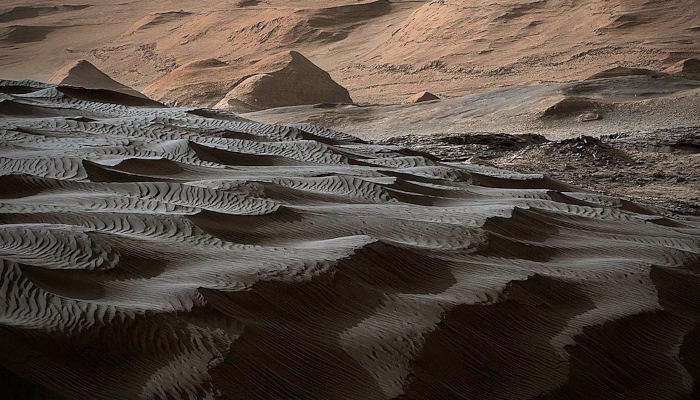
Ralph Alger Bagnold (3 April 1896 – 28 May 1990) was a British engineer, geomorphologist, desert explorer, and soldier. His work fundamentally changed our understanding of sediment transport. His pioneering studies of wind-blown sand and desert dunes established a quantitative, physics-based approach to aeolian geomorphology.
Bagnold’s scientific career was closely connected with his fascination with deserts. As an officer in the British Army, he spent years in North Africa and used his periods off leave to explore parts of the Sahara. His expeditions across the Libyan Desert combined exploration with systematic observations of dunes, sand movement, and desert landscapes.
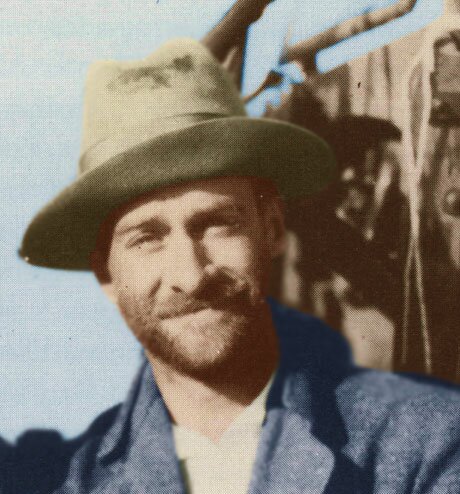
On a 1932 desert exploration (source: Long Range Desert Group, https://lrdg.hegewisch.net/)
Rather than simply describing dunes and other aeolian landforms, Bagnold sought to understand the physical processes responsible for their formation and movement. After leaving active military service in the 1930s, he constructed a wind tunnel and conducted experiments on sand transport, connecting field observations with laboratory measurements and physical theory.
Bagnold’s most influential work, The Physics of Blown Sand and Desert Dunes, was published in 1941. His studies of saltation, the characteristic hopping motion of sand grains, helped establish relationships between wind velocity, grain size, and the rate of sediment transport. His approach provided a framework for understanding how processes operating at the grain scale contribute to the development and migration of dunes.
He also investigated sediment transport in water, the behaviour of granular materials, river meanders, and bedload transport. His 1966 US Geological Survey publication, An Approach to the Sediment Transport Problem from General Physics, applied physical principles to sediment transport in flowing water and became an important contribution to fluvial geomorphology and sediment transport research.
Bagnold’s scientific legacy extends beyond Earth. The Bagnold Dunes, an active dune field on the northwestern flank of Mount Sharp in Gale Crater on Mars, were informally named in his honour. NASA’s Curiosity rover investigated these dunes as part of its exploration of the Martian surface, providing an opportunity to study dune dynamics under conditions very different from those on Earth.
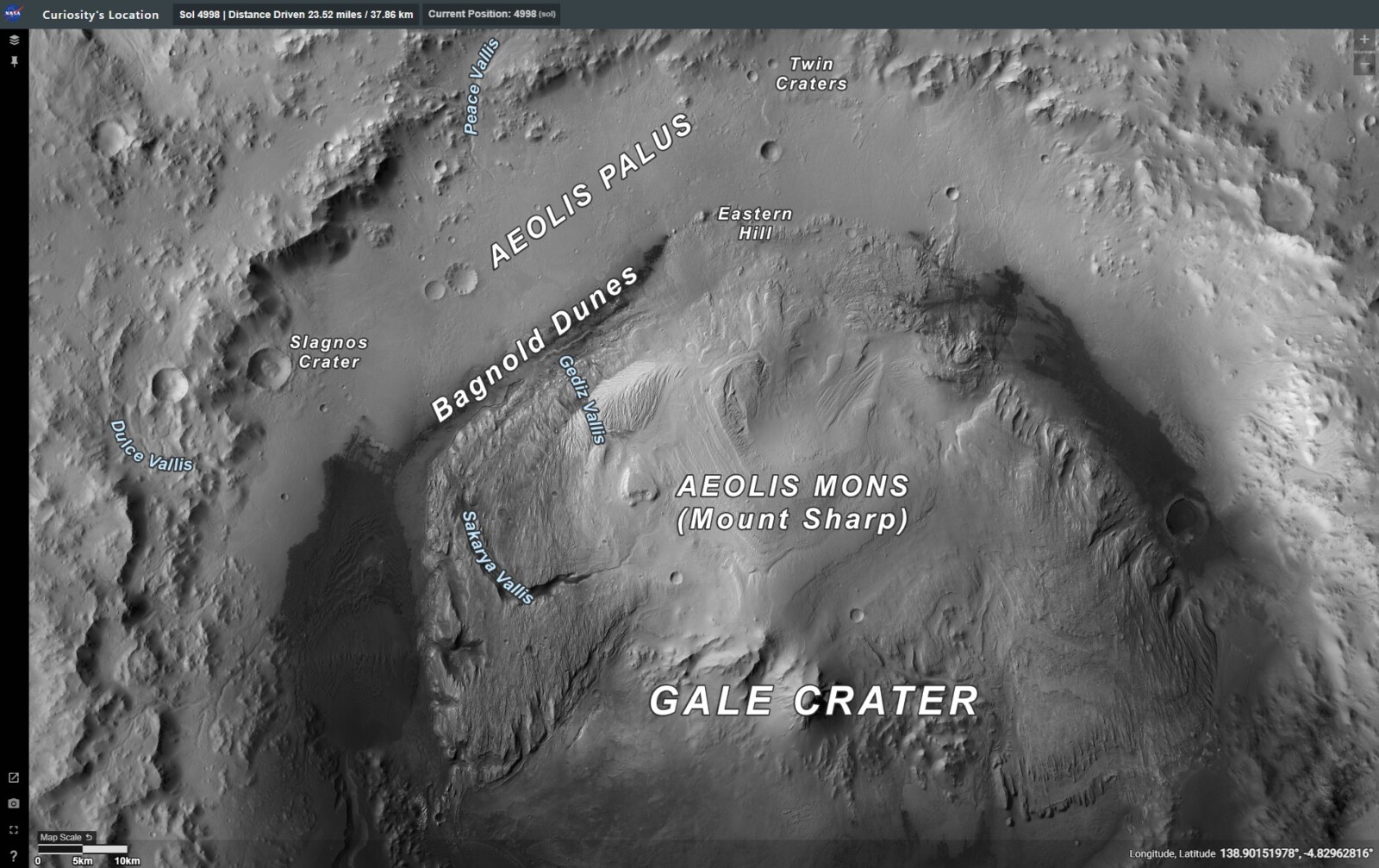
Location of Bagnold Dune Field (source: Curiosity Rover’s Location Map, NASA, https://science.nasa.gov/mission/msl-curiosity/location-map/).
The connection is more than symbolic. Bagnold pioneered the study of how wind moves sand grains on Earth, while the investigation of the Bagnold Dunes allows scientists to examine how similar processes operate in Mars’ much thinner atmosphere and under lower gravity. In this sense, questions first explored by Bagnold in the deserts of Earth have become part of planetary geomorphology.
Bagnold’s influence on geomorphology is also commemorated by the European Geosciences Union (EGU) through the Ralph Alger Bagnold Medal, established by the EGU Geomorphology Division to honour his scientific achievements. The medal is awarded annually to a scientist who has made an outstanding contribution to the field.
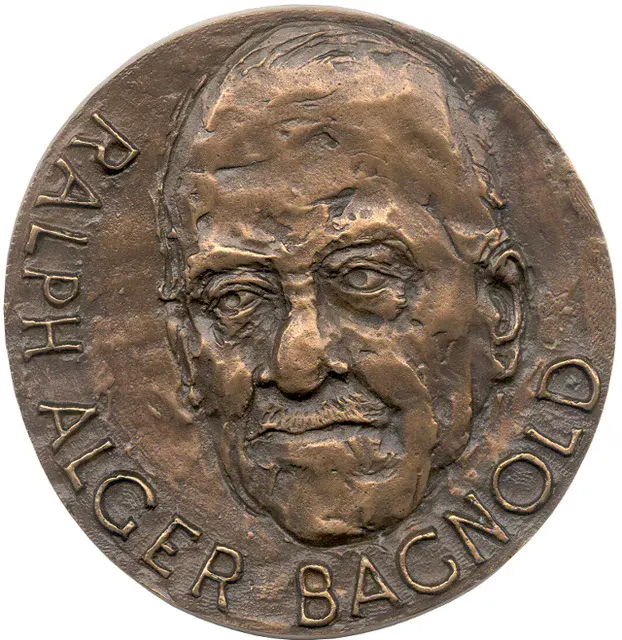
The Ralph Alger Bagnold Medal designed by József Kótai.
Importance
Ralph Bagnold was one of the pioneers of physics-based geomorphology, demonstrating how fundamental physical principles can be used to explain sediment transport. His work on the movement of sediment across aeolian and fluvial environments, linking laboratory experiments, field observations, and physical theory, provided a quantitative foundation for understanding one of the fundamental processes shaping landscapes.
Did you know?
Bagnold was not only a scientist but also played a significant role in the history of the Second World War. Drawing on his extensive experience of desert travel and navigation, he helped establish the Long Range Desert Group in 1940, a British reconnaissance unit operating deep behind enemy lines in the North African desert. He was awarded the Order of the British Empire in 1941 and was elected a Fellow of the Royal Society in 1944.
Selected Works
Bagnold R.A. 1936. The movement of desert sand, Proceedings of the Royal Society of London, Series A, Mathematical and Physical Sciences, Vol. 157, No. 892, pp. 594–620.
Bagnold R.A. 1941. The Physics of Blown Sand and Desert Dunes, Methuen, London, pp. 265.
Bagnold, R.A. 1966. An approach to the sediment transport problem from general physics, U.S. Geological Survey Professional Paper 422, pp. I1-I37, DOI: https://doi.org/10.3133/pp422I.
Bagnold R.A. 1974. The Physics of Blown Sand and Desert Dunes, Springer Dordrecht, pp. 265, DOI: https://doi.org/10.1007/978-94-009-5682-7.
Bagnold R.A. 1987. Libyan sands: travels in a dead world, Michael Haag, London, pp. 288.
Whose next?
Now it’s your turn!
Which geomorphologist whose surname begins with the letter “C” should be featured in the next post?
Share your suggestions in the comments.

![[EGU 2022] International Tracing Day – UniVienna – Sunday 22 May](https://blogs.egu.eu/divisions/gm/files/2022/04/2022_Tracing_Day_Vienna_220522-161x141.jpg)
Richard Bready
It’s very good to see Ralph Bagnold’s work and life recalled for present-day admiration. His accomplishments represent the essence of geology as a science of flow, of uniform processes, of vast landforms based on minute particles. Beyond the fascination of his story, he created an entire discipline; Andrew Goudie of Oxford remarked that Bagnold “bestrides twentieth-century aeolian studies like a colossus.” To paraphrase what Pope said of Newton: “Deserts and desert’s flows were veiled in wind; Bagnold by leaps and jumps got them down-pinned.”
For a longer appreciation of Bagnold’s accomplishments, and a sensitive, evocative description of his favored habitat, see Welland, The Desert: Land of Lost Borders (2015).