Greenland, the world’s largest island, has one of the most challenging environments for geodetic measurements. Maintaining GNSS (Global Navigation Satellite Systems) stations here isn’t just about precision – it’s about ensuring data continuity in an area that’s constantly moving. This is the behind-the-scenes story of a 15,000 km journey around Greenland: five weeks of helicopter-based fieldwork, two engineers, a helicopter pilot and, and more challenges than we can count – each one earning us a few extra grey hairs. The perfect combination to make fieldwork become an adventure!
Why do we go on such a mission?
In collaboration with the Danish agency for Climate Data, DTU (Technical University of Denmark) Space operates and maintains the Greenland GNSS Network (GNET). GNET consists of 71 geodetic quality GNSS antennas mounted to bedrock all the way around Greenland. The Network plays a key role in determining bedrock displacement (Glacial Isostatic Adjustment), validation of climate satellite missions, reference network for Greenland, and much more. The oldest station dates back to 1995 with most of the network being established in 2007-2009. The network continuously measures Greenland’s movement. Most of the stations are categorized as remote sites, meaning that we are working with an autonomous running system, running on a battery and solar framework. This is where the problems start: freezing temperatures, high winds, equipment failure and visits by the native wildlife (foxes and polar bears) all contribute to potential downtime of specific sites. That’s the reason why we aim to visit every remote GNET site once a year, during our month-long helicopter-based fieldwork campaign during the summer.
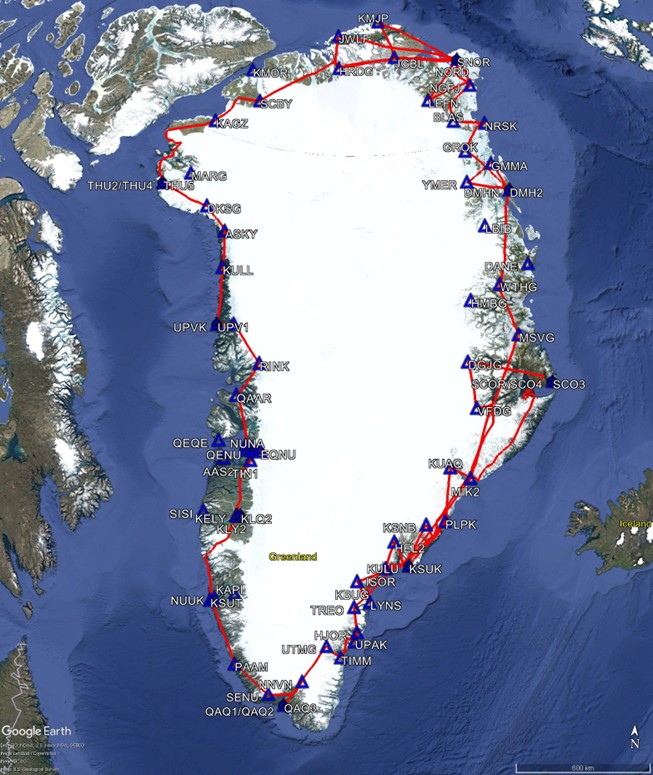
Overview map of the helicopter flightpath and all visited sites, from the 2025 summer season.
The 2025 season
In 2025, the goal of the trip was not only to perform general maintenance and make various updates on all 49 remote GNET sites, but also to install two new GNET and a GNSS-IR specific site in Daneborg. The helicopter trip usually starts in Tasiilaq in Southeast Greenland – with preparation and packing of personal luggage, tools and extra hardware into the helicopter. To be sure that we got everything packed and ready to go, we go for a small roundtrip out from Tasiilaq, to visit our two GNET sites in Isortoq and at Helheim glacier. With the confirmation that we were ready to go, we headed north with the aim of circumnavigating Greenland counterclockwise. A planned roundtrip of roughly 12,000 km of rural remoteness and five weeks in each other’s compagnies.
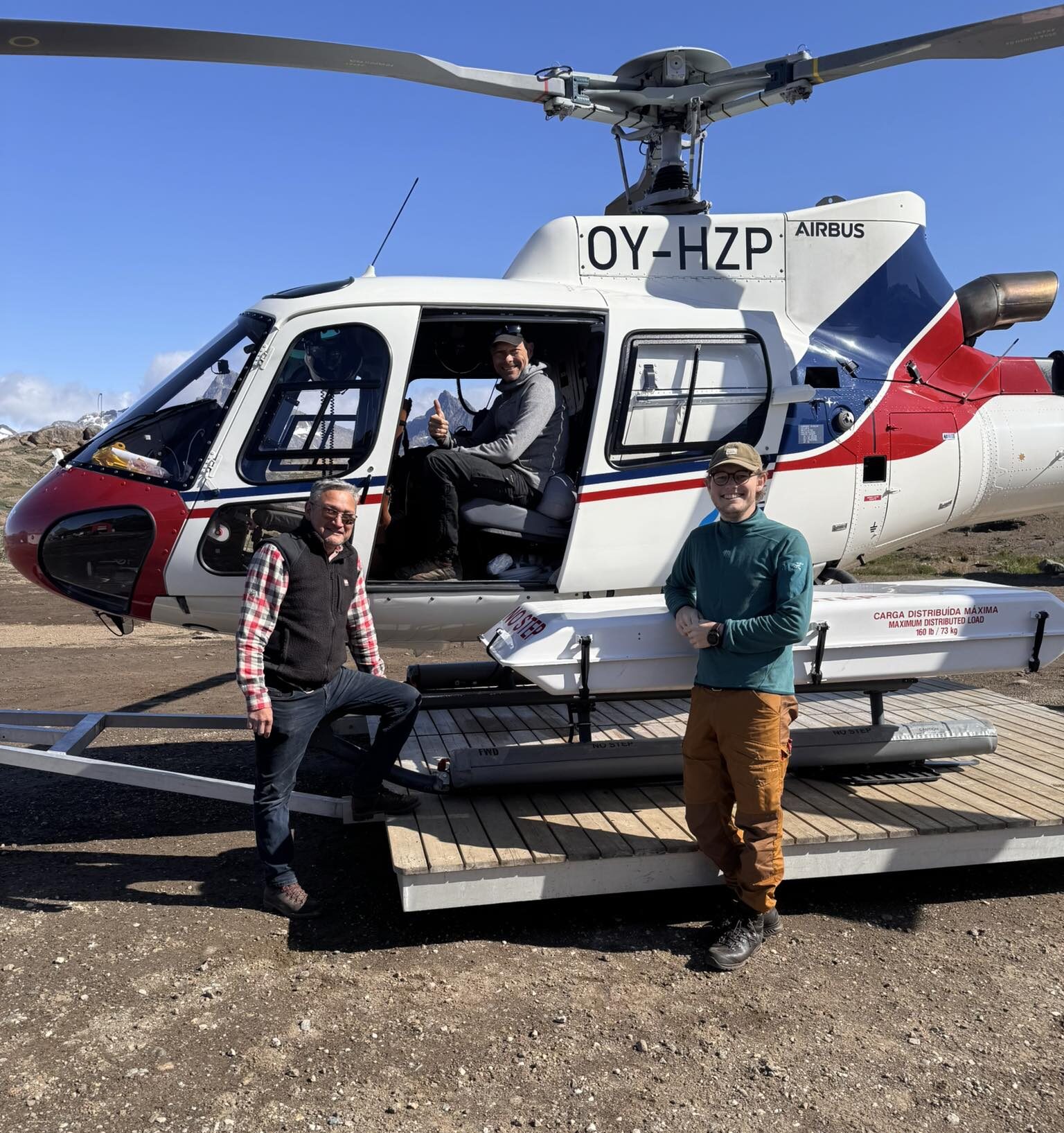
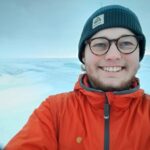
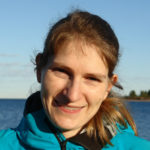
The GNET operational team before taking off (day 1). From left: Tim Nicholaisen – GreenlandCopter, Thomas H. Nylen and Christian Solgaard – both DTU Space. Picture cortesy by Jean-Marie Bärtsch.
The beginning
We started at our “base” in Tasiilaq and flew towards the north (remember, counterclockwise). Due to bad weather conditions, we made an unexpected stop just on the southside of Scoresbyssund fjorden. A night filled with excitement followed. With stories that will last a lifetime awaited us, it was with a sigh of relief that we were all still a part of the trip the following day. The coffee and breakfast at Nerlerit Inaat were close to the best I have ever had. However, the weather forecast for Northeast Greenland looked like winter was already back and the whole coast would be in snowstorm conditions for the next 14 days… No flying conditions for a helicopter. So, a decision had to be made: do wewait it out, risking being stuck for two weeks, or do we turn around, go clockwise around Greenland, throw all our planning and months of preparation out the window, and add an additional 2000 km to the journey to get as much done as possible… We chose the second option.
Starting again
Back in Tasiilaq after four days. we started the helicopter mission again, now almost ten days behind schedule. The new ambitious goal was to get from Tasiilaq to Qaqortoq (South Greenland) in one day, then the next day from Qaqortoq all the way up to Kangerlussuaq (KISS) (West Greenland) almost 1/5 of the entire trip in two days. At this point in the trip, we agreed that if we could make it to Pituffik Space Base in Northwest Greenland, then we would call the season a success. The season restarted, and finally it felt like we were making some progress. The weather turned for the better with only two bad days, where we would have to stay grounded. In Ilulissat we had a planned pilot change, and from there we headed further north over Qaarsut, Rink Glacier (which year after year proves to be one of the coldest and windiest places in non-glaciated Greenland), all the way up to Upernavik (Northwest Greenland) and then to Pituffik Space Base (Northwest Greenland). From Pituffik Space Base, we went for our station DKSG; however, the station showed some signs of a visitor.
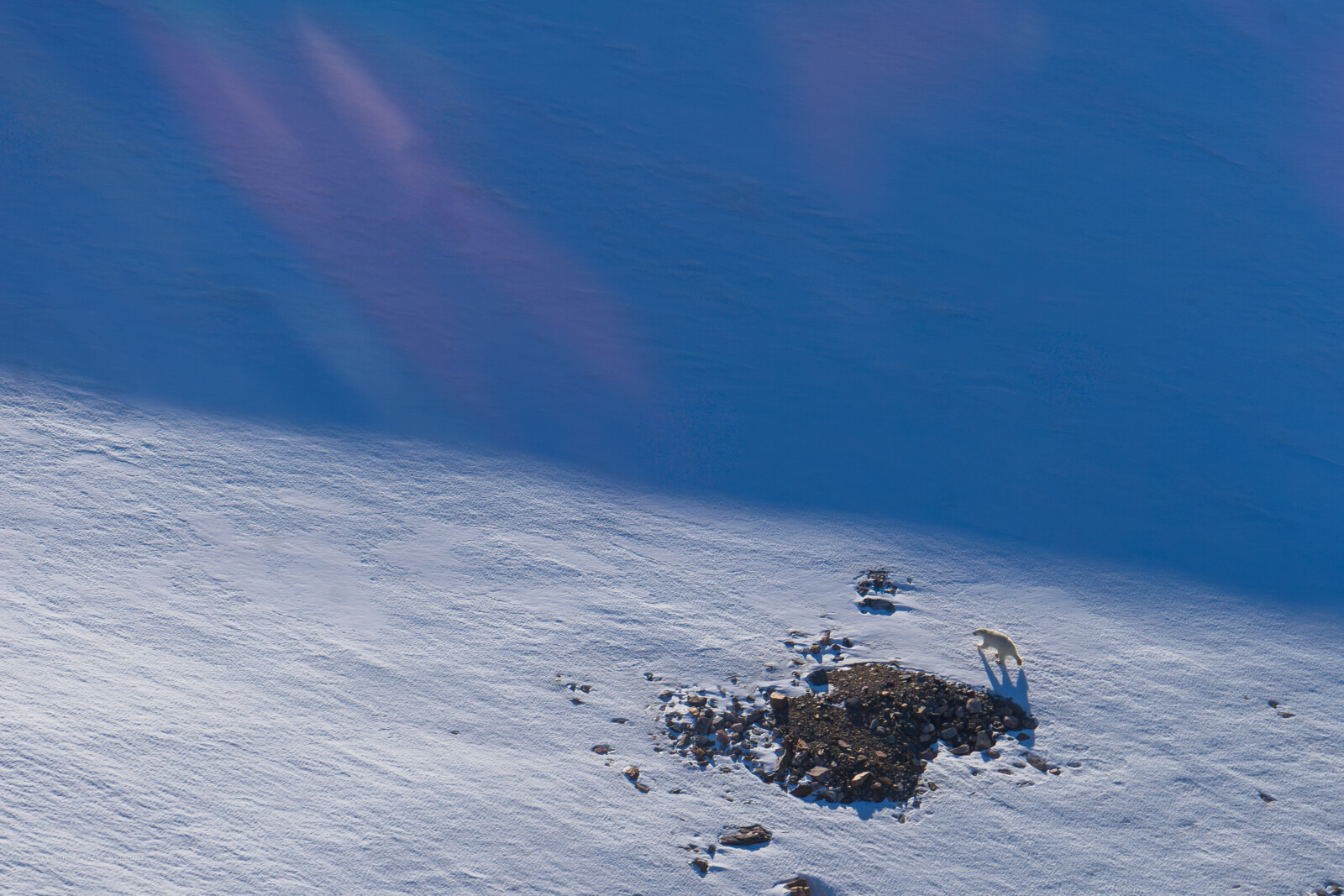
Polar bear from the comfort of the helicopter at Daugaard-Jensen Glacier, Northwest Greenland. Picture cortesy by Christian Solgaard.
Who visits the station besides us?
Greenland is known for polar bears, and they seem to have a liking for GNSS stations and installations as we usually find some of these stations almost completely chewed up when we arrive for maintenance. So, early in the trip we made it a security practice of flying a few circles with different diameters around our stations when arriving in the field. At this point after roughly 2.5 weeks in the field, we had luckily not encountered any polar bears near our GNET sites. However, our arrival at station DKSG (Daugaard-Jensen Glacier – Northwest Greenland) proved to change those statistics. The station is situated atop of a nunatak (a non-glaciated outcrop surrounded by the icesheet) a few kilometers inland. As we got closer, tracks started to appear in the older snow patches around our station. At closer inspection however the tracks looked weather washed and old, but we chose to do a few extra circles anyway and thank God for that decision! Not more than 2 minutes later we spotted him, a massive polar bear running up a hill less than a kilometer from where our station is located. I guess we found the culprit. Luckily, this time they chose not to check whether a GNSS station is part of a balanced diet.
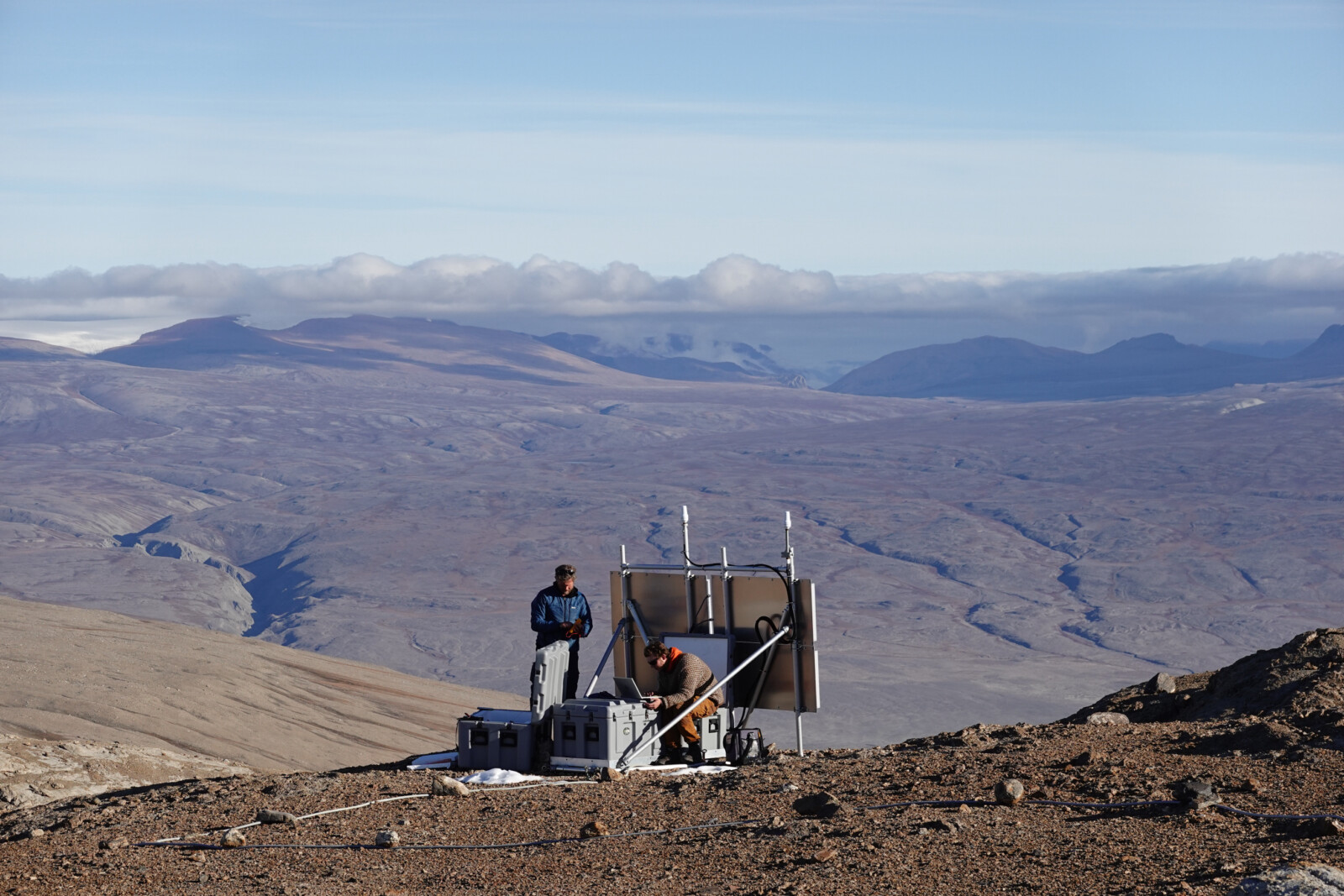
General maintaince on the GNET station HRDG in East Greenland. Picture courtesy by Jean-Marie Bärtsch.
Back on track
Once we made our intermediate goal at Pituffik Space Base, it was time to plan the last leg of the trip: from Station Nord to Tasiilaq, which is usually one of the hardest parts of the journey, even with the part usually being at the start of the field campaign. This year, we will have to tackle it after 3.5 weeks.
Again, the weather started to become very tricky, so we had to get to Danmarkshavn in a hurry with the plan of staying there at least two days. However, a worsening weather forecast made us work through the evening, such that we could leave right after breakfast the day after. The following morning, we barely escaped. Five minutes after takeoff, Danmarkshavn disappeared into fog with less than five meters of visibility, locked in bad weather for the week. Our plan to stop at Daneborg was abandoned when fog rolled in there as well, sending us directly to Mestersvig. From there, with flying again impossible, we walked out to our remote site accompanied by a retired Sirius dog as our polar bear guard. As we left Mestersvig and headed south to Tasiilaq, we were officially ending this year’s circumnavigation of Greenland. The feelings going through your body, when getting closer to the end of such a long field trip, are indescribable. On the one hand, you can get a feeling of sadness that it’s all coming to an end, and at home there is a desk in an office waiting for you. On the other hand, you are also so so tired of flying and working 15-hour days 7 days a week.
Not only polar bears around
When we arrived at Danmarkshavn, they had had problems with an Arctic wolf, which had been drawn in by the stations’ sledge dogs. As we worked in the evening a bit outside the base, in the silent Arctic evening, we heard the wolf howling in the distance, after a day of working in prime polar bear country, it was a very nice change of scenery, that the danger was “just” from a wolf and not a polar bear. It doesn’t take much to get used to the extremes.
Two is not enough
By now, you might think you know all about Greenland’s harsh weather and curious animals. But in the field, surprises come in many other forms too. After two weeks into the trip, we had a medical emergency, which meant one of our team members had to go back to Denmark for treatment (he is okay now) and we were one member short. This left our pilot and me in a bit of a conundrum, firstly we needed a reserve for the remainder of the trip, secondly, how the hell do you get a person from Denmark to North Greenland with a few days warning!? We started working on the logistical problem first, myself in Pituffik and a colleague back at DTU in Denmark. Good contacts in the Joint Arctic
Command (JACO) quickly made it possible for us to get a person on the next C-130 flight from Aalborg to Station Nord, the flight was to arrive at Station Nord six days later. Then, finding someone who is able to go on a 2.5 week long fieldwork with a two day warning – luckily we had a colleague on reserve. Now the next challenge was for the pilot and me to get from Pituffik in the west to Station Nord in the east in one day to meet our new companion, a trip that normally takes two days. Four refuelling stops, three GNET stations, and hours upon hours of beautiful scenery found nowhere else in the world than North Greenland, we made it to Station Nord and welcomed our new companion from Denmark. From then on, the three of us tackled the rest of the trip together.
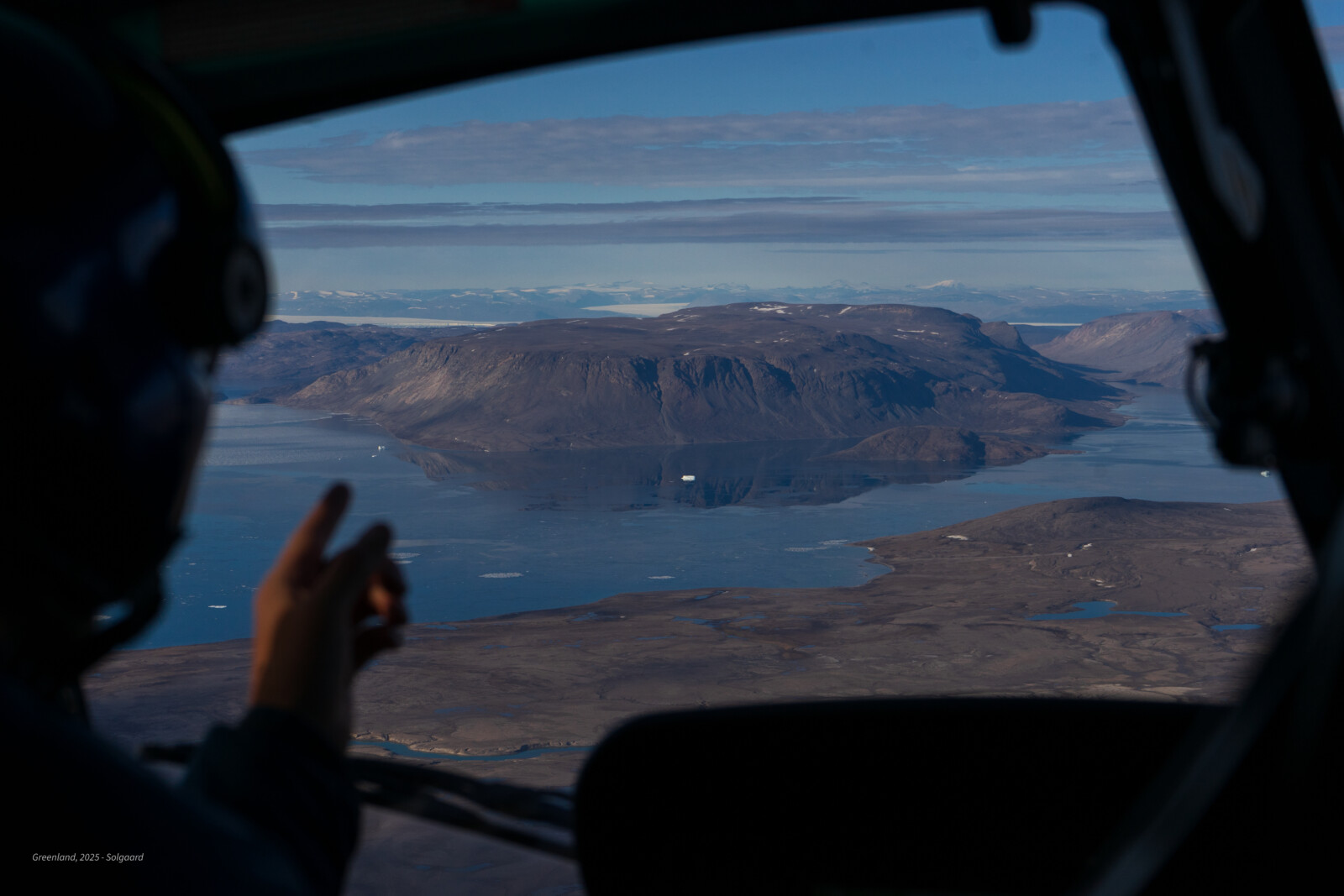
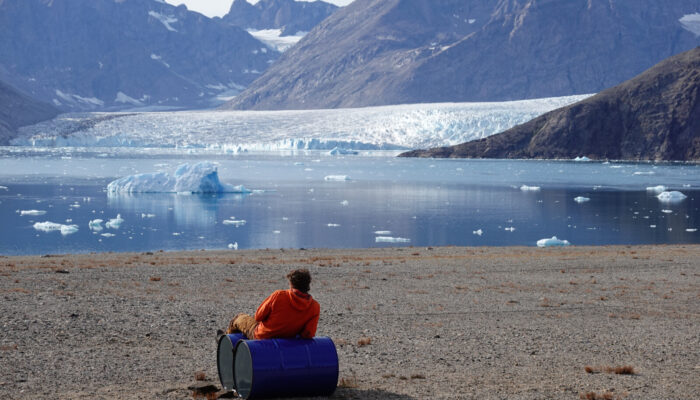
One of the great benefits of flying around Greenland in a helicopter, is the endless series of beautiful landscapes. Picture courtesy by Christian Solgaard.
In the end, the expedition members covered around 15,000 km, flying around for 85 hours. We visited all but five remote GNET sites (which in a normal year is more than approved), we told the same jokes around a thousand times to each other in the helicopter and the same stories we told in the beginning were retold at the end. And all of us are returning home to family and normal life, with enough stories to last a lifetime!
A season with as many problems and challenges as we have ever had, but still, I for one are already looking forward to the next season, as we do it all over again in the summer of 2026, but hopefully counterclockwise then.
– Edited by Editors