Invited guest from the EGU 2025 Outstanding Student and PhD candidate Presentation (OSPP) Award Wind is not easily visible. On historical time scales, its directions and velocities have been measured and recorded by instruments. To some degree, these parameters can also be simulated by climate models. But how about winds in the more distant past? And why would we want to know about them? In many p ...[Read More]
Winds of change – How can we reconstruct the directions of winds in the past?
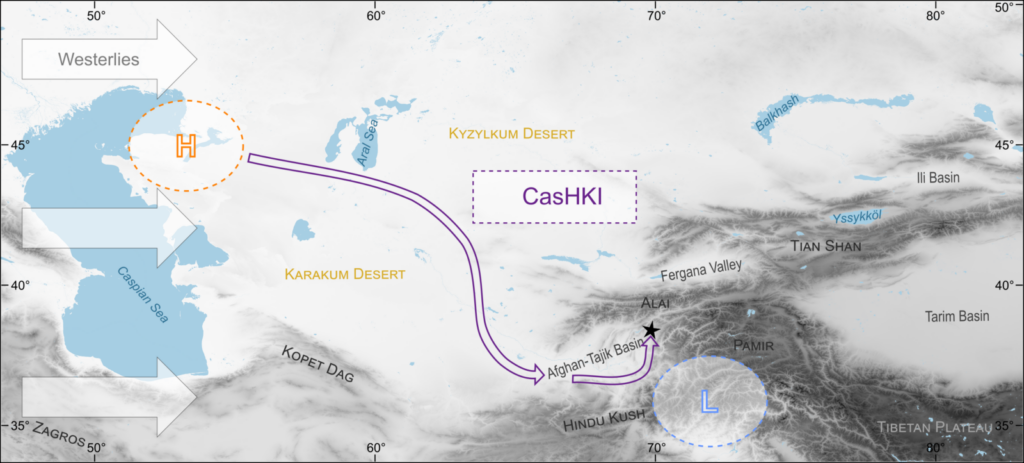
Figure 1: Map of Central Asia showing dominant influences on directions of dust transporting winds (in purple). The Caspian Sea Hindu Kush Index (CasHKI), a pressure difference between the Caspian Sea and the Hindu Kush mountains, leads to a deflection of westerly winds (Kaskaoutis et al., 2017). The winds are further deflected by the Alai, Pamir and Hindu Kush Mountains. Black star shows the location of the study described here. Figure from Schneider et al. (2026).