
Tinted detail of a photo: Weathered limestone cliff built of hundreds of thin stacked layers like a pile of pancakes, grey at the top and orange-brown below, with a small dark pool in a hollow.
CL
Climate: Past, Present & Future

Kamila Ryzner

I am a research assistant at the magnetics laboratory in Grubenhagen at LIAG. So far, I have studied physical geography with a focus on sedimentology and the influence of humans on landscapes and landscape development at the University of Wroclaw. I worked with the interpretation of geochemical data and grain size distributions mostly in loess deposits. Right now, I am dealing more intensively with rocks and paleomagnetics. I am interested in reconstructions of paleoenvironments.

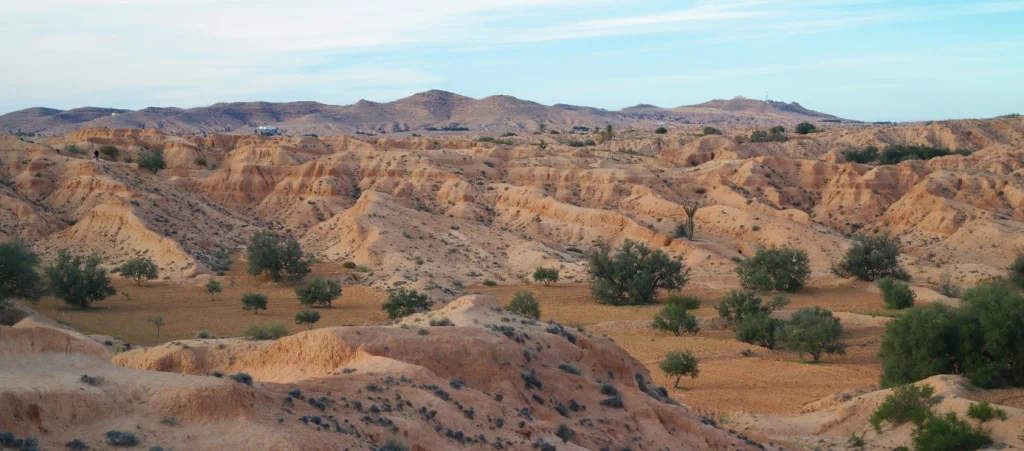
Desert loess: formation, distribution, geoscientific value
Desert loess: formation, distribution, geoscientific value

Loess is an aeolian (wind-driven) silty sediment covering over 10% of the Earth’s land surface; it occurs predominantly in the mid-latitudes. On a global scale, loess is among the most widespread unconsolidated sediments, and of crucial importance for agricultural regions where loess deposits are known to form fertile soils because of its ability to store …[Read More]