
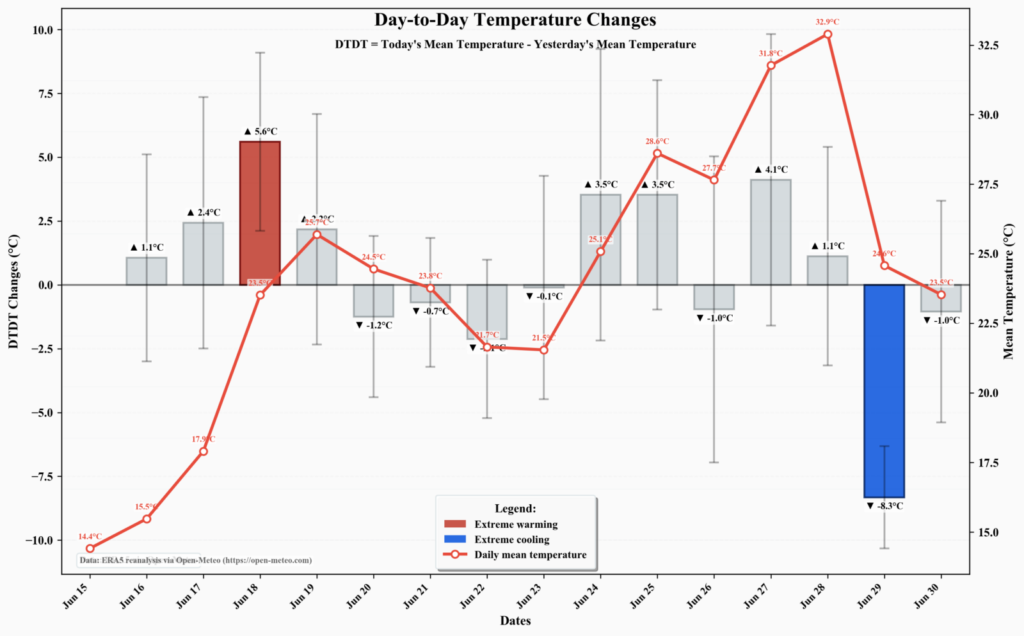
Berlin just went through a brutal heatwave, and then out of nowhere, the temperature crashed between June 28 and 29. The daily mean temperature dropped from nearly 33°C to 25°C—a dramatic drop of about 8°C in just 24 hours (based on ERA5 reanalysis data structure accessed via Open-Meteo).
Scientists call these abrupt shifts temperature volatility: rapid transitions from unusually cold to warm conditions—or vice versa—from one day to the next (Hamal & Pfahl, 2025). These sudden temperature changes can have serious consequences. They are linked to increased risks of heat stroke, respiratory and cardiovascular illnesses, particularly among older adults and young children; they can damage crops during sensitive growth stages and may even slow economic growth (Kotz et al., 2021; Zou et al., 2024).
When we talk about climate change, we usually focus on rising average temperatures. Yet changes in day-to-day temperature variability receive far less attention. That is precisely the gap our research aims to address.
Not One Story, but a Global Tug-of-War
It is tempting to assume that a warmer world will simply bring more temperature swings everywhere. More heat, more extremes—it sounds intuitive.
Our recent study, published in Weather and Climate Dynamics, shows that the reality is more complicated. Future changes in temperature volatility resemble a global tug-of-war: some regions are projected to experience weaker extreme day-to-day temperature swings, while others will see them intensify (Figure 1).
To understand why, we need to look at the physical processes that drive these rapid temperature changes.
The first is advection—the horizontal movement of air masses. Think of cold Arctic air surging south into Berlin or Chicago, or warm subtropical air pushing poleward.
The second is an adiabatic process, which occurs when air moves vertically. Rising air expands and cools, while sinking air compresses and warms.
The third is a diabatic process, which involves energy exchanges at the Earth’s surface and atmosphere. Cloud cover, soil moisture, evaporation, and incoming sunlight can all influence how quickly temperatures rise or fall from one day to the next.
Climate change affects all three processes, but not equally everywhere or in every season. As a result, there is no single global story of future temperature volatility. Instead, the changes form a patchwork of regional responses driven by different physical mechanisms.
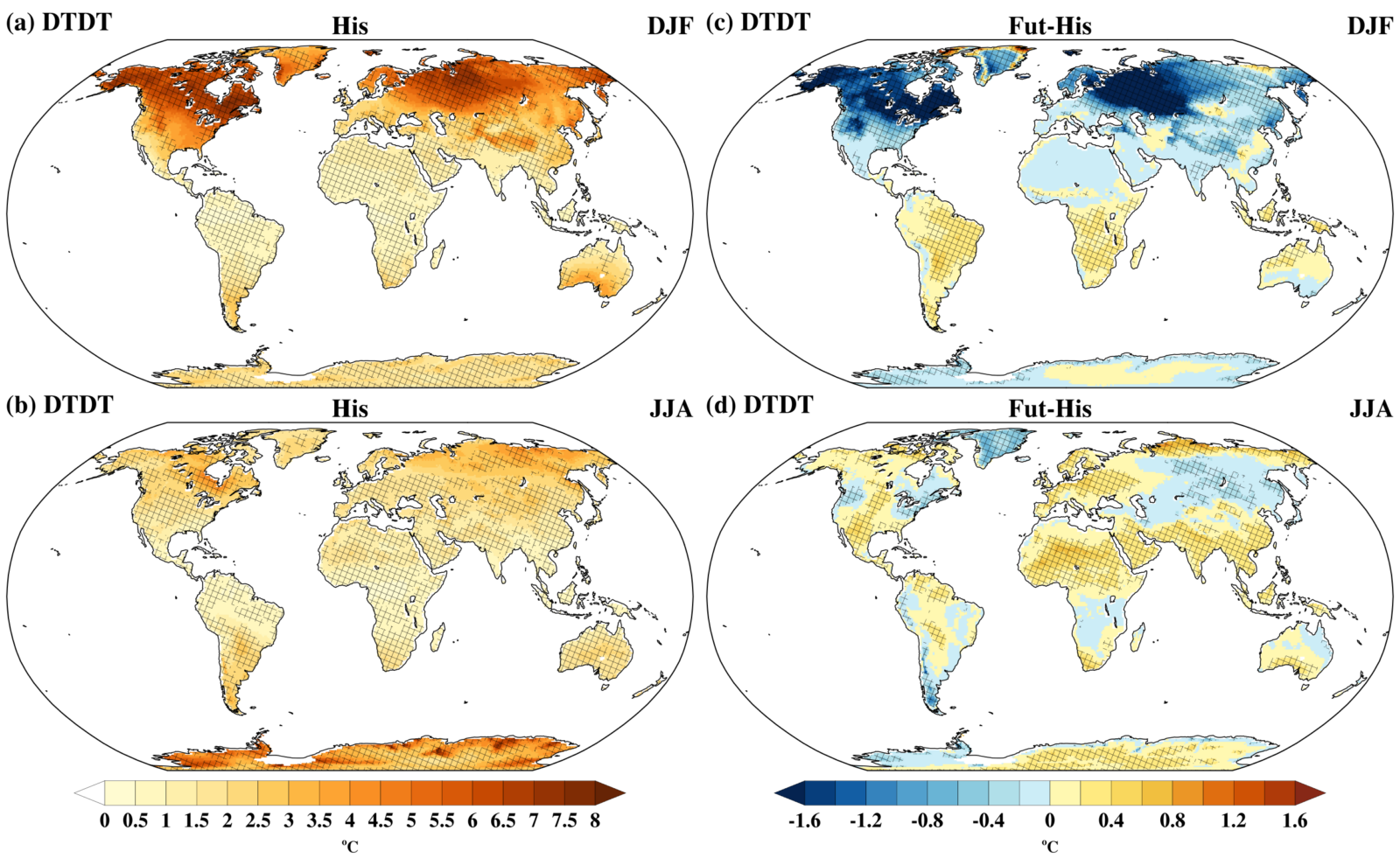
Figure 1. Day-to-day temperature (DTDT) variability in the (a, b) historical climate (His) and (c, d) projected future changes (Fut-His). Blue colours indicate regions where temperature swings are projected to weaken, while red colours indicate regions where they are projected to strengthen. Results are shown for December- February (DJF) and June- August (JJA). Cross-hatching indicates statistically significant changes (Figure adapted from (Hamal & Pfahl, 2026)).
The Extratropics: A Calmer Winter
One of our most striking findings is that many mid- and high-latitude regions—including North America, northern Europe, and northern Asia—which currently experience some of the largest extreme day-to-day temperature swings, are projected to see those swings weaken during winter (Figure 1a, c).
The main reason is Arctic amplification.
The Arctic is warming much faster than the global average. As a result, the source region of many cold-air outbreaks is becoming substantially warmer (Screen, 2014). In the past, an Arctic air mass moving southward could produce a dramatic temperature shock. In the future, that same air mass will still be cold relative to its surroundings, but it will not be as cold as it once was.
In other words, the temperature contrast between the Arctic and the mid-latitudes is shrinking, reducing the intensity of winter temperature swings.
Summer tells a more complicated story. Some extratropical regions also show declining temperature volatility during summer (Figure 1b, d), but the patterns are less coherent and no single mechanism dominates. Instead, changes arise from a combination of advection, diabatic, and adiabatic processes, with their relative importance varying between regions and individual events.
The Tropics and Subtropics: Moving in the Opposite Direction
In many tropical and subtropical regions, the tug-of-war pulls the other way.
During Southern Hemisphere summer, areas such as the Amazon Basin, Southeast Asia, and southern Africa are projected to experience stronger extreme day-to-day temperature swings, despite currently exhibiting relatively low temperature volatility (Figure 1a, c).
Here, the changes are driven less by advection and more by local atmospheric processes. Rapid transitions between cloudy, rainy conditions and clear skies can dramatically alter the amount of solar energy reaching the surface, producing large temperature differences between consecutive days. At the same time, changes in vertical air motion associated with convection can amplify cooling events.
In the subtropics during Northern Hemisphere summer—including parts of the Sahel, central Europe, Central America, and southern Asia (Figure 1d)—changes in diabatic heating play a particularly important role.
As soils become drier in a warmer climate, less energy is used for evaporation, and more is converted into sensible heat—the heat we directly experience as warmer air temperatures. This shift can amplify temperature fluctuations from one day to the next, increasing temperature volatility.
So, will summers in Berlin become more unpredictable?
The answer is likely yes.
But increasingly, the uncertainty may come from summer rather than winter.
Why This Matters for Adaptation
The central message of this research is that global warming does not affect temperature variability uniformly.
While extreme day-to-day temperature swings are projected to weaken across many northern mid- and high-latitude regions, they are expected to intensify across parts of the tropics and subtropics—regions that are often among the most vulnerable to climate-related health, agricultural, and economic impacts (IPCC, 2023).
Understanding the physical drivers behind these changes—from Arctic amplification to drying soils—can help move climate adaptation beyond one-size-fits-all solutions. Instead, adaptation strategies can be tailored to the specific risks facing different regions.
Because in this global tug-of-war, knowing where the rope is pulling hardest is the first step toward preparing for what comes next.
Read the full open-access study in Weather and Climate Dynamics here.
This post has been edited by the editorial board
References:
1. Hamal, K., & Pfahl, S. (2025). Physical processes leading to extreme day-to-day temperature change – Part 1: Present-day climate. Weather Clim. Dynam., 6(3), 879-899. https://doi.org/10.5194/wcd-6-879-2025
2. Hamal, K., & Pfahl, S. (2026). Physical processes leading to extreme day-to-day temperature change – Part 2: Future climate change. Weather Clim. Dynam., 7(2), 1009-1032. https://doi.org/10.5194/wcd-7-1009-2026
3. IPCC. (2023). Climate Change 2022 – Impacts, Adaptation and Vulnerability: Working Group II Contribution to the Sixth Assessment Report of the Intergovernmental Panel on Climate Change. Cambridge University Press. https://doi.org/10.1017/9781009325844
4. Kotz, M., Wenz, L., Stechemesser, A., Kalkuhl, M., & Levermann, A. (2021). Day-to-day temperature variability reduces economic growth. Nature Climate Change, 11(4), 319-325. https://doi.org/10.1038/s41558-020-00985-5
5. Screen, J. A. (2014). Arctic amplification decreases temperature variance in northern mid- to high-latitudes. Nature Climate Change, 4(7), 577-582. https://doi.org/10.1038/nclimate2268
6. Zou, Z., Li, C., Wu, X., Meng, Z., & Cheng, C. (2024). The effect of day-to-day temperature variability on agricultural productivity. Environmental Research Letters, 19(12), 124046. https://doi.org/10.1088/1748-9326/ad8ede