

Introduction
Human-caused climate change is increasing the frequency of extreme weather events around the world, and Europe is no exception. These events typically last from a few days to several weeks or even months. Using climate models and reanalysis products, scientists are studying how extreme weather events will evolve and where they are likely to become more frequent and intense in a warming world, particularly in vulnerable regions.
Paleoclimate research makes an important contribution to this effort. Changes in global and regional climate leave traces in physical and biological materials called proxies, which are preserved in natural archives such as trees, corals, speleothems, and ice cores. Scientists have overcome numerous technical and methodological challenges to extract these proxies and use them as a valuable source of information about past climate changes. The type and resolution of information available depends on the nature of the proxy and the archive in which it is stored.
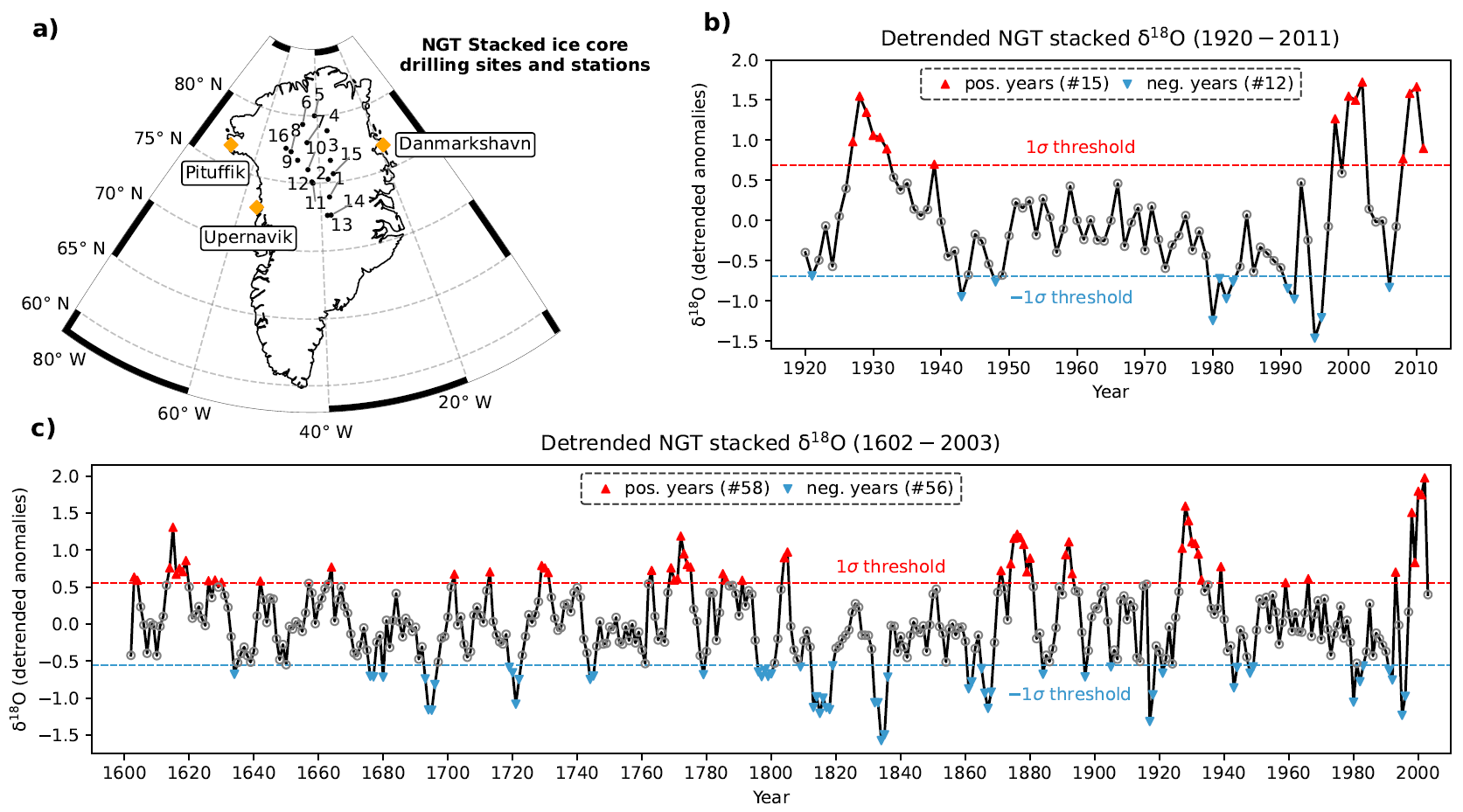
Figure 1 Ice cores locations (dots) and weather stations (diamonds) used in stacked ice cores (a). The detrended anomalies of δ18O series over the period 1920− 2011 and 1602− 2003 (b, c). The upward-pointing red triangles refer to years whenever the δ18O is above the threshold 1σ (pos. years) (σ = standard deviation). Similarly, downward-pointing blue triangles refer to years below the threshold −1σ (neg. years).
In our study, we use the stable oxygen isotope ratios δ18O recorded from 16 Greenland ice cores combined into a single composite record called a stacked record (Figure 1a). This proxy reflects the relative abundance of heavy and light oxygen isotopes in the ice compared to a predetermined sample. Variations in this ratio are primarily driven by the local temperature at which precipitation forms and moisture source conditions. The variation of the stable oxygen isotope ratios is a widely used proxy of past climate temperature changes, but it is also a very good proxy of large-scale atmospheric and oceanic anomaly patterns. While some studies have as well linked variations of the stable oxygen isotope ratios to weather regimes and atmospheric blocking, our study examines its relationship with extreme hydroclimatic events across Europe.
How does stable oxygen isotope ratios in Greenland ice cores capture extreme events over Europe?
Our study first links stable oxygen isotope ratios variability in the stacked record to a specific atmospheric phenomenon: atmospheric blocking. Blocking occurs when a persistent high-pressure system persists over a region deviating the jet stream, a narrow band of strong winds in the upper atmosphere that flows around the globe. The meandering of the jet stream creates favorable conditions for extreme weather events such as cold spells, heatwaves, and heavy precipitation.
Our hypothesis is that when atmospheric blocking occurs over Europe, the circulation over the North Atlantic prevents relatively warm and humid mid-latitude air masses from reaching Greenland, resulting in precipitation with less heavy stable isotope of oxygen, which in turn affects the stable oxygen isotope ratios signal recorded as anomalously low values in the ice cores.
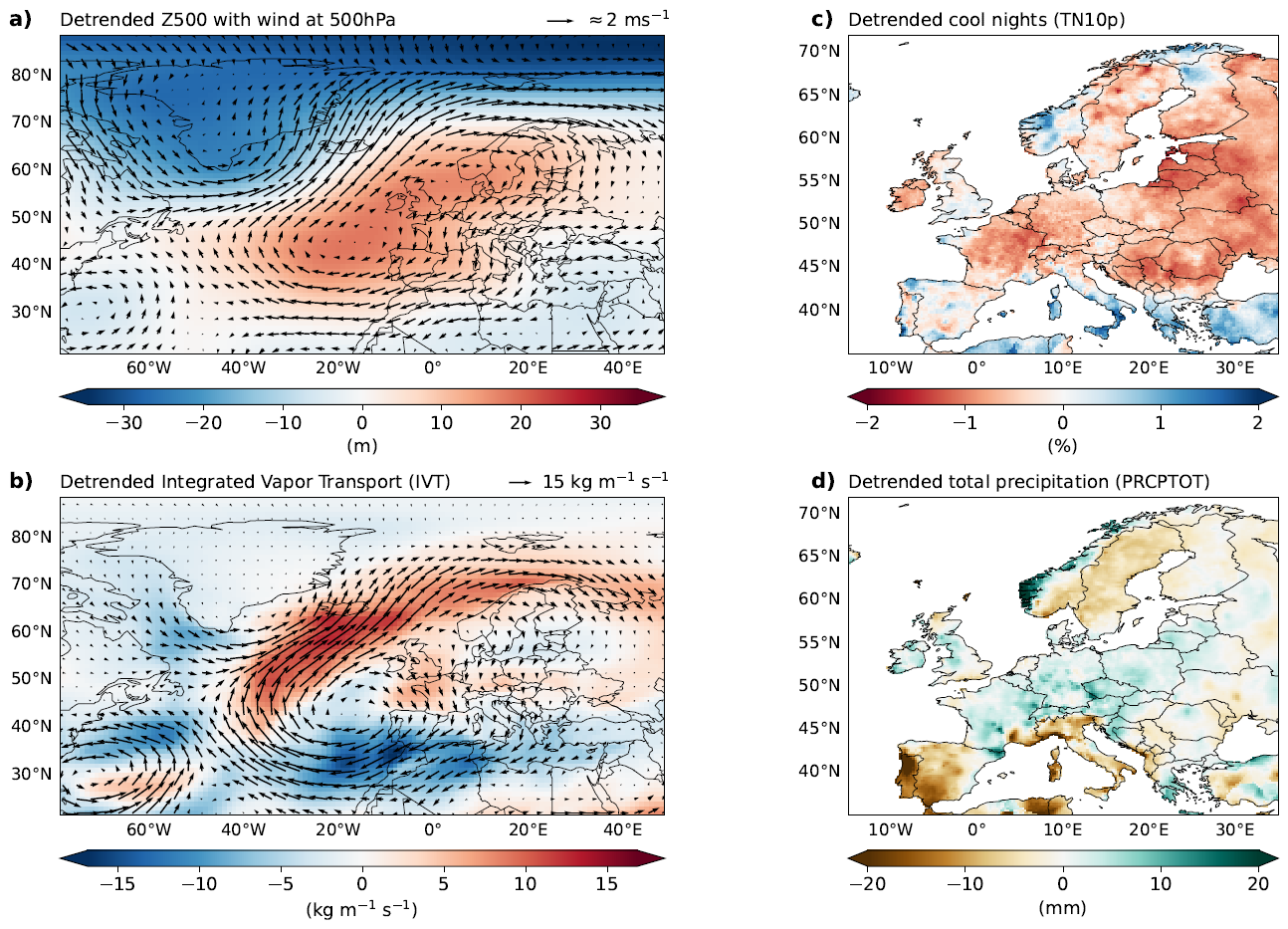
Figure 2 The composite maps of the detrended monthly anomalies of the geopotential height (shaded) at 500 hPa (Z500) and the wind (vector) at 500hPa (a), detrended integrated vapor transport (IVT) (b), detrended cool nights index TN10p (c), and detrended total precipitation index PRCPTOT (d) on the winter season (DJF) in the negative years the NGT stacked ice core record for the period 1920− 2011.
To test this hypothesis, we divided the stacked ice core record into two periods: an observational period (1920 – 2011) and a long-term perspective period (1602 – 2003) (Figure 1b & c). We focused first on the observational period, where data availability is greater. Within this period, we identified years with particularly low stable oxygen isotope ratios values and examined the average large-scale atmospheric circulation patterns during those years (Figure 2a). The resulting circulation pattern provides empirical support for our hypothesis, showing that the atmospheric configuration prevents mid-latitude air masses from reaching Greenland (Figure 2b). Importantly, we found that atmospheric blocking occurs four times more frequently during low stable oxygen isotope ratios years compared to all other years. A similar pattern is also observed over the long-term period (Figure 3a).
How does atmospheric blocking shape temperature and precipitation across Europe?
During the observational period, the blocking events are associated with a high-pressure system stretching from the Azores toward northern and central Europe. This drives increased moisture transport toward northern Europe, particularly along the Norwegian coast, resulting in wetter conditions there (Figures 2d). Southern Europe, by contrast, tends to be drier.
Blocking also reshapes temperature patterns across the continent (Figure 2c). By drawing cold air masses southward from the Nordic region, it drives notable cooling in western Turkey and Greece, and to a lesser extent in southern Italy and the Iberian Peninsula. Central Europe, however, experiences relatively warmer conditions, as Atlantic air masses can still reach these regions. The overall picture is a clear spatial contrast: cooling in the southeast and warming in the centre and northwest.
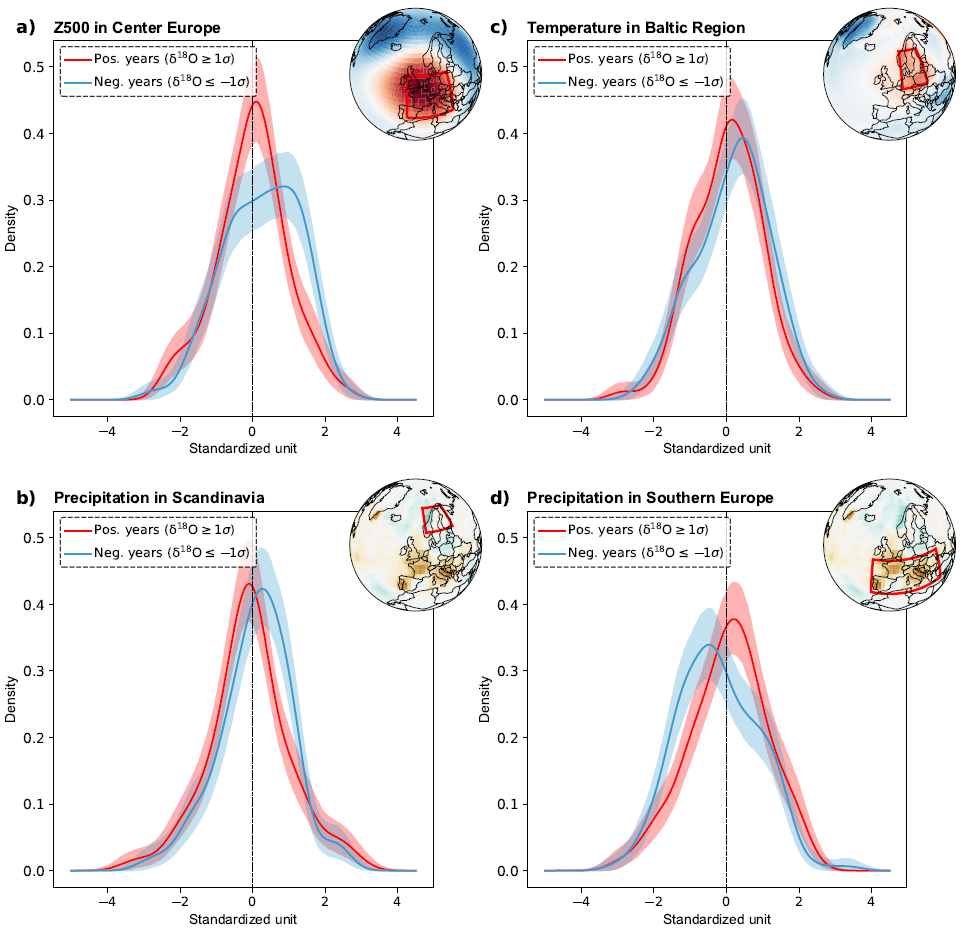
Figure 3 Probability density functions of the standardized monthly field average for the following atmospheric variables: geopotential height at 500 hPa (Z500) (a), 2-meter temperature over the selected box (b), and precipitation (c, d)). All indices are calculated for winter (DJF) during the negative years of the NGT-stacked ice core δ18O record, covering the period 1602–2003. The shaded bands represent the 90% confidence intervals. The corresponding analysis boxes are shown with solid red lines in the upper-right map of each panel. See the main text for the coordinates used for the NGT-stacked ice record.
Over the long-term period, the relationship between Greenland stable oxygen isotope ratios and European hydroclimate remains remarkably consistent. Lower stable oxygen isotope ratios values are again associated with circulation patterns resembling persistent blocking over Europe (Figure 3a), producing warmer and wetter conditions in northern Europe and cooler and drier conditions in the south. Comparing the distributions of temperature and precipitation changes between low and high stable oxygen isotope ratios years (Figure 3b, c & d) reveals that the effects of the blocking are most pronounced in the tails of these distributions, pointing to a greater likelihood of extreme wet and warm conditions in northern Europe, and extreme cold and dry conditions in the south. This recurring pattern suggests that the link between stable oxygen isotope ratios variability and European hydroclimate is stable over centuries.
Our results show that Greenland ice cores record atmospheric blocking activity over Europe, which plays a key role in shaping hydroclimatic extremes across the continent.
To read more about our research you can access the article here.
This post has been edited by the editorial board
References:
Gagliardi, A., Rimbu, N., Lohmann, G., and Ionita, M.: Northern Greenland transect stacked ice cores as a proxy for winter extreme events in Europe, Clim. Past, 22, 935–955, https://doi.org/10.5194/cp-22-935-2026, 2026.

IPCC: Climate Change 2021: The Physical Science Basis. Contribution of Working Group I to the Sixth Assessment Report of the Intergovernmental Panel on Climate Change, vol. In Press, Cambridge University Press, Cambridge, United Kingdom and New York, NY, USA, https://doi.org/10.1017/9781009157896, 2021.

Hörhold, M., Münch, T., Weißbach, S., Kipfstuhl, S., Freitag, J., Sasgen, I., Lohmann, G., Vinther, B., and Laepple, T.: Modern temperatures in central–north Greenland warmest in past millennium, Nature, 613, 503–507, https://doi.org/10.1038/s41586-022-05517-z, 2023.