
Want to know more about the latest breakthroughs in biogeochemistry?
Then you’ve come to the right place. Across marine biogeochemistry, fisheries science, and environmental health, new research is mapping the unintended consequences of a warming and increasingly exploited planet. By tracing carbon and contaminants through water, sediments, and food systems, these studies offer a portrait of Earth’s shifting balance.
Below, we highlight three of the most recent publications from Biogeosciences.
Carbon on the move: What a global model reveals about dissolved organic carbon in a warming ocean
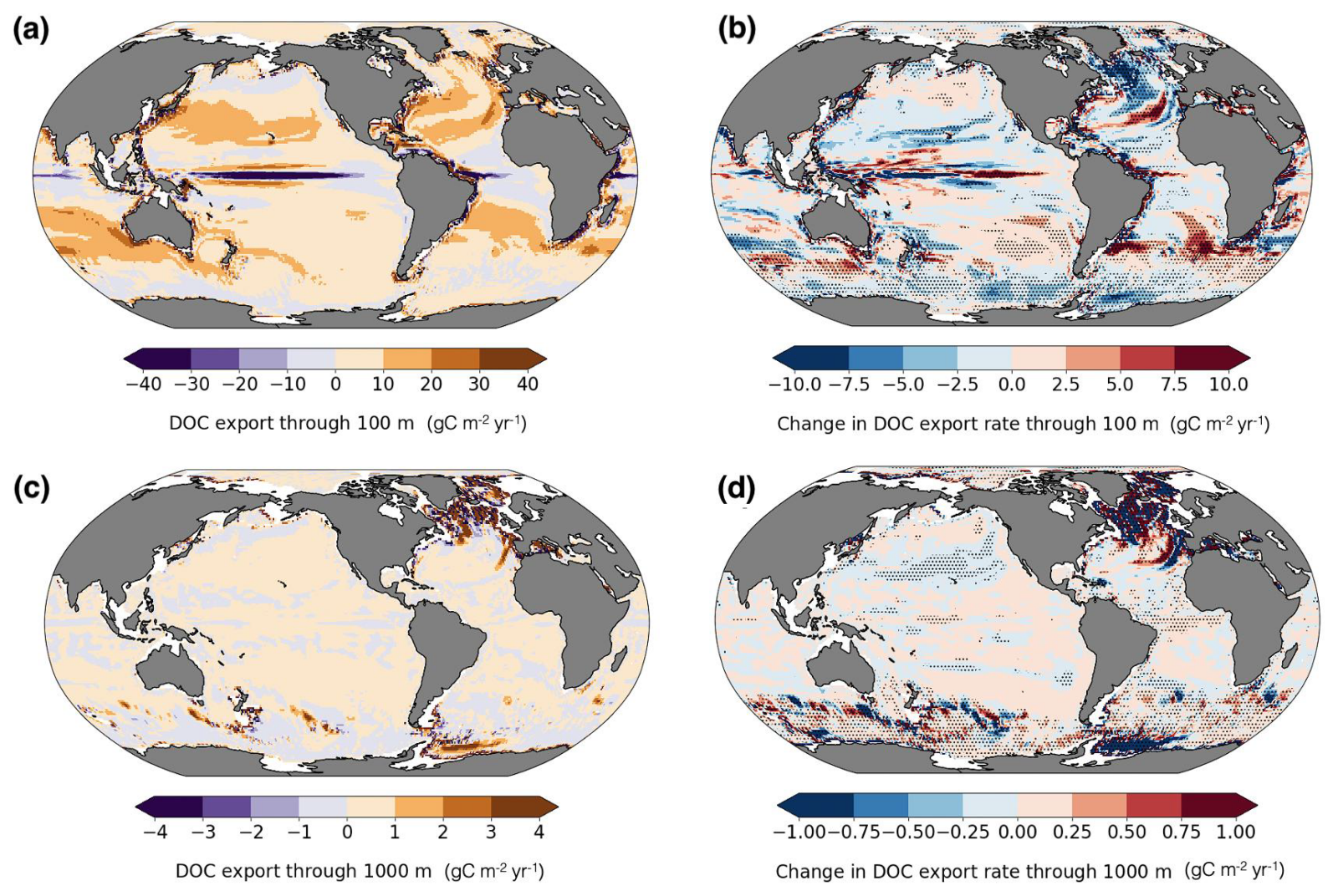
Fig. 1: DOC export rates at 100 and 1000 m and projected changes. Present-day (a, c); future minus present (b, d). Negative values indicate upward transport. Dots mark regions with significant changes (α=0.05) (Flanjak et al., 2025).
The ocean stores about ten times more carbon than land and atmosphere combined, largely by transporting carbon from the surface to long term deposits on the seafloor, helping regulate Earth’s climate. Biological processes in the sunlit surface ocean initiate this storage: microalgae (phytoplankton) use light to fix CO₂ into organic matter , which then enters the marine food web. Organic carbon then takes one of two pathways to long-term storage: as particulate organic carbon (> 0.45 µm), which sinks as marine snow and fecal pellets, and as dissolved organic carbon (DOC), a soup of small molecules released through exudation, grazing, and viral lysis. POC sinks directly onto the ocean floor and has long been recognized as a major export route to the deep ocean, whereas DOC is a major food source for bacteria and fuels the microbial loop in the surface layer while being transported by currents rather than gravity.
But climate change is reshaping this system. This study analyzes the changes happening in DOC export under the projected ‘worst-case’ high-emission scenario through biogeochemical modelling. As surface waters continue to warm, stratification strengthens, reducing vertical mixing and the upward supply of nutrients that support primary production. Biological productivity declines, reducing DOC production. Yet paradoxically, DOC concentrations in the upper ocean increase, since physical transport of DOC below 100 meters is slowed down. With less DOC is produced, even less is exported. Most of what does leave the surface is consumed by bacteria before reaching the deep sea, with deep flux far smaller than at shallow depths. Overall, the projected decline in DOC export amounts to 6%, confirming the expected downward trend.
Therefore, the ocean’s carbon story is not just about sinking particles but also about invisible pathways of dissolved carbon species shaped by physics. Globally, DOC accounts for about one-fifth of organic carbon export at 100 meters, and far more in nutrient-poor subtropical gyres, highlighting how understanding biological and physical processes shaping DOC cycling will be beneficial to better understand the role of DOC in the marine carbon cycle under ongoing climate change.
Read the full article here: Flanjak et al., 2025, Dissolved organic carbon dynamics in a changing ocean: an ESM2M-COBALTv2 coupled model analysis, Biogeosciences, 22, 6877–6894
Impact of mobile bottom fishing on organic carbon in seabed sediments – why we focussed on currently unimpacted areas
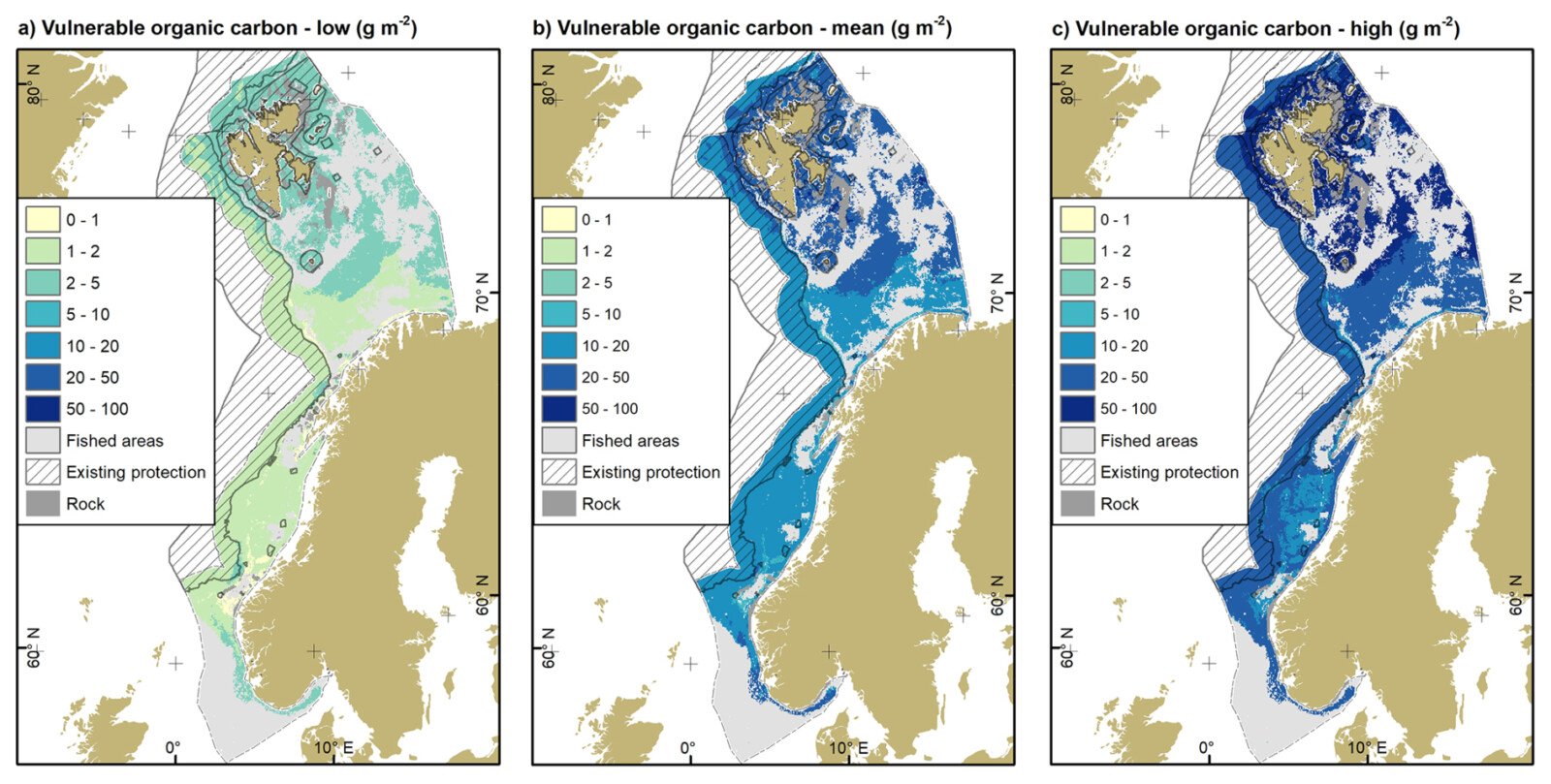
Fig. 2: Vulnerable organic carbon stocks of the surface layer for the three fishing impact scenarios: (a) low, (b) mean and (c) high. Existing area-based protection measures Area-based protection measures based on the regulation on the protection of coral reefs, Paragraph 58 of the harvest regulations, and the regulation on vulnerable marine ecosystems (VMEs). Rock refers to hard substrates, mainly rock and boulders. Source of land areas: ESRI (Diesing et al., 2025).
Continental margins are global hotspots of long-term organic carbon burial, quietly locking away a fraction of the carbon fixed by phytoplankton each year and playing a crucial role in climate regulation. Of the roughly 50 gigatons of carbon fixed annually, only a tiny share ultimately reaches the seafloor—and just about 10% of that is buried for the long term, indicating how this process takes place over long time-scales . Along the Norwegian continental margin, large stocks of organic carbon remain stored in surface sediments, especially in those undisturbed by mobile bottom fishing. Norway has already implemented extensive spatial protections, including coral reef protections, a long-standing closure west of Svalbard, and expanded safeguards in the Barents Sea, creating a unique opportunity to examine what is still intact.
Mobile bottom fishing, which drags weighted nets across the seabed, can resuspend sediments and stimulate microbial remineralisation, potentially converting stored organic carbon back into CO₂. Estimates of trawling-induced CO₂ release vary widely, yet surface sediments are consistently identified as especially vulnerable. By combining vessel monitoring data (2009–2020), spatial sediment modeling, and a meta-analysis of experimental studies, we estimated how much carbon in currently unfished areas could be at risk if trawling expands. We find that 207 million metric tons of organic carbon are stored in surface sediments, 139 million of which lie in unfished areas. Of these, about 19 million metric tons, primarily in the Barents Sea, could be vulnerable to disturbance, with uncertainty bounds ranging from 2 to 34 million metric tons.
Large amounts of organic carbon remain stored in seafloor areas of the Norwegian continental margin that have not yet been disturbed by mobile bottom fishing—and these untouched stores are among the most vulnerable to future impacts. By identifying where this vulnerable carbon is located and how much could be lost if trawling expands into these areas, this study provides a practical evidence base for management. Protecting unfished, carbon-rich seabed areas now is one of the most effective ways to prevent avoidable carbon loss and to maintain the ocean’s role in climate regulation.
Read the full publication here: Diesing et al., 2025,Mapping organic carbon vulnerable to mobile bottom fishing in currently unfished areas of the Norwegian continental margin, Biogeosciences, 22, 7611–7624
Review of Artisanal Small-scale Gold Mining (ASGM) derived mercury in agricultural systems: an unhealthy competition for space
Artisanal and small-scale gold mining (ASGM) may sound almost folksy, conjuring up images of miners panning for gold beside mountain streams. However, next to providing livelihoods for an estimated 20 million people while supplying up to one-third of the world’s gold, it is the world’s largest anthropogenic source of mercury. Booming gold prices have driven its rapid expansion across Africa, Asia, and Central and South America, where mercury amalgamation remains the dominant extraction method because it is cheap and effective. Yet this process releases vast amounts of mercury into air, soils, and waterways.
This study synthesises current research on the pervasive contamination of agricultural systems by ASGM-derived mercury, identifying the key environmental pathways and subsequent risks to food security.
It becomes clear that the consequences of mercury amalgamation extend far beyond polluted rivers and mining sites. Once emitted, mercury can redeposit locally or travel long distances, entering agricultural systems through atmospheric uptake by leaves or deposition to soils. Crops grown near ASGM sites—including cassava, soy, pumpkin, peanuts, maize, sweet potato, and other crops—have been found to contain dangerously high levels of inorganic mercury, sometimes exceeding safe daily intake thresholds. Mercury is absorbed into plant tissues via two main pathways: through the atmosphere, especially in leaves, and from roots of saturated soil crops. Rice poses a particular concern: cultivated in flooded paddies that favor mercury methylation, it can accumulate both total mercury and methylmercury, with many samples surpassing safety guidelines. Animal products such as eggs, meat, and milk may also carry elevated mercury levels, though this pathway remains understudied.
Therefore, ASGM represents not only a mining or environmental issue but one of potential food security and public health. Addressing it requires better monitoring of soil–plant–atmosphere pathways, deeper investigation into mercury in crops and livestock, and stronger collaboration between international researchers and local communities to translate science into protective action, so that academic research can better support the existing local efforts to advance public health through education, changes in practice, and advocacy.
Read the full publication here: McLagan et al., 2025, Reviews and syntheses: Artisanal and small-scale gold mining (ASGM)-derived mercury contamination in agricultural systems: what we know and what we need to know, Biogeosciences, 22, 6695–6726
Edited by Nicola Krake