Prof. Jonathan Williams is an atmospheric chemist at the Max Planck Institute for Chemistry in Mainz, Germany, where he leads research into volatile organic compounds — the invisible molecules emitted by forests, cities, people, and everything in between. His work spans the Amazon rainforest to cinema audiences, from elderflower blossoms to the breath of cities.
Chemist by Chance, Then by Choice
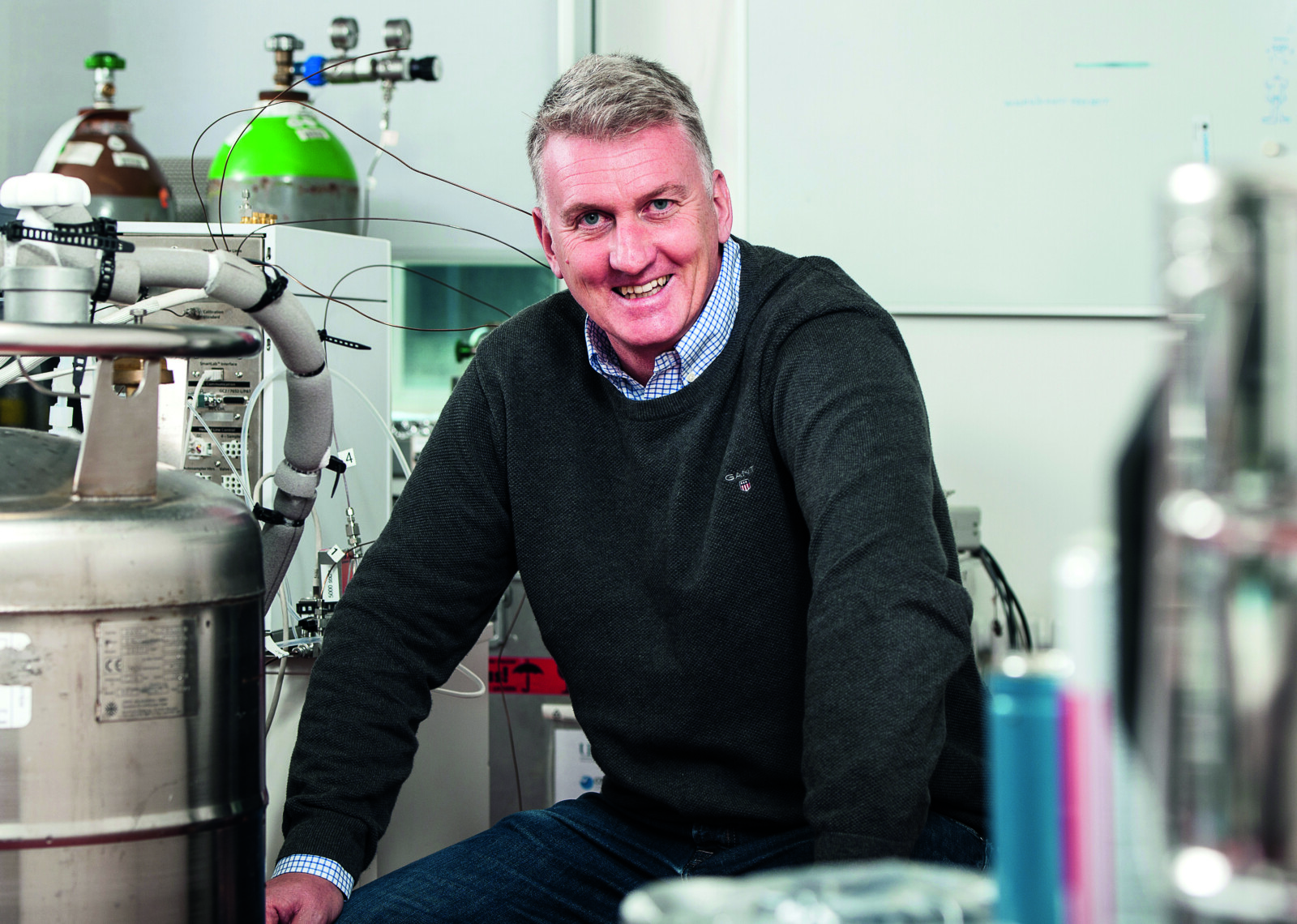
Photo provided by Jonathan Williams
Jonathan Williams never sat down and decided to become a chemist. It happened gradually, as it often does — through a run of good teachers, a growing fascination with how electrons explain the everyday world, and one piece of 1980s news that seems to have shaped a generation of atmospheric scientists.
“When I was at school, the ozone hole story was breaking”, he recalls. “These atmospheric chemists were flying off to Antarctica to explain this amazing phenomenon – it seemed very attractive to be part of.” The discovery that human activity could punch a hole in the planet’s protective chemistry at a planetary scale felt genuinely alarming, genuinely exciting. For a teenager drawn to organic chemistry and natural phenomena, it was a calling. He went on to become a atmospheric chemist and studied under Paul Crutzen, who won the Nobel prize in 1995 for his work on the ozone hole.
It’s a privilege to still be doing something which your curiosity naturally takes you to.
What Are VOCs? And Why Should Anyone Care?
The atmosphere around us is full of molecules most people have never heard of: volatile organic compounds, or VOCs. Williams explains the three main characteristics to become a member of this family:
- You have to be volatile – meaning you readily go into the gas phase at normal temperatures.
- You have to be organic, so containing a carbon atom.
- And you have to be a stable compound rather than a radical.
There are thousands of them, each with its own story. They come from trees, cars, factories, cooking, cleaning products, insects — even people. And although they exist at trace concentrations, measured in parts per trillion, they drive a remarkable amount of the chemistry we all depend on. Ozone formation, particle production, cloud condensation – all of it is tied to these near-invisible molecules.
The atmosphere cleans itself of them through what Williams calls a near-miraculous mechanism: the OH radical. “Nobody’s ever heard of it,” he admits. “But every day, for free, it scrubs out toxic gases and reduces the greenhouse effect. All you need is a little sunlight, some ozone, and water.” He has a standing proposal: if anyone ever gets elected mayor, put up a statue for the OH radical. It deserves the recognition.
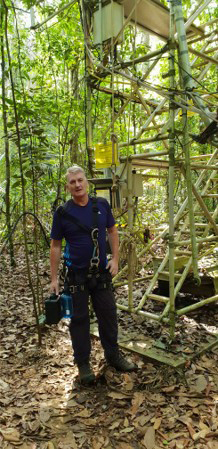
Jonathan Williams in the rainforest. Photo taken by Achim Edtbauer.
Listening to the Amazon
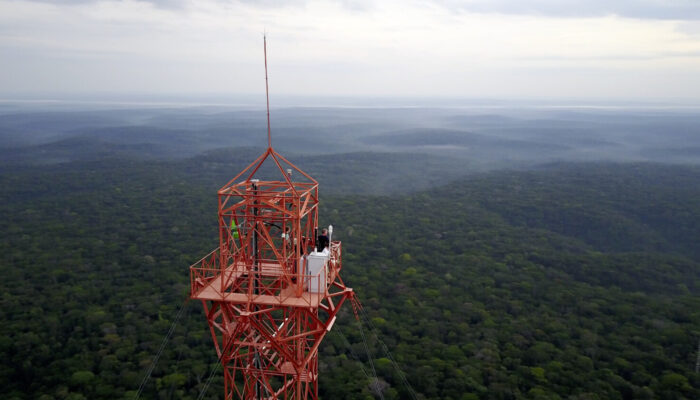
For the past decade, Williams’s group has maintained a measurement tower deep in the Amazon rainforest – the largest single source of biogenic VOCs on Earth. Globally, around 90% of all VOC emissions are biogenic, and the tropical rainforest accounts for the lion’s share. “We’ve characterised the breath of the rainforest more or less continuously for ten years,” he says. “Because it’s the most important source on the planet – we have to.”
What they’ve found goes far beyond a catalogue of molecules. The forest, it turns out, is talking: constantly, chemically, and with extraordinary precision. Plants communicate stress, insects signal to flowers, and the whole ecosystem hums with invisible messages in a chemical language that science has barely begun to decode.
One of the group’s most striking recent discoveries involves chiral compounds, molecules that exist as mirror images of each other, identical in every way except their orientation in space. Alpha-pinene, the molecule responsible for the smell of pine forests, comes in two such forms. Williams’s group found that one enantiomer is directly linked to photosynthesis, while the other follows a completely different pathway through the plant’s biochemistry. When the Amazon suffers under an El Niño drought, the ratio between these two mirror images shifts: and Williams can read the ecosystem’s distress directly from the air.
We’re listening in to the conversation between the various parts of the ecosystem — plants, insects, flowers — all communicating chemically and invisibly.
From the Jungle to the Cinema
One of the more surprising detours in Williams’s career started when he realised his instruments had nothing to do in winter. Atmospheric photochemistry is driven by sunlight; cinema audiences peak at Christmas. The solution was obvious, at least to him: move the mass spectrometer into the film theatre.
A cinema, he explains, is a nearly perfect controlled experiment. Clean air is pumped in from below the seats; used air is extracted through the ceiling. The same film is shown to multiple groups, giving reproducibility. His instruments can measure hundreds of VOCs every second — fast enough to track the audience’s emotional response in real time, as their breath and skin chemistry shift with the emotions on screen.
“The students started being able to guess which film was running just from the way certain chemicals were behaving,” he says. The work eventually became serious enough to predict a film’s age classification from the fear responses measured in the ventilation shaft. It earned the group an Ig Nobel Prize — an honour Williams clearly enjoys. “It’s a bit of fun. But you always learn something, even on the hobby projects.”
That cinema work pulled the group indoors. They began studying what human beings themselves emit — from breath, from skin — in climate chambers in Copenhagen, working through the pandemic. The same chemistry that fills a forest also fills the rooms where we live. The two worlds are closer than most people think.
Urban Air, Greening Cities, and Getting the Timing Right
Back in the city, Williams is watching a policy transition unfold in real time. NOx emissions from vehicles have been coming down steadily across Europe, and with them the ozone and particle levels that once made cities like Los Angeles genuinely dangerous to breathe in. “People were running marathons in 400 parts per billion of ozone at the 1984 LA Olympics,” he notes. “It seems shocking to think about now.”
But as the obvious culprits recede, other sources are coming into view. Cleaning products, personal care items, adhesives and paints — all releasing VOCs that were once a negligible fraction of urban chemistry, but are now, as car emissions fall, starting to matter. “The indoor products are becoming a significant fraction of the urban VOC inventory,” Williams explains. “We weren’t looking there before.”
Meanwhile, city planners are eager to green urban spaces — not only for beauty, but for the well-documented mental health benefits and the trees’ ability to scavenge ozone through their stomata. The ambition is right, says Williams, but the timing matters. Plant trees before NOx has fallen far enough, and you actually make the ozone problem worse, because the biogenic VOCs from the trees interact with the remaining nitrogen oxides to produce more pollution, not less. “You have to get your NOx low enough first. That’s where modelling comes in — getting the timing right for the transition.” He nods, for a moment, in the direction of his atmospheric modelling colleagues.
On Science, Balance, and the Right Kind of Addiction
Williams runs his group, by his own description, as a non-micromanager. People follow their enthusiasm; he tries to steer, advise, and occasionally point out when something on a beer mat calculation looks worth pursuing. He is also, he says, known for telling his students to go home.
“Working all weekend might mean you advance quickly for a couple of weeks,” he explains. “Then you burn out. If you get the balance right; stop working, do other things – your brain works better. You get different impulses. You can sustain creative, productive work for much longer.” It’s advice he gives freely, and he means it.
He also means something slightly more philosophical about what it costs to love your work too much. A former supervisor of his, he recalls, retired and within weeks found himself in steep mental and physical decline — simply from the removal of the constant stimulus that research had provided. The institute gave him an office back. “He was a research question junkie,” Williams says. “Strange to watch. But I think I understand it.”
Sometimes you pick up an ant in the rainforest and it smells of toluene, and you think — what is going on?
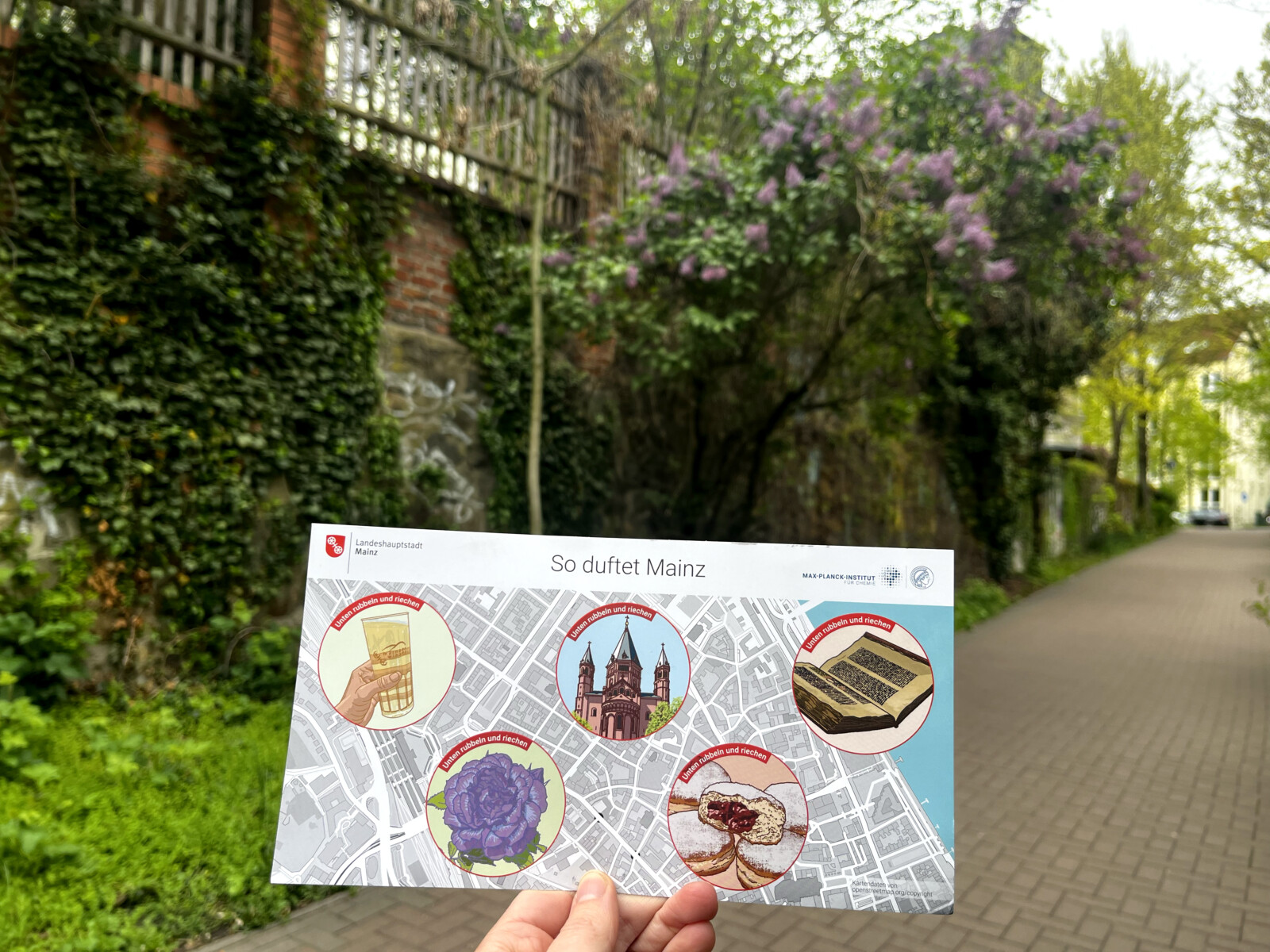
Postcard with the smells of Mainz. Photo taken by Roxana Cremer.
Smelling the City, Hearing the Forest
The conversation keeps returning to smell — as science, as philosophy, and as something surprisingly personal. Williams has noticed what most people tune out: that cities have a chemistry you can sense if you pay attention. Stockholm smells different from Mainz. The approach of elderflower season is legible in the air before you see a single blossom. When you’ve registered a smell, he says, you never quite lose it again.
He has a citizen science project to prove the point: a collaboration with the plant-identification app Flora Incognita, with an add-on called Duft Incognita (smell incognita). Tens of thousands of users across Germany are walking through parks and forests identifying plants and logging what they smell. When a particular plant reaches critical density — right now it’s blackthorn, its almond-and-vanilla scent drifting through Mainz — Williams’s team goes out to measure the actual emissions and posts the chromatograms on the website. Public curiosity converted into atmospheric data, freely given.
It started, he says, from his walk to work through the fields and trees near the institute. He times his route to arrive around nine. He knows every bush. He regularly sees the same animals.
I love just the moment you get into the green! The heart rate goes down. It’s somehow more.
It’s the kind of thought that arrives on long walks when you’ve spent enough years paying attention to the invisible chemistry around you that the boundary between science and meaning starts to blur.