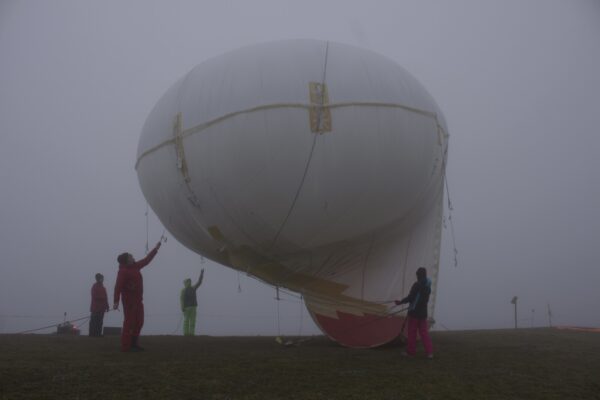
It’s murky grey, windy, and freezing when we head out into the countryside of the Swiss pre-Alps. We are looking for low hanging clouds to serve as our natural laboratory. Wintertime low stratus clouds can cover Switzerland for days. This type of cloud is stable with temperatures below 0 ºC and it contains plenty of liquid cloud droplets, but no ice crystals. These are the perfect background conditions for starting our experiments (see Figure 1, left). We launch an uncrewed aerial vehicle (UAV) to seed the cloud with aerosol particles. These aerosol particles trigger the formation of ice crystals. As there was no ice present in the natural cloud, we can attribute all the observed ice crystals to the artificial perturbation. This allows us to study ice crystal growth in a controlled and reproducible manner under real world conditions. So, instead of bringing the cloud into the lab, CLOUDLAB takes the lab into the cloud.
But why are we interested in ice growth processes? They are essential for the formation of precipitation (Mülmenstädt et al., 2015). Accurate precipitation forecasts are vital in order to reduce their risks and damages. Improving our understanding of ice growth processes on the microphysical scale will help us to represent them more accurately in numerical weather models.
The key role of ice in precipitation formation
Starting with a cloud consisting of many tiny, purely liquid cloud droplets, it is rare, that the cloud droplets grow large enough to fall out as rain. When this cloud cools down to below 0 ºC, counter-intuitively, its cloud droplets do not freeze immediately. A temperature of around -38 ºC is needed, to overcome the energy barrier of rearranging the water molecules into the hexagonal ice lattice. Thus, cloud droplets remain in a meta-stable liquid state between 0 ºC and -38 ºC and are referred to as supercooled cloud droplets. In the atmosphere many solid aerosol particles are suspended, which are needed to help to overcome the energy barrier. If a supercooled cloud droplet merges with a mineral dust particle, for example, the solid surface reduces the energy barrier and the cloud droplet freezes at negative temperatures much higher than -38ºC.
Therefore, liquid water and ice can coexist in clouds with temperatures between 0 ºC and -38 ºC. These so-called mixed-phase clouds are particularly favorable for fast growing ice crystals, which subsequently initiate precipitation. This efficiency boils down to differences in required supersaturations, i.e., water vapor reservoirs, for the growth cloud droplet and ice crystals. Here, we find a peculiar process: the Wegener-Bergeron-Findeisen (WBF) process, which takes place in conditions, where cloud droplets experience a subsaturated environment, while ice crystals still are in supersaturated conditions. Hence, ice crystals will grow through vapor deposition onto their surface, while cloud droplets evaporate replenishing the water vapor reservoir (see Figure 1, right). This way, ice crystals can reach fast precipitable sizes; either as snow or they melt and become rain. In contrast, processes that do not involve the ice phase are less effective in producing precipitation. As a result, more than 70 % of precipitation in the mid-latitudes originates from the ice phase (Mülmenstädt et al., 2015).
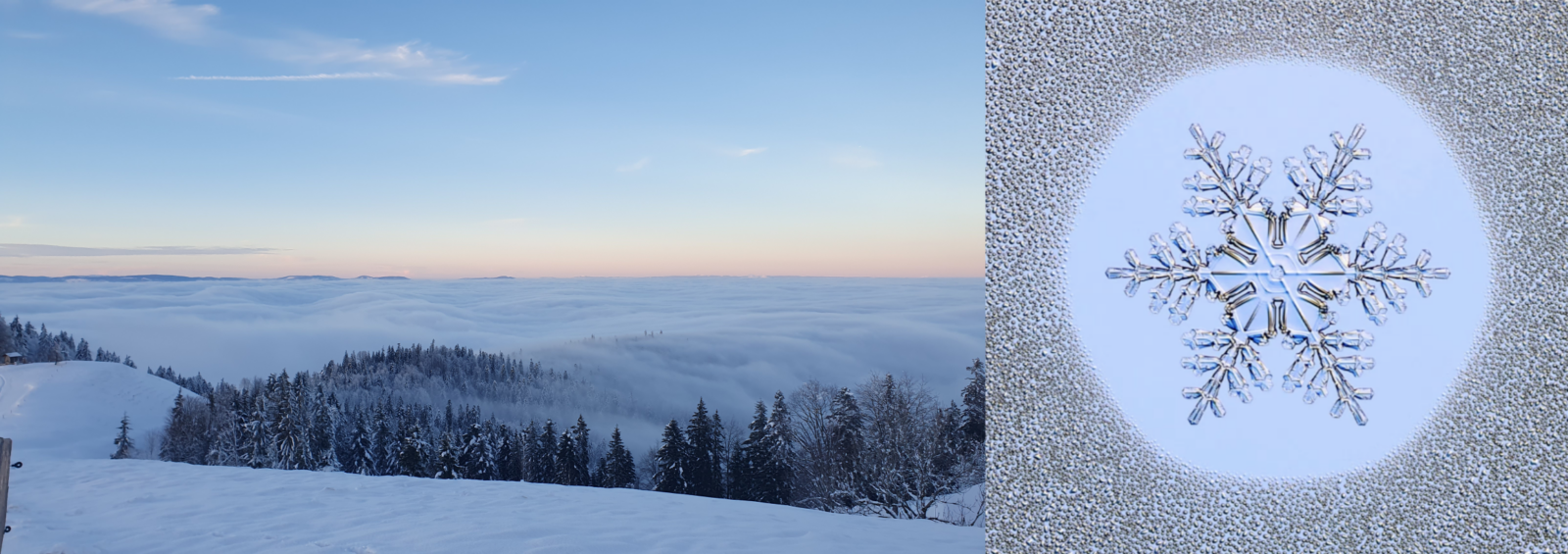
Figure 1: Top view of a low stratus cloud covering Switzerland (left). Picture taken by CLOUDLAB. Image depicting the WBF process with an ice crystal in the center surrounded by cloud droplets. Image taken from www.snowcrystals.com/.
Our mission
We want to quantify ice growth processes in natural clouds in a controlled manner. Therefore we target in Switzerland frequently occurring stratiform liquid-only clouds, so-called low stratus clouds, which form in the lowest 2 km of the atmosphere. They are characterized by a constant wind direction and can persist for several days. If cloud top temperatures are below -5 ºC, we head out into the field and start our experiments.
To start an experiment we emit aerosol particles by a UAV into the cloud layer. The wind direction and wind speed define where and how far upwind of the main field site we seed the cloud. At the main field site there is a suite of in situ and remote sensing instruments waiting to observe the advected seeding plume. This experimental set-up is visualized in Figure 2. On the ground, we have various remote sensing instruments, such as cloud radars, lidars, and radiometers. On a tethered balloon system flying inside the cloud there are in situ instruments such as a holographic camera to observe individual hydrometeors, an anemometer, and an aerosol particle spectrometer. These measurements are completed by radiosonde profiles and disdrometers on the ground to measure precipitation (Henneberger, Ramelli et al., 2023). So far, more than 90 cloud seeding experiments were conducted during the winters between 2021 and 2026.
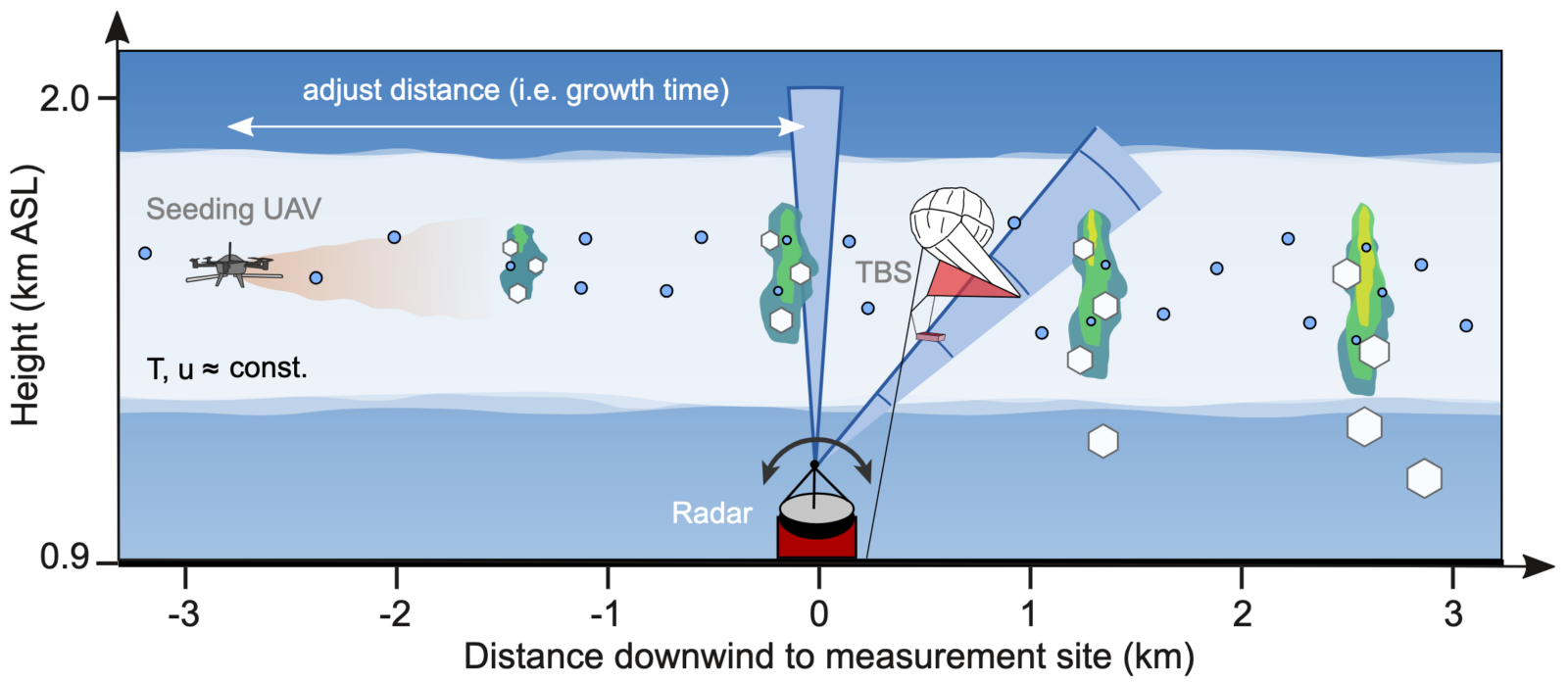
Figure 2: Overview of the cloud seeding experiments performed during CLOUDLAB: A seeding UAV releases seeding particles into the cloud, which initiates ice formation. The newly formed ice crystals can grow through the Wegener–Bergeron–Findeisen process. The seeded patch is characterized by a tethered balloon system (TBS), and remote sensing on the ground (Ramelli et al., 2024).
Microphysical observations and model implications
Figure 3 shows different shapes of ice crystals observed during our experiments. Microphysical changes in the plume and meteorological conditions of the environment are measured simultaneously. This helps us to enhance our understanding of the WBF process under natural conditions. For example, we can analyse how the ice growth rates vary with temperature or liquid water content of the background cloud. Ramelli et al. (2024) found that the ice crystal growth rates in CLOUDLAB have a considerable larger variability than in previously published laboratory studies, which can potentially accelerate precipitation initiation.
Moreover, the modeling world benefits from these observations. Omanovic et al. (2024) compared simulated cloud droplet and ice crystal number concentration to in situ measurements. They found that the simulated WBF process is slower in terms of changes in liquid water content and ice crystal sizes. Ultimately, these studies retrace the processes of ice formation and growth, but further investigation is still required to incorporate these findings in operational weather models.
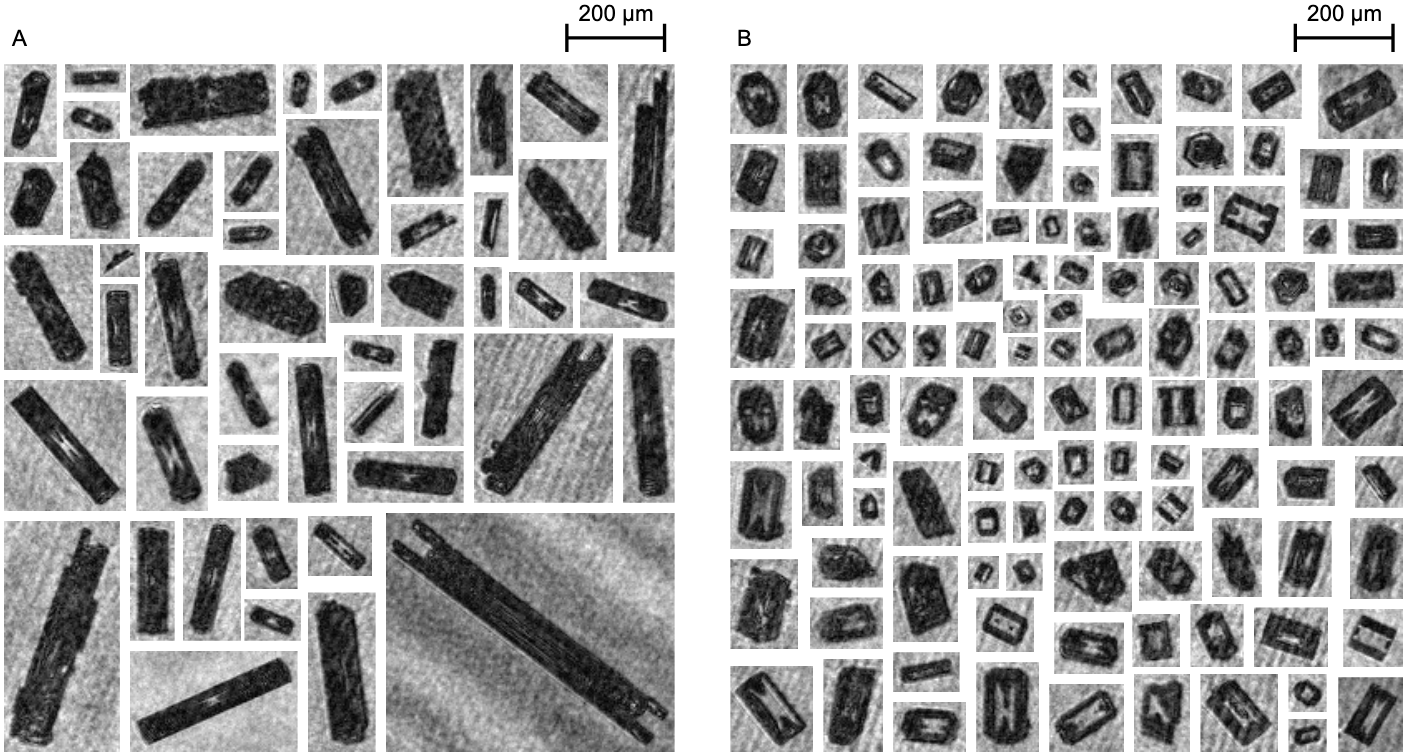
Figure 3: A randomly selected sample of ice crystal images observed by the holographic camera during seeding experiments (Ramelli et al., 2024).
What’s next?
As part of the next-generation CLOUDLAB team, we are currently out in the field. We are building on our colleagues’ work by conducting observations over longer growth times and across a wider temperature range. Besides supercooled clouds, we also target clouds with warm cloud top temperatures to study processes only involving cloud droplets. Additionally, we measure how the radiative cloud properties evolve during an experiment, test different seeding materials, and analyse the chemical composition of water and ice collected in the cloud and on the ground. Lastly, we will chase the seeding plume with free floating balloons to observe its evolution along a Lagrangian trajectory.
We therefore hope for many more cold, murky grey, and windy winters until 2029. Stay tuned for what findings we will reveal. 🙂