
Modern atmospheric science relies on precise and stable measurements to understand how the composition of the atmosphere evolves over time. From air quality to climate-relevant trace gases, long-term observations are essential for identifying trends and detecting subtle changes. One of the key tools enabling such measurements is infrared spectroscopy, which allows scientists to identify and quantify atmospheric gases by measuring how molecules absorb infrared radiation from the Sun.
High-resolution Fourier Transform Infrared (FTIR) spectrometers are widely deployed at ground-based monitoring stations around the world. These instruments are often assumed to operate close to ideal conditions, with stable optical alignment and well-defined performance characteristics. In reality, however, no instrument is perfectly stable over long periods of operation. Small optical imperfections can develop gradually and may influence the measured spectra in subtle but systematic ways.
The central message of our study is that even small, often overlooked instrumental imperfections can significantly affect atmospheric measurements if they are not properly characterised and accounted for.
Inside the spectrometer, the incoming sunlight is converted into a spectrum that contains the absorption fingerprints of atmospheric gases. The fidelity of this spectrum depends on how accurately the instrument reproduces the true spectral shape of the radiation. Over time, factors such as mechanical wear, slight misalignments, and internal reflections within optical components can distort this response. These effects may not be obvious during routine measurements, but they directly influence the sharpness of spectral features and, ultimately, the accuracy of retrieved gas concentrations.
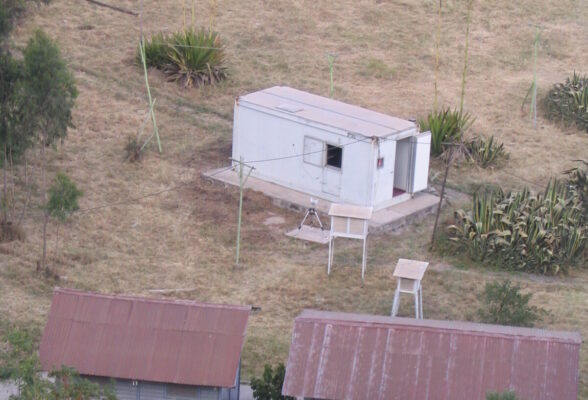
In our recent study published in Atmospheric Measurement Techniques (Daba and Tsidu, 2026), we investigated these effects using a high-resolution FTIR spectrometer operated in Addis Ababa, Ethiopia. This station contributes long-term atmospheric observations from tropical Africa, a region where such measurements remain relatively scarce. We focused on identifying realistic instrumental effects that arise during routine operation, including changes in optical alignment, variations in modulation efficiency, and periodic distortions caused by internal optical reflections, commonly referred to as channeling.
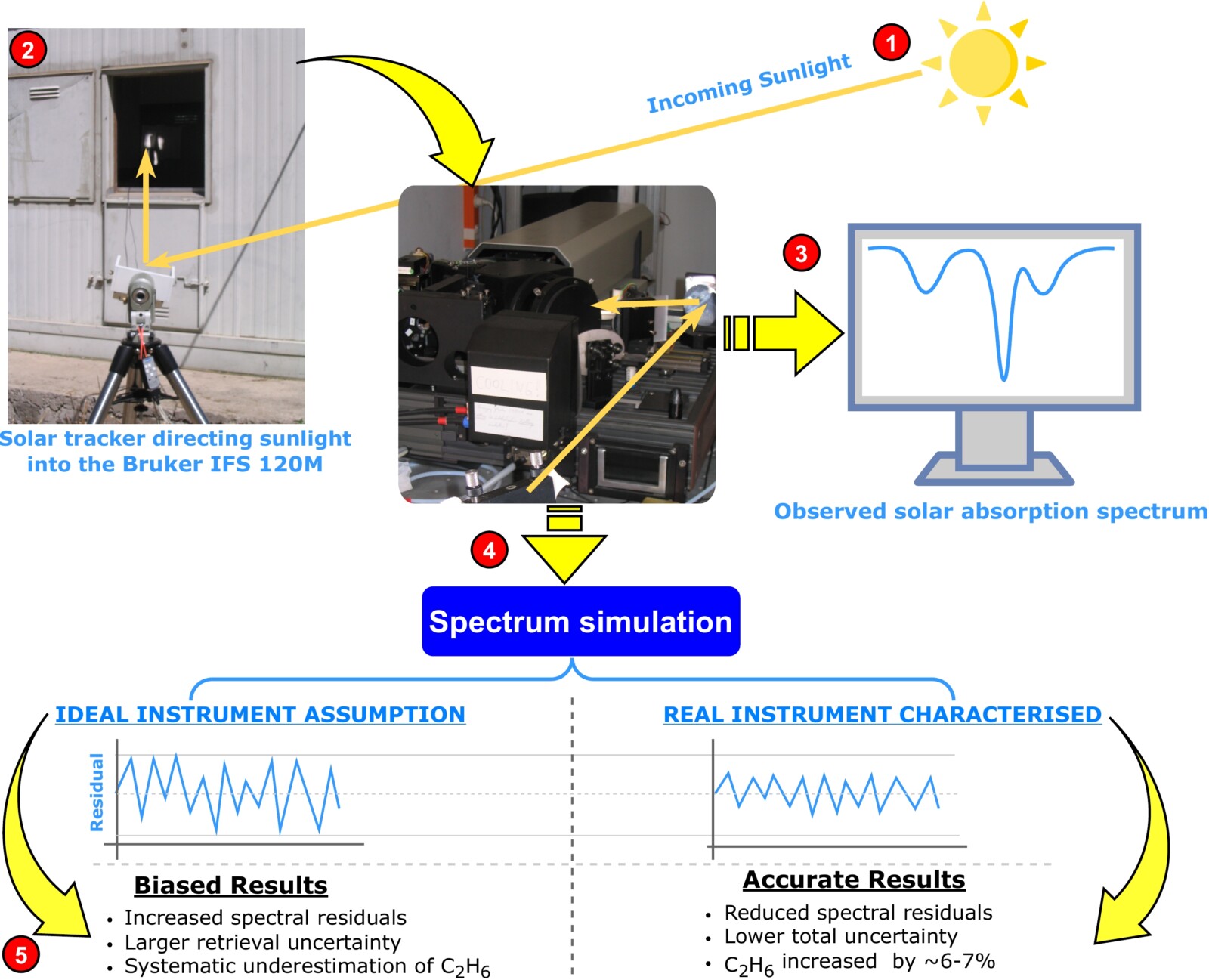
Figure 1: Measurement and spectrum simulation workflow (Steps 1 to 5).
The measurement and retrieval process is summarised in Fig. 1. Incoming sunlight is directed into the Bruker IFS 120M by a solar tracker, where the recorded signal is transformed into an observed atmospheric absorption spectrum. This spectrum is analysed using a forward simulation. In practice, this simulation can be performed in two different ways: either by assuming an ideal instrument or by using an empirically characterised instrumental response. The difference between these two approaches is the central focus of our study.
To obtain a realistic instrument description, we carried out dedicated diagnostics and instrument line shape (ILS) characterisation. These steps allow us to quantify subtle effects such as small optical misalignments, changes in modulation efficiency, and channeling caused by internal reflections. Although these imperfections are often not immediately visible in routine measurements, they slightly distort the spectral line shape and therefore influence the atmospheric retrieval.
Figure 1 illustrates how these instrumental assumptions propagate into the final atmospheric products. When the instrument is treated as ideal, the mismatch between observation and simulation remains larger. This leads to increased spectral residuals, higher retrieval uncertainty, and a systematic underestimation of the retrieved ethane (C2H6) amount.
When the empirically characterised instrument behaviour is included, the agreement between observation and simulation improves noticeably. The spectral residuals are reduced, the total uncertainty becomes smaller, and the retrieved C2H6 column increases by about 6–7%. This demonstrates that realistic instrument characterisation has a direct and measurable impact on atmospheric trace-gas products.
These findings highlight why instrument diagnostics and atmospheric retrievals should not be treated as separate steps. Even modest departures from ideal instrument behaviour can introduce systematic biases into long-term datasets. If such effects are ignored, apparent trends may partly reflect instrumental artefacts rather than true changes in the atmosphere.
By explicitly linking instrument characterisation with atmospheric retrievals, our study shows how a realistic description of the spectrometer improves the reliability and longterm consistency of FTIR-based observations. This is particularly important for long-term monitoring stationsand forregions where observational data are limited and eachmeasurement carries substantial scientific value.
More broadly, this work is a reminder that atmospheric measurements do not depend only on the atmosphere itself, but also on how well we understand the instruments used to observe it. Carefully characterising the real behaviour of these instruments helps ensure that the changes we detect in atmospheric composition truly reflect physical processes in the atmosphere and not hidden instrumental effects.




Mezemir Girma
What a read!
Gezahegn Sufa
Thank you! I’m glad you found it interesting.
A. Addisuu
Very interesting study!