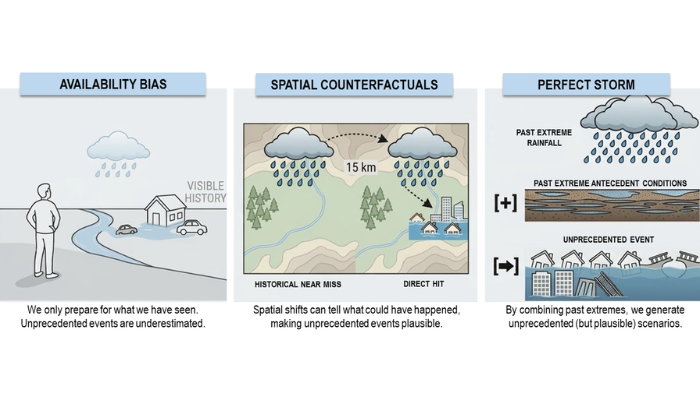
The aim of risk management is to prepare society in order to limit loss and damage when an extreme event occurs and to restore the functioning of society afterwards . While current risk management practices are helpful in many regards, they fall short when it comes to unprecedented events. An analysis of event pairs and …[Read More]
1727 search results for "network"
If you didn't find what you were looking for, try searching again.
EGU Campfire Geodesy – Share Your Research – 18th Edition
We are excited to announce the 18th edition of Geodesy Campfire – Share Your Research in April. The Geodesy EGU Campfire Events “Share Your Research” give (early career) researchers the chance to talk about their work. We have two exciting talks by our guest speakers, David Rodríguez Collantes and Klara Middendorf. Below, you can find …[Read More]
First time at an EGU General Assembly? We’ve got you covered!
Europe’s biggest geoscience conference, EGU26, is just over one month away! Each year, the EGU General Assembly brings together over 19,000 researchers, scientists, academics and journalists to discuss and share the latest developments in planetary exploration, Earth observation, polar science, climate change, natural hazards, and much more. And it is held at the Austria Centre …[Read More]
GeoTalk: meet Christina Orieschnig, hydrologist and science communicator!
Hello Christina! Welcome to GeoTalk. Before we dive in, could you introduce yourself to our readers? Hey everyone! I’m a researcher at the Institut de Recherche pour le Développement (IRD) in Montpellier in the South of France. For my work, I specialise in remote sensing and hydrological modelling, with study areas in Cambodia, Tunisia, and …[Read More]
From Seismic Signals to Safer Trains: Italy’s First Earthquake Early Warning System for High-Speed Railways
Earthquakes remain among the most disruptive natural hazards worldwide, capable of causing sudden loss of life, severe economic damage, and long-lasting societal impacts. One of the most effective tools developed in recent decades to mitigate these effects is Earthquake Early Warning (EEW), a real-time monitoring strategy that exploits a fundamental physical property of earthquakes: seismic …[Read More]
Highlighting: Martian Geomorphology (Interview with Lauren Mc Keown)
This blog post is part of our series: “Highlights” for which we’re accepting contributions! Please contact Emma Lodes and Anna van den Broek (GM blog editor, elodes@asu.edu, a.j.vandenbroek@uu.nl), if you’d like to contribute on this topic or others. by Lauren Mc Keown, Assistant Professor – University of Central Florida. Email: Lauren.Mc.Keown@ucf.edu. Website: http://www.laurenemckeown.com/. What is interesting …[Read More]
Hydrotalks: IAHS working group leaders and coordinators on HELPING scientific decade, working groups activities, and writing community papers
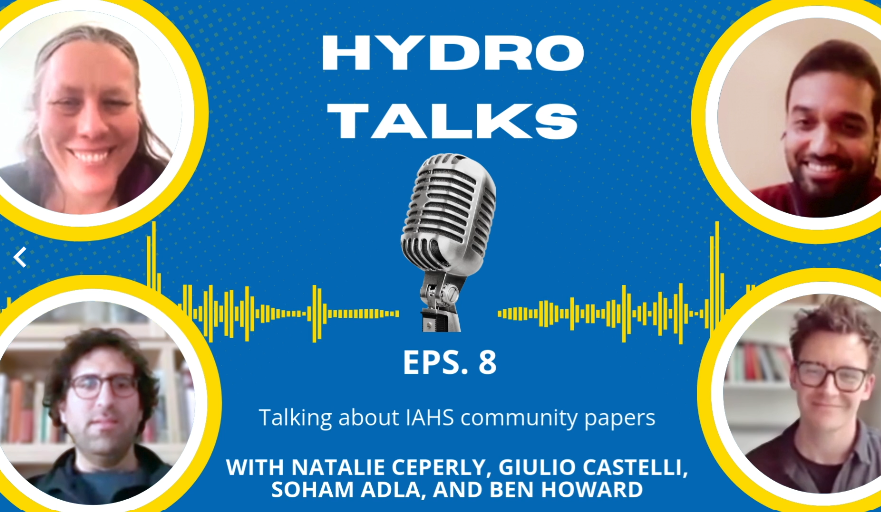
In episode 8 of the Hydrotalks podcast, we hosted four coordinators of working groups of the HELPING hydrological decade. We warmly welcomed Dr. Giulio Castelli (University of Florence) and Dr. Natalie Ceperley (University of Bern), group co-leaders of Co-Creating Water Knowledge working group; Dr. Soham Adla (ING Bank, Netherlands), a coordinator of Science communication, outreach, and …[Read More]
EGU Campfire Geodesy – Share Your Research – 17th Edition
We are excited to announce the 17th edition of Geodesy Campfire – Share Your Research in March. The Geodesy EGU Campfire Events “Share Your Research” give (early career) researchers the chance to talk about their work. We have two exciting talks by our guest speakers, Hugo Lecomte and Marius Schlaak. Below, you can find the …[Read More]
IGS: A Home for the Global Cryosphere
Like many glaciologists (in the broad sense – as in, cryospheric researchers, not just those who study glaciers!), my professional “home” has been the International Glaciological Society (IGS) ever since grad school; My first conference was an IGS branch meeting, I found my postdoc by networking at an IGS symposium, I have published work in …[Read More]
FrenSZ workshop: a French interdisciplinary initiative around subduction zones.
Since 2022, the annual FrenSZ workshop has been bringing together a vibrant and interdisciplinary community around subduction zones in France. In this week’s blog post, we dive into how FrenSZ is organized, highlight its scientific outcomes and how it is opening new connections on the international stage. A large French community. In France, a fairly …[Read More]