
An important part of our annual conference is giving students and recent graduates the opportunity to present their work – through a poster and drinks reception at the end of the day. Last year we had some fantastic posters – from both undergraduate and postgraduate students, and recent graduates. This week and next we’ll be …[Read More]
Latest posts
Turning science into fun games for citizens
Sounds like fun. Have a look at this interesting read and see how scientist are turning to citizens to help them with analysing large volumes of data. “A few days ago, I was an astrophysicist and contributed to a research project by organising sunspot images in order of complexity. After I’d had enough of that, …[Read More]
Imaggeo on Mondays: A massive slump
One of the regions that has experienced most warming over the second half of the 20th century is the Potter Peninsula on King George Island in Antartica. It is here that Marc Oliva and his collaborators are studying what the effects of the warming conditions on the geomorphological processes prevailing in these environments. “Permafrost is …[Read More]
Guest Blog: Volcanology in Vanuatu!
Ben Clarke and Eleri Simpson are about to start their 4th year at the University of Leicester. Having shown a strong interest in applying geoscience to development through the conversations we’ve had with them over the past two years – we were really pleased to hear they has successfully arranged some work experience in Vanuatu. We’re also …[Read More]
Monday paper: Use of phytoremediation and biochar to remediate heavy metal polluted soils: a review
Paz-Ferreiro, J., Lu, H., Fu, S., Méndez, A., and Gascó, G.: Use of phytoremediation and biochar to remediate heavy metal polluted soils: a review, Solid Earth, 5, 65-75, doi:10.5194/se-5-65-2014, 2014. Soil heavy metal pollution Due to increased extraction and use by various industries, heavy metals come easily to the environment in various ways. Unlike organic substances, heavy metals can not …[Read More]
Friday Photo (127) – Slow Water Collection, Tanzania
Water Collection – Chato District, Tanzania Some of these women and children in Tanzania had been waiting at these small holes for 5 hours for enough water to seep through the ground to fill their buckets. Understanding enough geoscience to consider (i) changing groundwater levels at different times of the year and (ii) different geological …[Read More]
Reducing water scarcity possible by 2050
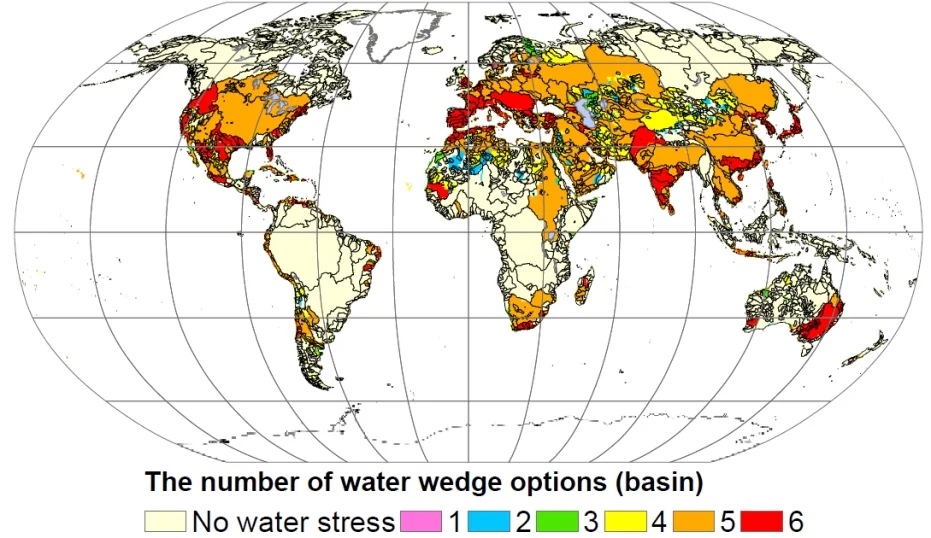
Press release from McGill University of our research published yesterday in Nature Geoscience. Water scarcity is not a problem just for the developing world. In California, legislators are currently proposing a $7.5 billion emergency water plan to their voters; and U.S. federal officials last year warned residents of Arizona and Nevada that they could face …[Read More]
GeoCinema Online: The Geological Storage of CO2
Welcome to week two of GeoCinema Screenings! In a time when we can’t escape the fact that anthropogenic emissions are contributing to the warming of the Earth, we must explore all the options to reduce the impact of releasing greenhouse gases into the atmosphere. The three films this week tackle the challenge of separating CO2 …[Read More]
Scientists and the social network
Nature just blew the bubble! Last month an article entitled Online collaboration: Scientists and the social network, by Richard Van Noorden, put focus on the role social media has on scholars. The article gives a detailed insight on the attitude of scientist towards social media by discussing the various existing platforms such as Google Scholar, ResearchGate, LinkedIn, Twitter, …[Read More]
Mediterranean Environmental Research Group (GRAM)
By Marc Oliva The Mediterranean Environmental Research Group, (GRAM) from the University of Barcelona has over 20 years of working experience in the field of the effects of forest fires on soil properties. In 1998 the doctoral thesis entitled “Fire effects on soil properties, the role of fire intensity” carried out by Xavier Úbeda …[Read More]