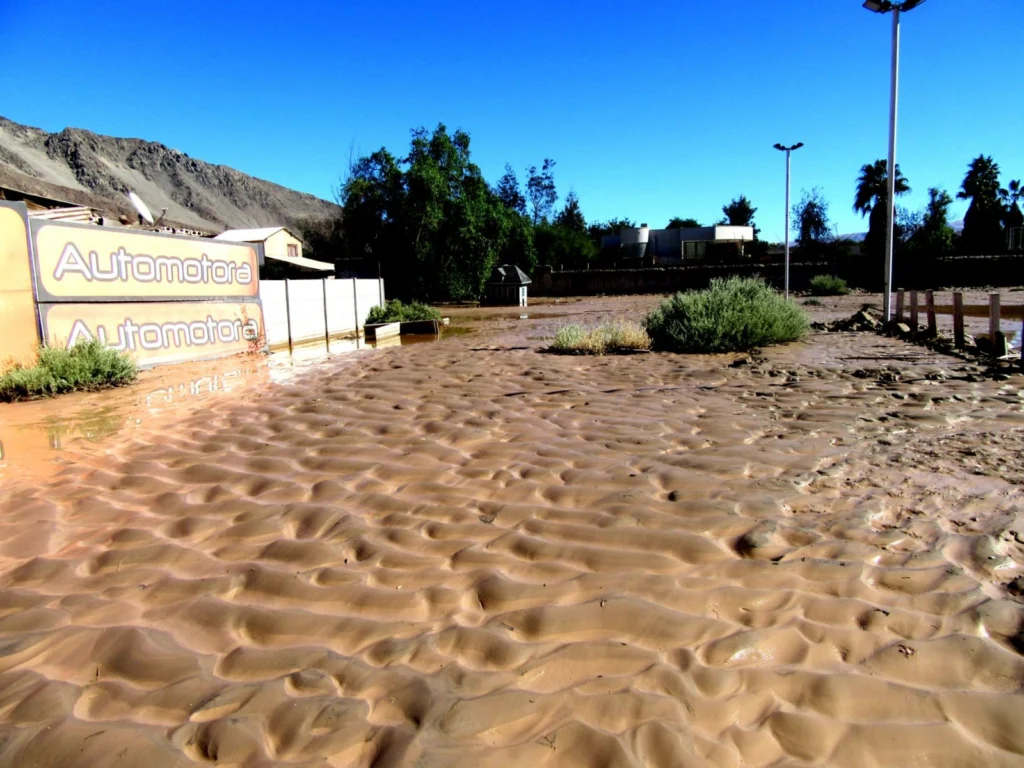
Despite being one of the driest regions on Earth, the Atacama desert is no stranger to catastrophic flood events. Today’s post highlights how the sands, clays and muds left behind once the flood waters recede can hold the key to understanding this natural hazard. During the severe rains that occurred between May 12 and 13, …[Read More]
flooding
GeoSciences Column: Mapping floods with social media
Picture this: you are on your commute home, smartphone or tablet in hand, surfing the internet. You might quickly catch up on the latest news, check in with your friend’s on Facebook, or take to Twitter to share a morsel of information with your followers. This scenario is common in the modern era of technology. …[Read More]
Climate-proofing the Netherlands
Emerging Leaders in Environmental and Energy Policy (ELEEP) fosters transatlantic relations, forges dialogue, and promotes leadership across energy and environmental policy landscapes. Former EGU Science Communications Fellow and ELEEP member Edvard Glücksman reports back from the Netherlands, where citizens manage the continuous threat of climate-related devastation through a combination of creatively adapted urban spaces and innovative …[Read More]
Call for abstracts: The 9th Alexander von Humboldt Conference
The Alexander von Humboldt Conference is part of the EGU’s Topical Conference Series, and will be taking place in Istanbul, Turkey (24 – 28 March 2014). The aim of the meeting is to open a forum on natural hazard events that have a high impact and a large destructive potential, focussing on the Euro-Mediterranean Region in …[Read More]
Geosciences Column: Getting a handle on glacial lakes
Glacial lake outburst floods (GLOFs) are caused when masses of meltwater are released from behind a glacier moraine. Moraines are piles of unconsolidated debris that have either eroded from the glacier valley or have been deposited by melting glaciers. When they fail, a huge volume of water can be released, threatening populations further down the …[Read More]