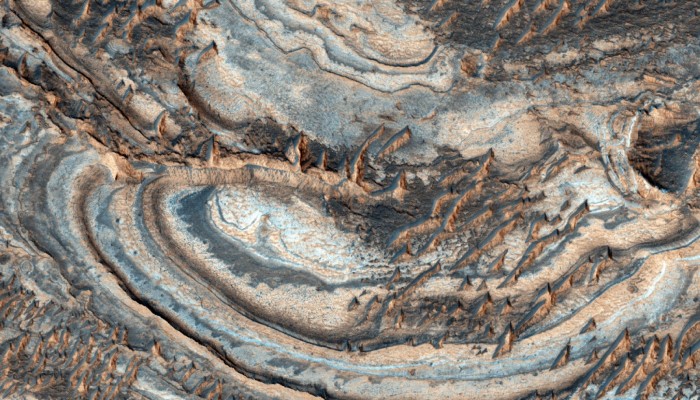
Understanding where we come from and whether Earth is the only habitable planet in the Solar System has been a long standing conundrum in science. Partly because it is our nearest neighbour, partly because of its past and current similarities with our own home, Mars, the red planet, is a likely contender in the quest for extra-terrestrial life. In this guest blog post, James Lewis, a PhD student a ...[Read More]
Geosciences Column: Using tall trees to tot up tropical carbon
Forests in the tropics account for about half the above-ground carbon on Earth and as the trees grow older they are capable of storing more and more. In fact, their carbon-storing potential is so large that they are increasingly being viewed as a means of mitigating climate change. Take, for example, the United Nations effort to reduce degradation and deforestation by assigning value to forest car ...[Read More]
Imaggeo on Mondays: A fly by some fantastic farming
This week’s Imaggeo on Mondays is brought to you by Kristof Van Oost, a scientist from the Georges Lemaître Centre for Earth and Climate Research (UCL) in Belgium. He tells us how local organic farms are being managed to ensure a lot of carbon stays in the soil… This is a picture of the organic farm Het Open Veld in Leuven, Belgium. The farm is built around an alternative agriculture model in whic ...[Read More]
Imaggeo on Mondays: How sea urchins can help mitigate climate change
This week’s Imaggeo on Mondays stars the humble sea urchin – a creature suffering from the effects of climate change, but one that could also provide a way to sequester some of the CO2 responsible… Carbon dioxide and water react to form carbonic acid – a mixture of bicarbonate and hydrogen ions. Sea urchins bag the bicarbonate to grow bigger, stronger shells, or ‘tests’, but without a catalyst, th ...[Read More]