Humankind’s development is often associated with facing challenges. The original ideas required to solve new problems keep pushing the power of human creation towards more sophisticated and practical solutions. However, part of the excitement of any challenge comes from the dangers of trying something that nobody has accomplished before.
An example of technological advances driven by human ambition was the space race between the United States of America and the Soviet Union during the Cold War. One way these powerful countries would compete to showcase the superiority of a capitalist or socialist system was by reaching farther into space, for example, with the first human sent to space in 1961 by the USSR or the first humans on the Moon in 1969 by the USA. However, during the 1980s, the spatial exploration hype wasn’t as strong as in previous decades, and the American President Reagan was looking for ideas to inspire the younger generations again. In this context, the Space Shuttle program was operated by NASA from 1981 to 2011. Its ambitious goal was to reach space more often, with several crewed missions in which up to 8 astronauts would spend about one week to reach space, complete their tasks, and return to Earth safely.
With the inspiration that challenges can bring, the USA Space Shuttle program proposed a space mission named after a pioneering British ship expedition at the end of the 19th century: Challenger. While the former was interested in the depths of the ocean, the latter was meant to explore beyond the skies. The Challenger Space Shuttle was initially built for ground testing, but at some point, it would be faster and less expensive to adapt it to a flight rather than to upgrade the other orbiter available. After this redesign phase for the spacecraft’s new purposes, from 1983 to 1986, the Challenger flew nine crewed missions, completing almost one thousand orbits around our planet during the 62 days it spent in space. During such missions, the astronauts launched several civilian satellites, repaired a telescope designed to observe the Sun, and conducted research on the extreme conditions of space, where there is no gravity to which life on Earth is adapted. In addition to the technical and scientific investments, the orbiter also challenged some social conventions by carrying among its passengers the first American woman and the first African-American astronaut.
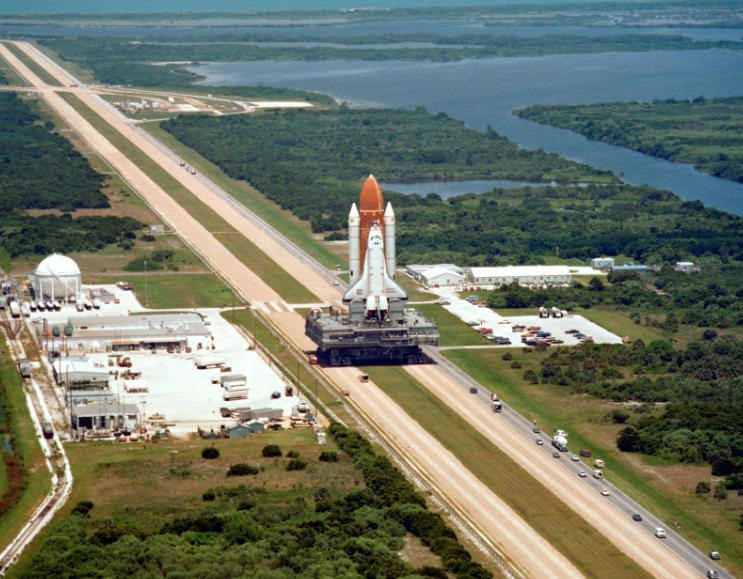
The Challenger Space Shuttle on its way to its final flight.
Source: NASA – https://www.dvidshub.net/image/760483/space-craft-hc-s-challenger; original from http://www.nbcnews.com/slideshow/technologyandscience/the-challenger-tragedy-in-pictures-41180120, Public Domain
The Teacher in Space: A Mission for the Next Generation
Despite the success of the Challenger missions, NASA was under constant pressure to secure financial support and planned to demonstrate the reliability of spaceflight to strengthen its value. President Reagan aimed to engage the general public of the USA by promoting interest in high-tech careers among children through education. Therefore, for the tenth Challenger flight, NASA would send a teacher to space. This teacher would give two 15-minute lessons while in orbit, which would be broadcast on television, and later tour around the country to give lectures about their experience. After receiving more than eleven thousand applications, Christa McAuliffe was chosen by NASA to be the first teacher to go to space. She received one year of training while still raising expectations among the general public about her journey.
Hence, the tenth mission of the Challenger orbiter was to conduct classes from space, but also to launch a satellite to improve the communication system for other space shuttle missions, and to launch a satellite to observe Halley’s Comet. However, several unforeseen technical problems and weather conditions delayed the launch a few times, increasing pressure on the mission, which was being extensively covered by the media.
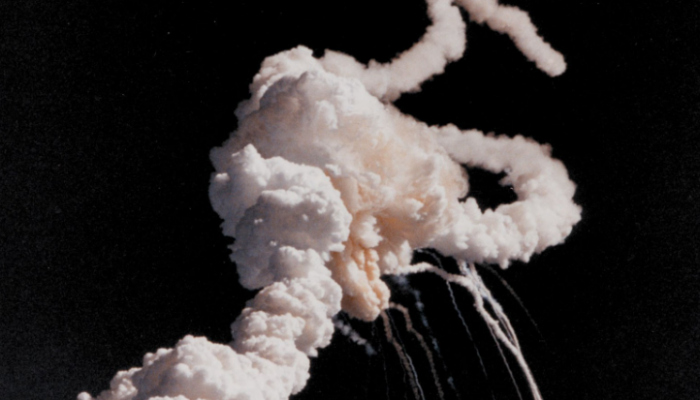
It was on an icy cold day in Florida, exactly forty years ago, on January 28th, 1986. Still, many U.S. citizens were gathering to watch the launch of the space shuttle that would take the first teacher to space. Many schools had suspended their regular classes to follow the launch on television, and the whole country was mobilized for this thrilling endeavor to go beyond the known boundaries of what humankind had achieved so far. Despite the delays and the bad weather, the USA would once again be the first to reach a new milestone in the space race. They would, if the Challenger had not exploded 73 seconds after the launch.
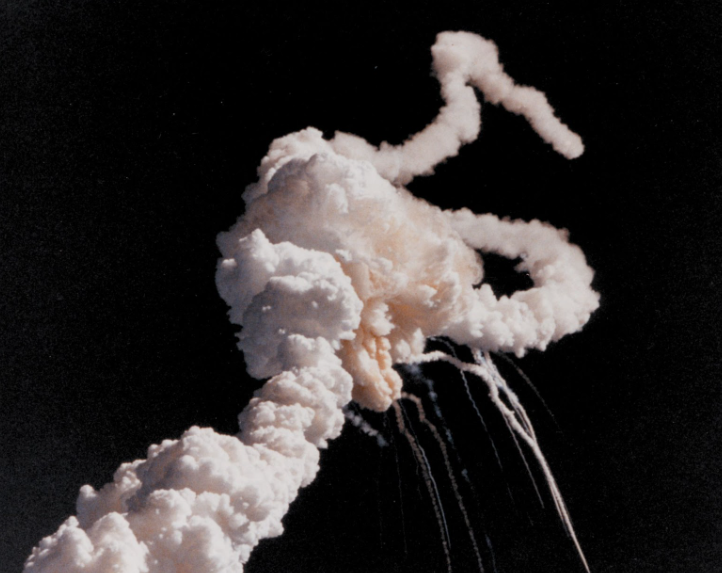
Icarus’ fall; Challengers self-destruction.
Source: Kennedy Space Center – https://www.flickr.com/photos/nasa2explore/10697912315/in/album-72157630719371642/, Public Domain
Lessons from the Fall of Icarus
The whole world mourned as special missions searched for debris from the space shuttle in the Atlantic Ocean. All generations of astronauts were somehow affected by the story of this accident, with the real fear that travelling to space is not as secure or guaranteed as NASA wanted it to be perceived. Children, who deserve our encouragement, watched their nightmares play out on television as the American dream collided with a reality of negligence, fueled by a desire to cut corners and save money.
According to investigations by a special committee, the Rogers Commission, the low temperatures in Florida reduced the resiliency of the primary and backup O-rings, rubber joints commonly used to maintain pressure differences and prevent leaking in valves. These O-rings failed to seal the burning gas from one of the boosters, and the leaking flame melted some securing struts, leading to the explosion of the fuel tank. The blast pressure and aerodynamic forces at 60 km altitude destroyed the orbiter. Still, the astronauts probably died when the crew cabin reached the ocean, either due to oxygen loss or the impact with the water.
Nevertheless, Challenger’s structural failure can also be attributed to management failure. The Rogers Commission report faulted NASA, its Marshall Space Flight Center, and Morton Thiokol, Inc., for poor engineering and management. The Commission gathered testimonies from some engineers involved in the Challenger mission who had expressed concerns about the reliability of the seals for at least two years before the accident, while the space shuttle was still often being launched. Some of these engineers had warned their superiors about a possible failure the night before Challenger’s last launch. Still, after tense meetings, the pressure to win the space race prevailed over concerns about safety. The report pointed out a communication gap between the engineers building the shuttle and the managers, who were focused mainly on budget and deadlines, claiming that NASA’s declared ambition of flying 24 missions per year had pushed the Space Shuttle program to strain its physical and financial resources and overwork its employees.
It was on board the Endeavour that the first teacher reached Earth’s orbit. Barbara Morgan, who was Christa McAuliffe’s backup, completed her predecessor’s mission in August 2007. Since then, with special emphasis on the International Space Station, many payloads have been targeted for science communication and outreach, with videos showing routine aspects or specific experiments, such as growing plants in space. McAuliffe’s legacy remains a reference for generations that witnessed the catastrophic accident that led to a change in priorities for the world’s largest space agency to date.
In the current phase of the space race, it is essential to keep the Challenger mission in mind, so that the fast pace and financial ambitions do not override these hard-won lessons and prioritize the security of astronauts and technicians. As much as the Greek myth had taught Western culture for centuries, Icarus’ ambition to build wings and fly into the skies could not have ended in a tragic fall if he had been more cautious about the material of his wings. As much as wax melts under the heat of the Sun, the rubber O-rings of Challenger could not operate properly on a cold winter day in Florida, and we hope not to find other examples for the 21st century. If we want to prevent losing heroes and keep inspiring ourselves, we should consider safety measures and be cautious about the risks that ambition can lead to, so that the next challenges don’t become tragedies.