
Did you know that yesterday, Sunday, January 4, 2026, marked 65 years since Erwin Schrödinger passed away? While the internet loves him for his cat in a box thought experiment, Geoscientists love him for something much more practical: the equation.
Many of us have spent decades debating the health of a hypothetical feline in a box (I remember watching this episode of the Bing Bang Theory and thinking: Well, Erwin, your equation is useful in real-life settings too!) while completely ignoring the fact that Schrödinger’s Alpine vacation founded the modern mining industry and gave us the keys to the Earth’s basement. While the rest of the scientific community treats his wave equation like a sacred relic of theoretical physics, geoscientists have been using it as a high-powered metal detector.
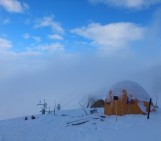
The birth of modern geology began in the winter of 1925 during a mountain getaway in Switzerland. Accompanied by an old girlfriend whose identity he took to his grave, and a pair of pearls (legend says that he stuffed this pair of pearls into his ears as makeshift earplugs, seeking a state of total sensory deprivation). At the time, Schrödinger was annoyed with the “solar system” model of the atom, where electrons behaved like tiny planets orbiting a sun. He found it far too tidy for a universe he saw as much more messy. He decided to treat the entire subatomic world as a series of vibrating waves and, therefore, turned the periodic table into a giant, invisible orchestra. He emerged from the snow with the Schrödinger Equation ($H\psi = E\psi$), a piece of math so powerful it allows us to predict the behavior of matter without actually seeing it. For a geologist standing on top of several miles of solid, opaque rock, this was (and still is!) the perfect gift.
The great quantum jailbreak
For centuries, geology was considered less of a hard science and more of a vibes-based filing system. Most geologists operated on the principle of superposition, which is a fancy way of saying ‘the stuff on the bottom was probably there first’. We could look at a canyon wall and confidently state that layer A was older than layer B, but we were blissfully ignorant of the actual time scale. Was that gap a weekend of heavy rain or ten million years of tectonic silence? We had the book of Earth’s history, but the page numbers were missing, for a while.
Then came Schrödinger’s wave mechanics, and suddenly, the rocks started talking in precise, numerical dates. This transition happened because Schrödinger’s math revealed a subatomic prison break: Quantum Tunneling. In the classical world of physics, a radioactive particle inside a uranium nucleus is trapped. It is surrounded by a massive energy barrier: a metaphorical twenty-foot-thick concrete wall of nuclear force. According to the old rules, that particle doesn’t have the energy to climb the wall, so it should stay there forever. The uranium should never change, and therefore the geological clock should never tick.
However, Schrödinger’s equation proves that particles aren’t solid marbles. This non-marble nature is actually what makes the Earth’s interior behavior predictable. Because electrons aren’t solid, we can think of them as cloud-like waves that obey the Pauli Exclusion Principle, which prevents these clouds from overlapping. Consequently, this creates electron degeneracy pressure. So, when geophysicists study the Earth’s core, they are looking at how electron waves deform and repel each other under millions of atmospheres of pressure. The reason the Earth’s inner core remains solid despite being as hot as the surface of the sun is entirely due to the way these electron waves interact!
When that particle wave hits the concrete wall of the nucleus, a tiny, microscopic sliver of the wave actually extends through to the other side. There is a mathematically certain probability that the particle will simply manifest on the outside of the wall without ever having to climb it. Think of it as a subatomic ghost walk. Because Schrödinger gave us the math to calculate the exact frequency of these ghost walks, geochronologists turned into the universe’s most patient accountants. We know exactly how long it takes, on average, for half of a uranium sample to ‘tunnel’ its way into becoming lead.
The reason we can confidently tell a room full of skeptics that the Earth is precisely 4.54 billion years old is entirely due to this quantum magic trick. I think we can all agree that Schrödinger gave the Earth a pulse! Every time a geoscientist pins an absolute date to a tectonic shift, they are counting the echoes of particles that shouldn’t have been able to escape, but did, because Schrödinger realized that even the hardest walls in the universe are “leaky.”
Simulating the Inferno
Perhaps the most satirical twist of all is that we use Schrödinger’s math to visit places that would instantly vaporize any human brave enough to try. We cannot drill to the center of the Earth; the heat and pressure make the rock behave like stiff plastic, and the iron core like a turbulent sea. Instead of going there, we use Density Functional Theory (DFT). This is a fancy way of saying we put Schrödinger’s equation into a supercomputer and ask it: “If I squeeze these iron and silicon atoms with the weight of a thousand mountains, how will their electrons behave?” These simulations have revealed the Post-Perovskite phase transition deep in the mantle and explained how the liquid outer core generates the magnetic field that keeps our atmosphere from being stripped away by the sun. We have mapped the center of our planet using nothing but math and the ghost of an Austrian physicist who just wanted some peace and quiet in the Alps.
Final reflections
We clearly have a significant journey ahead to fully resolve the inverse problem and many of the persistent uncertainties of Earth’s interior dynamics. However, for the present, our current seismic and stratigraphic models, fortified by the quantum-mechanical understanding of how waves move through matter, are decent and strong enough to interpret the structural evolution of the crust. We owe this precision to Schrödinger’s equation; it transformed the Earth from a collection of mysterious (and sometimes fascinating and gorgeous-looking) rocks into a predictable crystalline system. Schrödinger gave us the geological clock of radiometric dating and the ability to simulate the crushing pressures of the mantle that no human drill will ever reach (yet?). Yet, the horizon of discovery is expanding. The next great frontier for humanity, powered by ever-more-complex applications of Schrödinger’s math, lies in the prediction of deep Earth transitions. We are on the verge of discovering high-pressure mineral phases and superionic states of matter, where water or hydrogen behaves like both a liquid and a solid simultaneously, within planetary interiors. These discoveries will allow us to identify which distant exoplanets possess the quantum fingerprint necessary to shield an atmosphere and, therefore, harbor life.
As we continue to refine our quantum models, we are slowly learning to read the Earth as a vast, vibrating symphony of waves, a reality Erwin Schrödinger glimpsed in the silence of the Alps a century ago.