
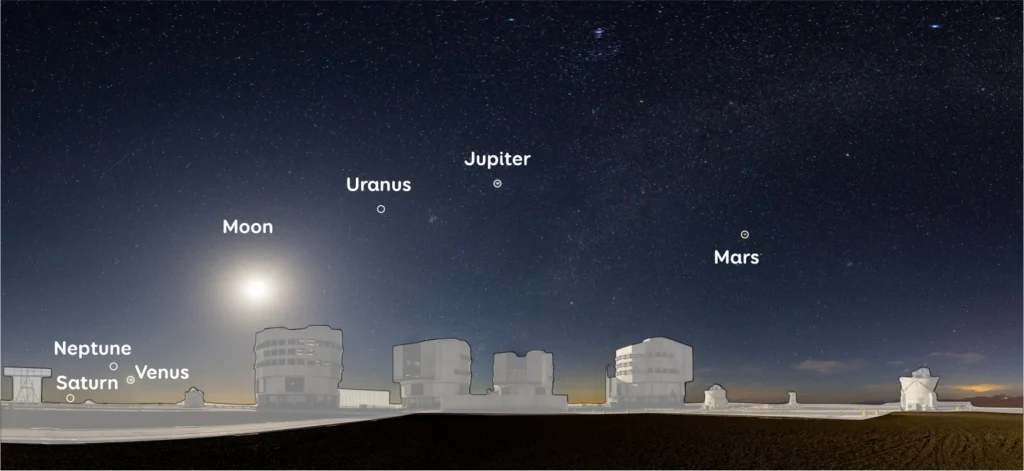
Mercury, Venus, Mars, Jupiter, Saturn… are they deities or planets? The names of the planets of our Solar System are so deeply rooted in modern culture that we rarely stop to think about their true meaning, or about how other ancient cultures might have called them. Today we explore the fascinating origins of the names of the planets and why they are linked to mythological characters.
Current names: are they truly Romans?
In principle, yes: the names we use today come from the Latin names Mercurius, Venus, Mars, Iuppiter and Saturnus. However, the Romans adopted them from the Greeks, replacing each Greek god with its Roman counterpart. Therefore, the Greek Hermes became Mercury, Aphrodite became Venus, Ares became Mars, Zeus became Jupiter and Kronos became Saturn.
The Greeks, in turn, had a more complex understanding of the planets. On the Cosmos is one of the most important works for understanding how the Greeks viewed them. Its origins are still debated: it could have been written either in Aristoteles’ times (4th century BCE) or as late as the 1st century BCE (Hannah, 2020). In any case, it describes the dual view the Greeks had of the planets. The work arranges the planets in concentric circles, from the outermost, home of the fixed stars, inwards through the planets, the Sun to, finally, the Moon. Each planet is named both after a god and its brightness, such that: Kronos was also Phainon “the Shining One”; Zeus was also Phaëthon “the Radiant One”; Ares was also Pyroeis “the Fiery One”; Hermes was also Stilbon “the Glittery One” (Hannah, 2020). This coupling suggest how Greeks named the planets not only based on a divine system, but also on more physical, “scientific” basis.
The term “planets” seems to appear for the first time in earlier times, in the Plato’s Timaeus (Timaeus 38c) and Republic (Republic 616d–617b), written in the 4th century BCE (Hannah, 2020). Planētēs (πλανήτης) means “wanderer” and they were named and defined based on the needs of defining and safeguarding time (Plato, Timaeus 38c) . Also the Moon and the Sun were regarded as planets, since they also wandered in relation to the fixed stars: the Sun indicated seasons, whereas the Moon phases marked the months (Hannah, 2020). However, of the five planets, Plato mentioned only “the bringer of morning” referring to Venus, and “the one called sacred to Hermes“ referring to Mercury (Plato, Timaeus 38d). This suggests that the association of these wandering stars with Greek gods occurred later.
The first Greek mention of all five planets after gods appeared in the Epinomis, a 4th century BCE work attributed to Plato’s School, completed after his death (Hannah, 2020). The use of divine names suggests how Greeks attributed substantial divinity to the planets, describing them almost as Aphrodite, Hermes and so on. These names, however, appear to be Greek equivalents of the Babylonian gods associated with each planet: the Babylonian Nabû became Hermes, Ištar became Aphrodite, Nergal became Ares, Marduk became Zeus and Ninurta became Kronos (Hannah, 2020).
Babylonian astronomy was transmitted to Egypt, the Greco-Roman world, and beyond, already before but especially the conquest of Babylonia by Alexander the Great’s (Ossendrijver, 2020). The Babylonians believed the earthly world was connected with the celestial world, so the appearance and motions of the planets were signs and messages from the gods. Understanding the motions of celestial bodies was therefore extremely important for governing society (Shindell et al., 2023). The Babylonians were probably the first ones in recognizing the planets as wandering stars, as suggested by their original term “Bibbu”, meaning “wild sheep” or anyway something related to their relative and unpredictable movement relative to the fixed stars (Fig. 1).

Fig.1. “Planet” concept in the Akkadian term Bibbu in its two forms: (a) dUDU.IDIM and (b) MULbi-ib-bu (modified after Kasak and Veede, 2001).
From a modern perspective, this apparent wandering is a consequence of planetary orbital motion. Compared to distant stars, which appear nearly fixed relative to one another, planets continuously change their positions against the background of the constellations as they move around the Sun. The different orbital distances result in different orbital speeds and periods. Mercury completes an orbit in just 88 Earth days, whereas farther planets like Saturn take approximately 29.5 Earth years. Such differences in orbital speed between Earth and other planets lead to an apparent reversal in their direction of travel in the night sky when one planet overtakes the other, a phenomenon known as retrograde motion (Fig. 2). The planets do not actually reverse their orbits; the effect is a result of the movement of Earth and the observed planets around the Sun.
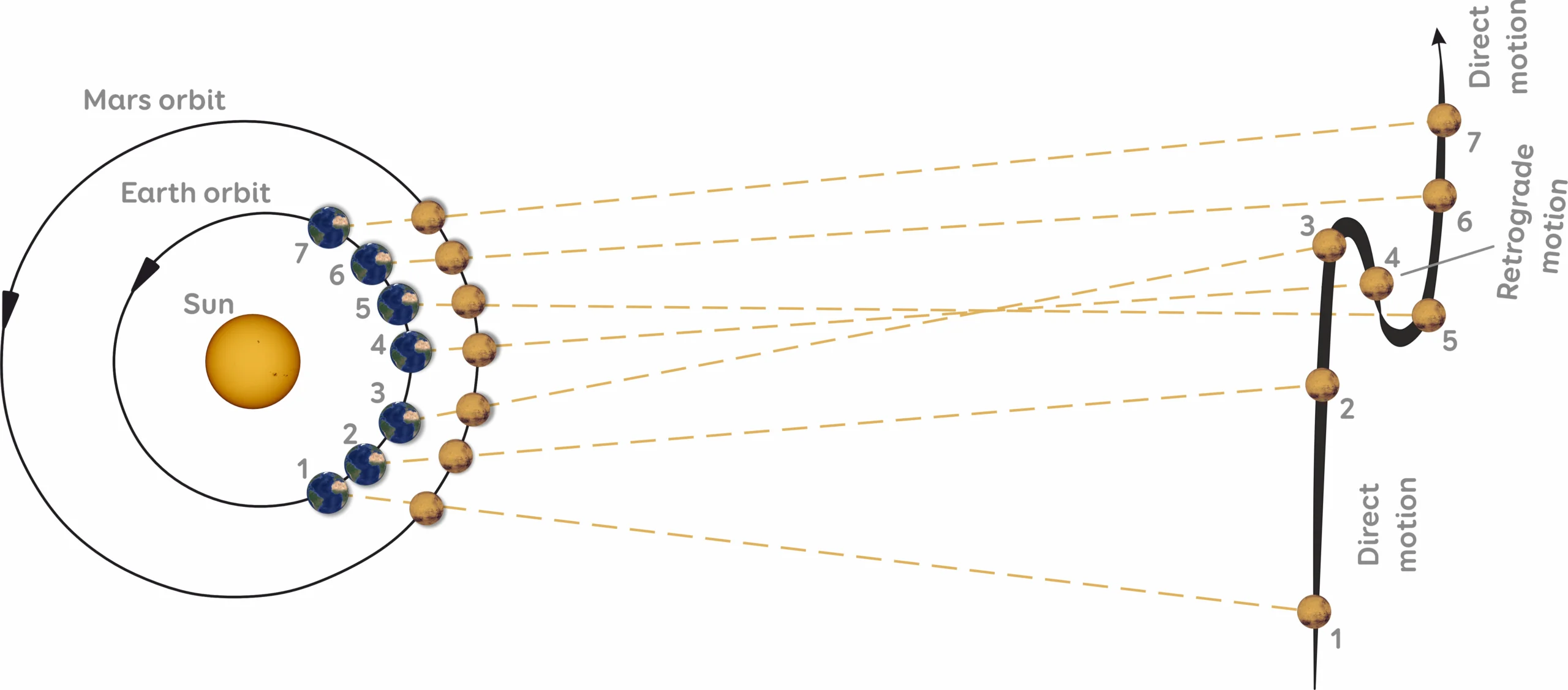
Fig. 2. The simultaneous positions of Earth and Mars in their orbit around the Sun are shown at successive times. The apparent position of Mars as seen from Earth is the point where the line passing through both planets intersects the stellar background (Modified after Ezell & Ezell, 1984; Earth and Mars images from Google Earth; Sun image from Eliza Teodorescu, distributed via imaggeo.egu.eu).
The Babylonians described and named the planets based on their movement, their appearance (brightness, colour) or the time of their appearance, and associated each of them with several gods. Over time, one main god came to predominate for each planet (Kasak and Veede, 2001) (Fig. 3):
Mercury was called Šiḫṭu, meaning “jump”, most likely due to its fast movement and its quick appearance and disappearance near the Sun. It was associated mainly with Nabû, the god of wisdom and writing.
Venus was called Dilbat, whose meaning is still unknown, and was likely associated with Ištar, the goddess of love and war. Although it was considered a single object, it had two different names for its morning and evening appearances: one was considered the female “Morning Star” and the other the male “Evening Star”. Both were seen as two aspects of the same goddess, reflecting her double nature of love and war. In this respect, the Babylonians were ahead of the early Greeks, who came after them, who likely believed these were two distinct stars: Hesperos (“the evening one”), the evening star, and Eosphoros (“bringer of dawn”), the morning star, both mentioned by Homer in his Illiad (22.317-318 and 23.226-227, respectively).
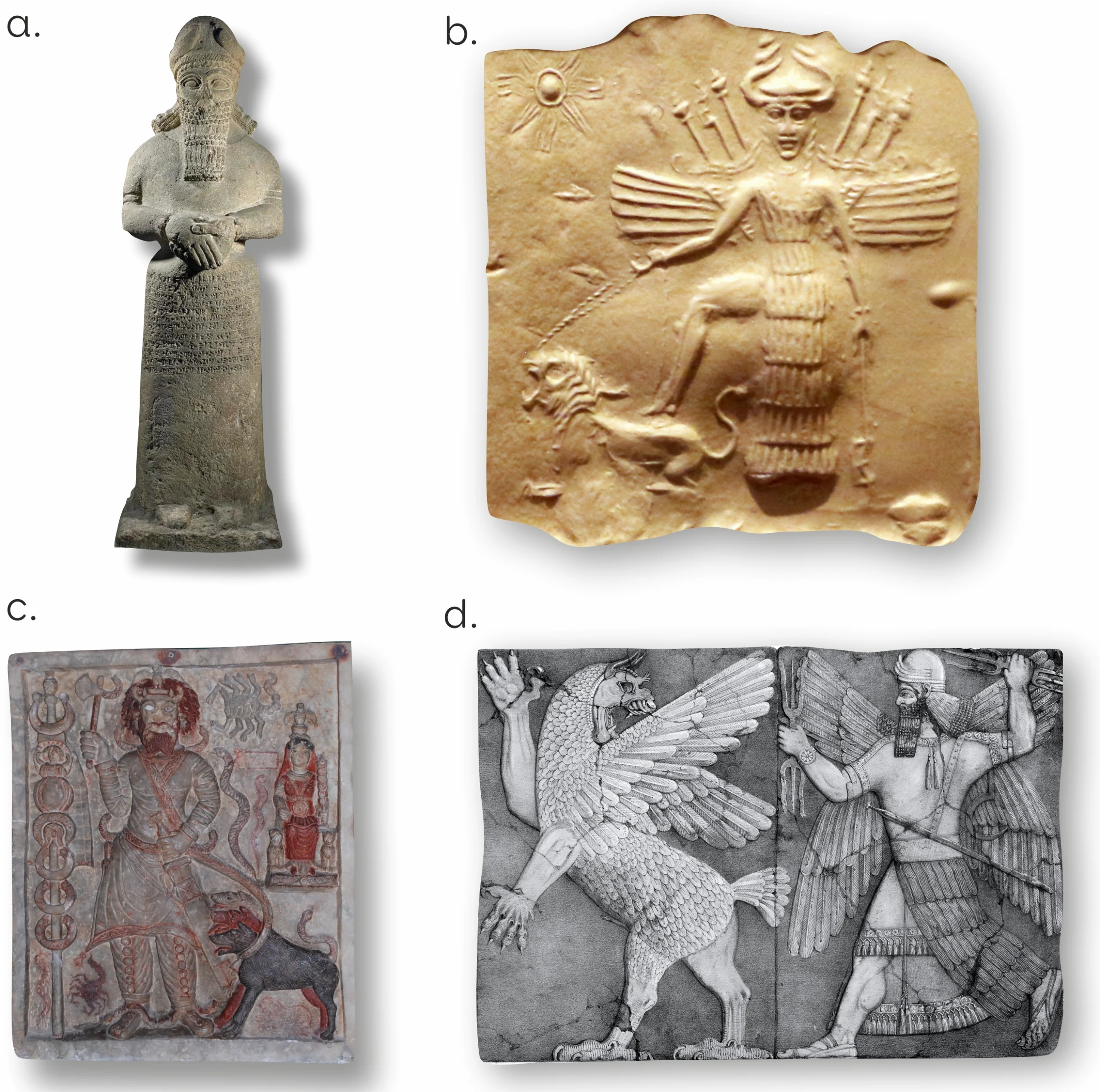
Fig. 3. (a) Limestone statue of attendant god dedicated to Nabu, The British Museum. (b) Partial impression of cylinder seal A 27903 from the Akkadian period (ca. 2350–2150 BCE) depicting Ištar with her foot on the back of a lion and accompanied by her emblem (Saiko, Wikimedia Common). (c) Hatra, Relief of the god Nergal, Qasr Libya, Museum (photo by Diane Siebrandt). (d) Mesopotamian god Ninurta (with thunderbolts) battles the gryphon-like Anzu; often associated with battle of Marduk vs Tiamat – story from Enūma Eliš (Public Domain).
Mars was called Ṣalbatānu, whose meaning is also unknown. Based on its Sumerian syllables, it has been interpreted as “the one who keeps the plague lasting”, which is in agreement with its association with Nergal, the god of plague, famine, war and the Underworld. Mars was also named differently based on its appearance and behaviour, such as “red star”, “bright lord”, “unpredictable star”, “hostile star”, and “foreign star”. These reflect its brightness, its red colour, and its irregular motion through the year. Above all, they reflected its connection with evil and bad omens, a characteristic the Greeks kept by linking it with Ares, the god of war.
Jupiter had no single clear name. It was named differently depending on its changing position in the sky. In later texts, however, it is usually associated with MUL.BABBAR, possibly meaning “White Star”. It became associated with Marduk, the city god of Babylon, who rose to become the chief god and was identified with Enlil, the god of air and earth.
Saturn was called Kayyamānu, meaning “normal, regular, steady”, depending on its slow movement. Saturn was also called “small, tiny” because of its dimness, and “Sun of the night” because its movement is as steady as the Sun’s. It was associated with Ninurta, the god of war and hunting.
Beyond their apparent motion, the planets displayed visual characteristics that helped ancient astronomers to distinguish them. Their colour and brightness are influenced by their physical characteristics like atmospheric composition, surface mineralogy and reflectivity. For example, Mars owes its characteristic reddish appearance to iron oxides on its surface, whereas Venus appears exceptionally bright in the night sky due to its thick sulphuric acid clouds reflecting a large part of the incoming sunlight. Jupiter and Saturn display pale yellowish and creamy white hues due to the composition of upper atmospheric clouds and hazes (Fig. 4). Uranus and Neptune are invisible to the unaided eye and their orbital velocity is so low that they would appear like fix stars: Uranus takes ca. 84 Earth years to complete one orbit, whereas Neptune takes ca. 164.79 Earth years. These differences demonstrate how the descriptions of planets were often rooted in careful observations of their physical appearances. Uranus and Neptune are barely visible
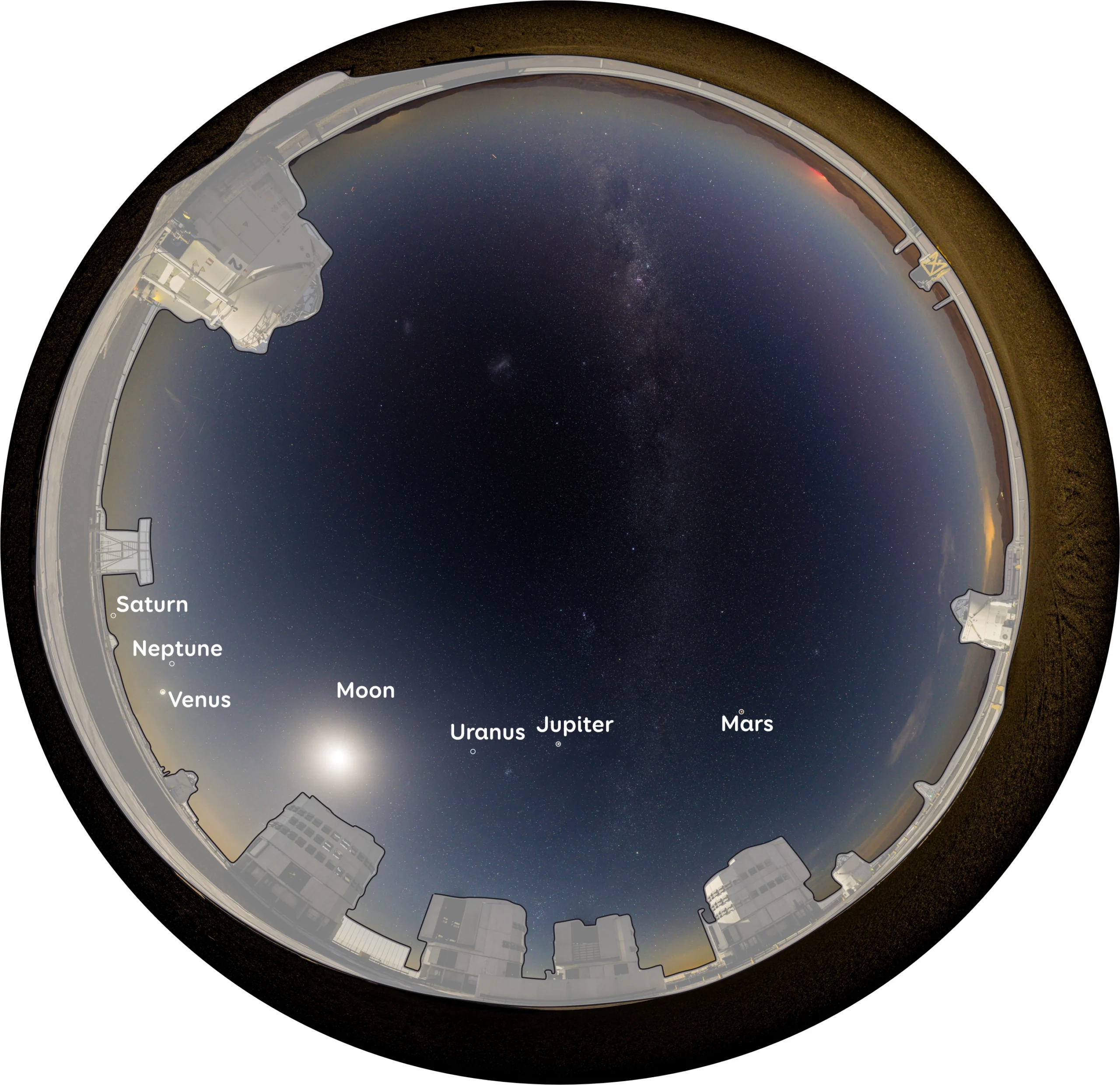
Fig. 4. Six planets lined up across the night sky on January 30, 2025 (modified after B.Haeussler/ESO).
The Babylonian planet names were in turn influenced by Sumerian isolate language, mainly through writing: many names were written with Sumerian signs but read in Akkadian. However, no Sumerian astronomical texts survive, so we do not know how the Sumerians themselves named the planets (Kasak and Veede, 2001).
Five out of Eight: what about the rest?
Although no ancient cultures seems to have observed the two more distant planets, their names were still associated with deities, following a tradition dating back to the Babylonians. Uranus was discovered by pure chance, whereas Neptune by pure mathematics.
Uranus was discovered by William Herschel in 1781, while surveying the night sky with his self-made telescope. The planet is barely visible to the naked eyes and moves so slowly that to ancient observers it would have looked like just an other star. Herschel initially wanted to name it “Georgium Sidus” in honour of King George III. However, the name was broadly unpopular, and following extensive long discussions, the German astronomer Johann Elert Bode proposed Uranus. After all, Uranus is the Greek god of the sky, father of Kronos (Saturn), who was in turn father of Zeus (Jupiter). The name was officially adopted around 1850, and Uranus remains the only planet named after a Greek god rather than a Roman god.
Neptune was discovered in 1846 thanks to the efforts of Urbain Le Verrier in France and John Couch Adams in England. By the early 1800s, astronomers observed that Uranus was not following its predicted orbit, and one possible explanation was that an other planet was pulling on it. Since communication was much slower then, the discovery of Neptune gave rise to a series of controversies over who deserved the credits and how the planet should be named. After a further extensive discussion, the name Neptune, after the Roman god of the sea, was finally accepted.
Uranus and Neptune are among the most controversial cases of planet naming, but they were not the firsts and they would not be the last…
References
Ezell, E.C., Ezell, L.N., 1984. On Mars. Exploration of the Red Planet 1958–1978, NASA SP-4212, NASA, Washington, DC.
Hannah, R., 2020. The Moon and the Planets in Classical Greece and Rome. The Oxford Research Encyclopedia, Planetary Science. Oxford University Press USA, 2020.
Iliad. Perseus Digital Library, Gregory T. Crane, Tufts University. Consulted on 08.11.2026.
Kasak, E., Veede, R., 2001. Understanding Planets in Ancient Mesopotamia. Folklore 16.
Ossendrijver, M., 2020. The Moon and Planets in Ancient Mesopotamia. The Oxford Research Encyclopedia, Planetary Science. Oxford University Press USA, 2020.
Plato, The Republic. In G.R.F. Ferrari (ed.), Translated by Griffith T. University of California, Berkeley. Cambridge University Press.
Shindell, M., 2023. Planets: A History of Observing Worlds and Changing Worldviews. In E. Aronova et al. (eds.), Handbook of the Historiography of the Earth and Environmental Sciences, Historiographies of Science.
Timaeus. Perseus Digital Library, Gregory T. Crane, Tufts University. Consulted on 08.11.2026.