ST
Solar-Terrestrial Sciences

Science Posts

How do we study the magnetosphere?

How do we study the magnetosphere?

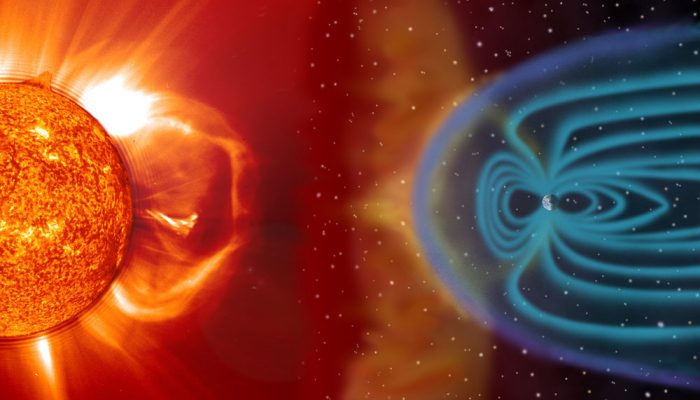
Our closest star, the Sun, is constantly emitting hot gas in all directions as its upper atmosphere, the corona, expands. This is known as the Solar Wind, also carrying with it an embedded magnetic field, the Interplanetary Magnetic Field (IMF).  The IMF originates  at the Sun and forms an enormous spiral throughout the solar system as the solar wind escapes radially, while the magnetic field-line ...[Read More]

Eyes on the Sun

Eyes on the Sun

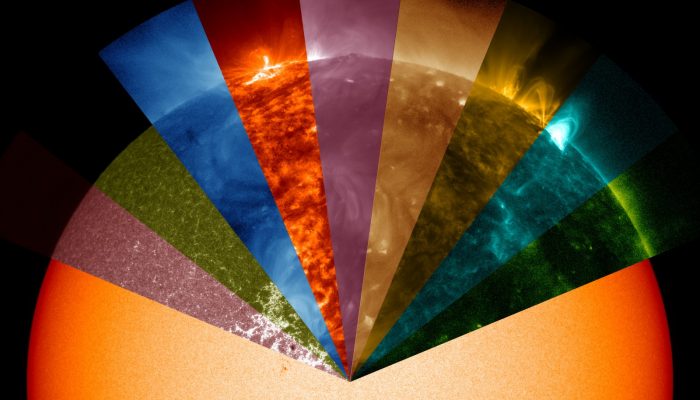
The Sun is a complex, dynamic ball of plasma which influences our lives. Studying the Sun is challenging because each of its layers have different composition, physics and wavelengths of emssion. Moving outwards from the photosphere (visible surface of the Sun), we have the chromosphere and the corona (hottest outermost layer). The solar plasma is in constant motion much like fiercely boiling wate ...[Read More]

Capturing a Whole Total Eclipse of the Sun: Megamovie

Capturing a Whole Total Eclipse of the Sun: Megamovie

by Hugh S Hudson (U. of Glasgow and UC Berkeley) Normally solar eclipses give an observer only a fleeting moment (minutes at most) to enjoy the solar corona. We aim to amplify that considerably in the August 21 eclipse across North America. The plan is simple: Megamovie will capture everybody’s images, especially those from a group of 1,000 photographc volunteers, and compile them into an op ...[Read More]