Introduction
The solar wind, a continuous outflow of charged particles from the solar corona, plays a fundamental role in shaping the heliosphere and driving space weather. Its interaction with planetary magnetospheres and atmospheres regulates magnetospheric dynamics, influences atmospheric escape, and governs space weather hazards that can affect both space- and ground-based technologies. Despite over six decades of study, many aspects of the solar wind remain poorly understood, particularly the processes responsible for its acceleration in the near-Sun region between 1.5 and 10 solar radii (R⊙).
Direct in-situ measurements from spacecraft such as NASA’s Parker Solar Probe (PSP) and ESA’s Solar Orbiter have advanced our knowledge by sampling closer to the Sun than ever before, but their closest perihelia remain outside ∼10R⊙. On the other hand, coronagraph observations are limited in probing the dense inner corona, leaving a critical observational gap. Understanding the velocity, density, and turbulence properties of the solar wind in this intermediate region is essential for constraining solar wind acceleration models, improving space weather predictions, and providing boundary conditions for heliospheric models.
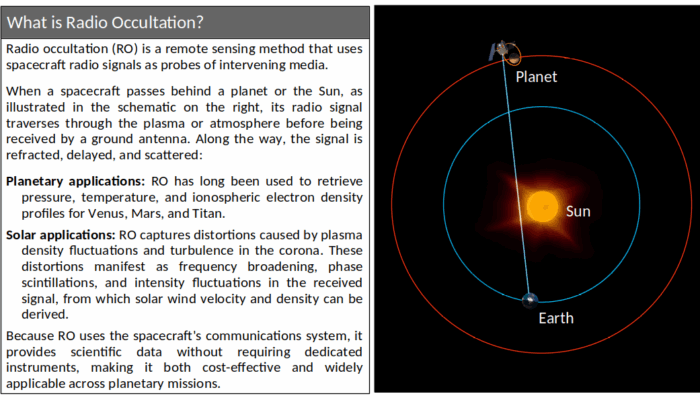
In this context, the research team has utilized radio occultation (RO) experiments as a cost-effective and powerful diagnostic of the near-Sun solar wind [Aggarwal, et al., 2025a, Aggarwal et al., 2025b]. RO leverages existing spacecraft radio links, requiring no dedicated hardware, and provides unique line-of-sight measurements of plasma properties in the solar corona during solar conjunctions.
First study: Mars Orbiter Mission (MOM)
The Indian Mars Orbiter Mission (MOM), launched in 2013, successfully entered Martian orbit after a 300-day cruise and far exceeded its planned six-month mission, operating for over eight years until September 2022 [Arunan, S., & Satish, R. 2015]. During the October 2021 solar conjunction, MOM conducted radio occultation experiments while in an elliptical Martian orbit. Telemetry, tracking, and command signals were transmitted via its 2.2 m high-gain parabolic offset antenna, which used oscillators with an Allan variance of ∼10-11. The downlinked S-band (2.29 GHz) signals were captured by the 32 m antenna of the Indian Deep Space Network (IDSN) in Bangalore using open-loop radio science receivers, following procedures similar to those described by the Deep Space Network Open-Loop Radio Science document. S-band signals propagate through Earth’s atmosphere with minimal attenuation, making them well-suited for solar occultation studies.
As the signals passed through the solar corona, they acquired characteristic plasma-induced signatures, enabling measurements of near-Sun conditions at heliocentric distances of 5-8 R⊙. By analyzing the spectral broadening of the received signals, the team estimated solar wind velocities and electron densities. Spectral broadening arises from scattering of radio waves by turbulent electron density irregularities in the corona. Broader Doppler spectra indicate stronger turbulence and higher solar wind speeds along the line of sight.
The analysis revealed solar wind speeds of approximately 100-150 km/s at these distances, with electron densities of order 1010 m-3. These results confirmed that the solar wind in this region remains in its acceleration zone, below the ∼400-800 km/s speeds commonly observed at 1 AU.
This study demonstrated that MOM, though not designed for solar physics, can contribute valuable heliophysics data, highlighting RO as a method to repurpose planetary spacecraft signals to probe the solar wind.
Advancing the method with Akatsuki
Building on MOM results, the team applied the technique to the Japanese Akatsuki Venus Climate Orbiter (VCO), which transmits at X-band (8.41 GHz) and has been performing solar occultation studies since orbital insertion. The higher frequency enables improved sensitivity to smaller-scale plasma density fluctuations, and Akatsuki’s orbital geometry allowed RO experiments at heliocentric distances as small as 1.4 R⊙.
Data from the 2016 and 2022 solar conjunctions were analyzed. The spacecraft communicated via a 1.6 m high-gain radial line slot antenna, with oscillators exhibiting Allan variance of ∼10-12 [Imamura et al., 2011]. X-band signals were received at the 64 m Usuda Deep Space Center and the IDSN in Byalalu , recorded in CCSDS-RDEF format, and processed using standard pipelines including carrier extraction, Fourier transformation, and Doppler power spectral density fitting [Aggarwal et al., 2025b].
The RO analysis identified both slow and fast solar wind regimes:
• Slow wind: 30-150 km/s, associated with closed magnetic field regions and streamers.
• Fast wind: 150-350 km/s, associated with coronal holes and open field lines.
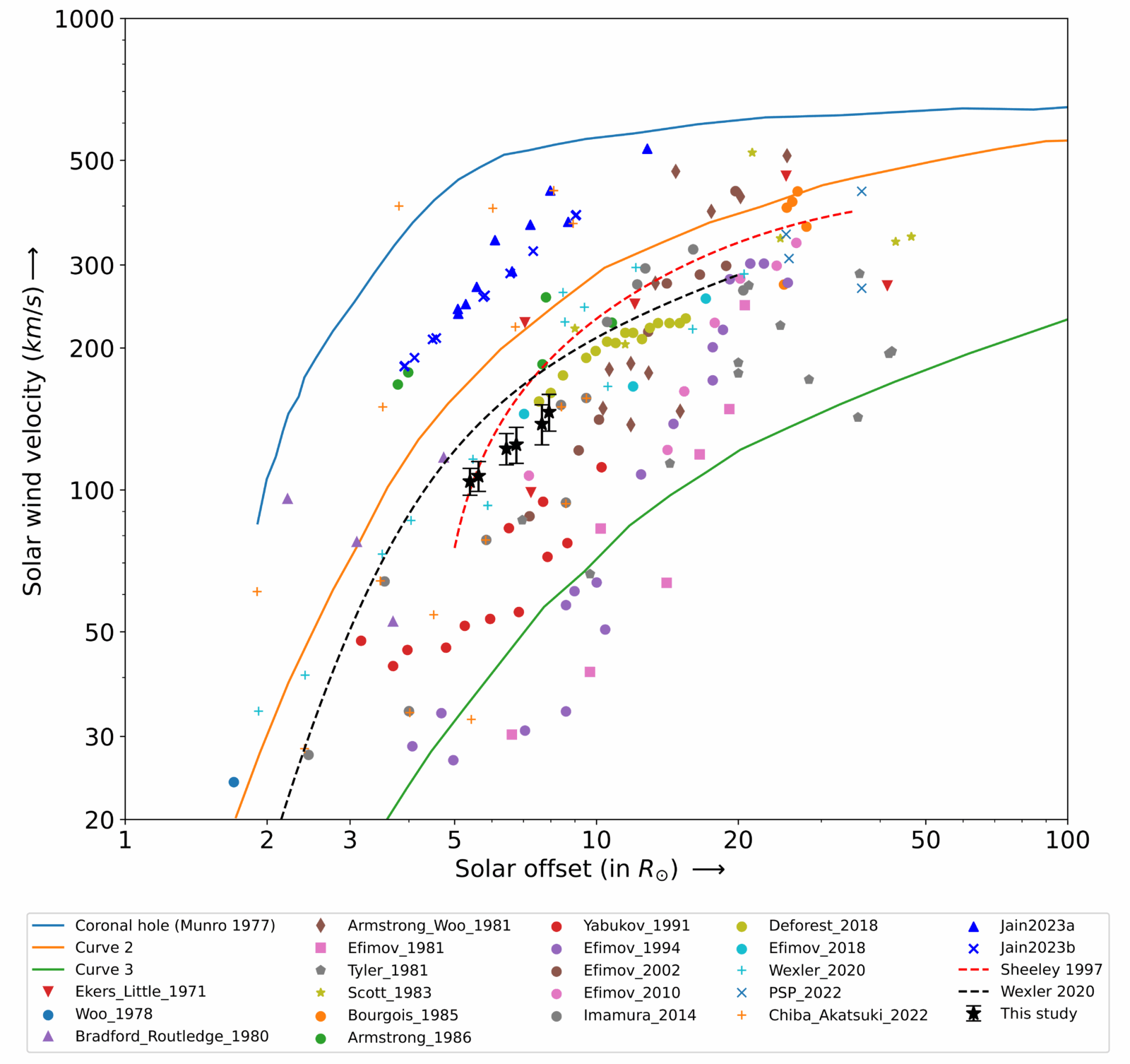
Solar wind velocity derived from MOM S-band signals at 5-8 R⊙. The gradual increase in velocity reflects the acceleration of the solar wind within the near-Sun region. Adapted from Aggarwal et al., 2025a, Aggarwal et al., 2025b
These observations, conducted during varying solar activity levels, revealed dynamic behavior in the near-Sun solar wind, including signatures linked to equatorial coronal holes and transient events like the “smiley-Sun” of October 2022.
The study confirmed that RO is robust across different spacecraft and frequencies, and that planetary missions can provide long-term monitoring of the inner heliosphere.
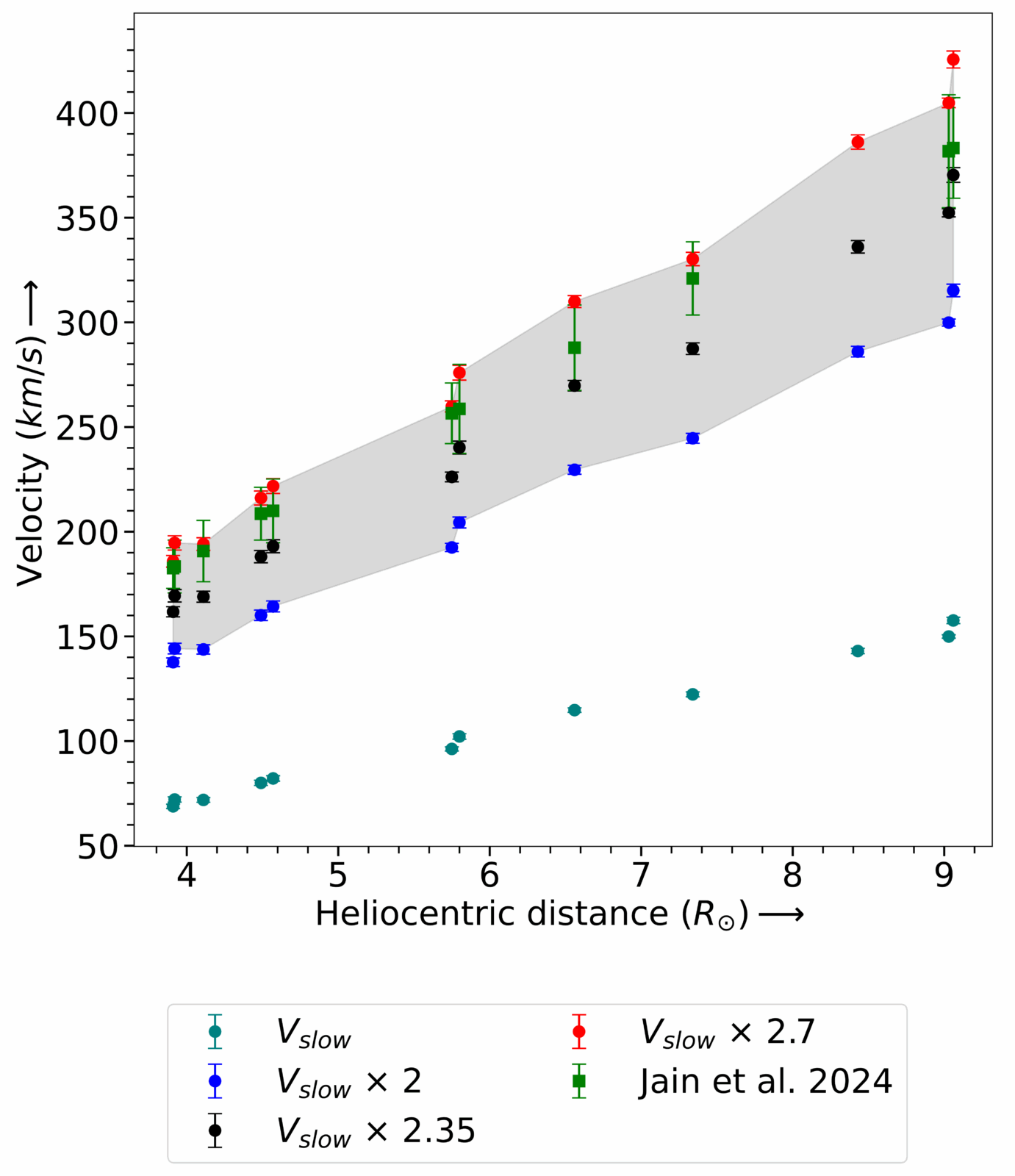
Figure 2: Solar wind velocities measured from Akatsuki X-band occultations at 1.4-10 R⊙. Both slow and fast wind flows are influenced by coronal hole structures. Adapted from Aggarwal et al., 2025b
Scientific significance
The MOM and Akatsuki results highlight several key implications:
• Bridging the observational gap: RO provides measurements in the critical 1.4-10 R⊙ region where solar wind acceleration occurs.
• Complementing in-situ probes: RO extends measurements closer to the Sun than current spacecraft like PSP, without requiring extreme shielding.
• Space weather relevance: Understanding solar wind acceleration and variability improves predictive models.
• Planetary and exoplanetary applications: Solar wind variability affects unmagnetized planets and offers insights for exoplanetary atmospheric escape and star-planet interactions.
• Cost-effectiveness: Any spacecraft with a stable carrier signal can serve as a probe during solar conjunctions, enabling opportunistic science.
Future prospects
The success of MOM and Akatsuki RO experiments demonstrates the potential of this approach for future missions. As more spacecraft are launched to Mars, Venus, the Moon, and the outer planets, each equipped with radio systems, opportunities for systematic RO measurements will expand. The research team envisions building a more comprehensive method to study other properties of the Solar wind, such as the magnetic field; for example, and developing a multi-mission database of solar occultation experiments, spanning a longer period, to track how solar wind acceleration varies with solar activity. This would provide invaluable complementary results to dedicated missions such as PSP, Solar Orbiter, and India’s Aditya-L1, launched in 2023. In addition, combining RO results with white-light coronagraphs, EUV imagers, and in-situ plasma instruments will enable a multi-diagnostic approach to constrain solar wind acceleration mechanisms.
Conclusion
Radio occultation is a powerful and underutilized tool for heliophysics. By analyzing spacecraft radio signals during solar conjunctions, researchers can derive solar wind velocities and densities in the 1.4-10 R⊙ region.
Studies with MOM and Akatsuki establish a methodology for such measurements, providing new observational constraints on solar wind acceleration and variability. This work demonstrates the potential of opportunistic heliophysics using planetary missions and paves the way for future integrated studies of the Sun, heliosphere, and planetary environments.

Keshav Aggarwal is a PhD student in the Department of Astronomy, Astrophysics, and Space Engineering (DAASE) at the Indian Institute of Technology Indore, India. His research focuses on planetary and space sciences, particularly spacecraft radio occultation and its applications to solar wind studies. Keshav is also investigating the interaction between solar wind and planetary atmospheres using radio occultation techniques. He has worked with data from various space missions, including the Indian Mars Orbiter Mission (MOM), Japan’s Akatsuki spacecraft, and India’s Chandrayaan 2 & 3 missions, to explore planetary atmospheres and space plasma environments. He is also interested in the study of planetary and exoplanetary systems, aiming to understand the physical and chemical processes that form planetary atmospheres and to investigate potential applications for modeling.