Hello all you Seismologists, eager to get together at EGU26! We are now getting very close to the next EGU General Assembly, and of course we are looking forward to reconnecting with all of you at EGU26. In this blog post, we would like to summarise many of the events that are organised by the Seismology Division and ECS Representatives of the Seismology Division during EGU26. Grab your calendar, ...[Read More]
Social media for Early Career Scientists: is it really useful?
In this period of confinement, most of the virtual interactions and news about the world come from the web and mainly social media. Today, we suggest looking at social media from the point of view of an early career scientist (ECS) and why we should (or should not) use them in our career path. In the next weeks, most of the international conferences will move on online virtual meetings and ...[Read More]
Seismology in the time of COVID-19
The COVID-19 pandemic has brought us somewhere new. With many of us confined to our homes, the Seismology ECS representatives launch a new blog series, where they put together articles, reflections, and stories to accompany the community through this unprecedented historic period. Read the articles here: ◆ Creating Value for Safety: from earthquake preparedness to pandemic outbreak response ◆ ...[Read More]
Creating Value for Safety: from earthquake preparedness to pandemic outbreak response
Disasters happen world-wide, almost every day. If you are an earthquake seismologist (or engineer), chances are good that seismic hazard is in your daily diet. Developing an earthquake scenario, estimating the seismic hazard, assessing the risk, regulating the land use: we usually conduct these tasks to limit the socio-economic impact of a seismic event. However, when planning and coordinat ...[Read More]
Ten years after the 2010 Maule earthquake: how science and ancestral knowledge build-up resilient societies
At 3:34 a.m. (local time) on February 27, 2010, a magnitude Mw 8.8 earthquake occurred in Central Chile and extended over around 500 km along the Maule and Bio Bio regions, a convergent zone between the Nazca and South America plates (Figure 1a). The occurrence of this large earthquake in the context of active subduction zones, as Central Chile, was expected by many Chilean and European res ...[Read More]
Ambient seismic noise and the quest for groundwater
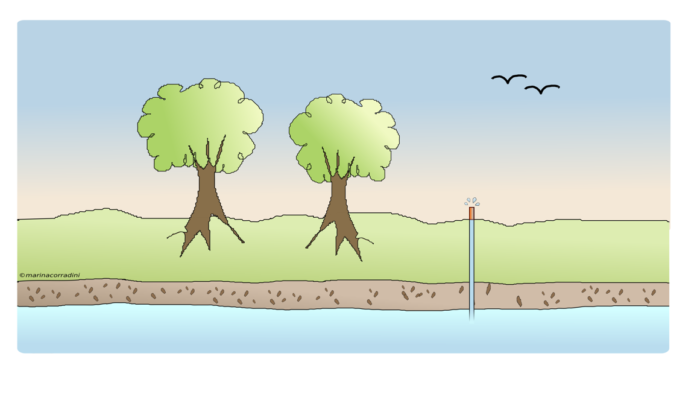
Groundwater is water stored within permeable geological formations, and nearly a third of Earth’s freshwater supply comes from this source (a). In Africa, the overwhelming majority of distributable freshwater is contained in groundwater, and in the EU, 75% of the population relies on groundwater (b). This dependence on groundwater is steadily rising. As humanity as a whole, figures out how ...[Read More]
Imaging volcanic perturbations induced by large earthquakes
In a study recently published in Nature Communications [1], an international team led by researchers from the Institut de physique du globe de Paris (IPGP) has sought to better understand how the 2011 Tohoku-Oki mega-earthquake in Japan disrupted volcanic regions, by monitoring the seismic anisotropy in these regions before and after the earthquake. What is seismic anisotropy? A seismic wav ...[Read More]
Hackathon: when ideas happen
You live in a developing country and wish for access to safe drinking water [1]. Or, you are at the supermarket and want to jump the endless line at the checkout [2]. Maybe you are a business woman and want to confidently represent yourself as the professional you are [3]. Whether it be inspired by the best of intentions or simply the laziness of a shopper, an idea worth developing always h ...[Read More]
Hackathon in Zurich – ETH Team
A colleague, external partners and I organized a hackathon on permafrost which took place from 28/11/2019 to 01/12/2019. We tried not to follow the traditional competition-like hackathon approach, but wanted to foster interdisciplinary knowledge exchange and collaboration through working jointly on a predefined dataset. We targeted to bring together computer and environmental scienti ...[Read More]
Hackathon in Vienna – IMGW Team
The whole idea of a Hackathon in Science came to me a couple of years ago, when I first read the AgileScientific blog written by Matt Hall. I figured that such an event is perhaps the most optimal way to generate and develop ideas in rapid time. Then, after I participated in the Ready2Order Hackathon in Vienna, my colleagues and I decided that the time has come and we need to make it happen ...[Read More]