
17th April marks the 125 anniversary of the first ever recorded seismogram from a distant earthquake. The widely recognised first teleseismic seismogram was recorded on April 17, 1889, in Potsdam, Germany by E. von Rebeur-Pacshwitz (Nature, 1889). The earthquake was in Japan and had a magnitude of about 5.8. Ironically the instrument was originally installed for astronomical purposes. The instrume ...[Read More]
Molding seismic surface waves
Following each major earthquake that occurs close to nearby cities many people wonder what scientist and engineers can do to minimise the seismic hazard on society. Whilst scientist try to understand the mechanism of each fault system on the globe, engineers try to find solutions for buildings to be more safe. One interesting experiment I came across lately is published in last month’s Physi ...[Read More]
Earthquake shakes Twitter users and geeks do some science (oh, and celebrities said they felt it too)
The ever increasing use of mobile phones constantly connected to the internet is bring on a new era in scientific research called crowdsourcing. On Wikipedia crowdsourcing is the defined as the practice of obtaining needed services, ideas, or content by soliciting contributions from a large group of people, and especially from an online community. In recent years social media is being used as a re ...[Read More]
Job opportunity with EGU
The EGU is seeking to appoint a Communications Officer to work with the EGU Media and Communications Manager in maintaining and further developing media- and science-related communications between the EGU and its membership, the working media, and the public at large. The Communications Officer will also work under the direction of the EGU Executive Secretary on activities related to the promotion ...[Read More]
Have you been drinking Guinness for St Patrick’s?
Yesterday was St Patrick’s day, celebrated world wide, probably with a pint of Guinness. Perhaps while sipping down a pint you may have wondered why do bubbles in Guinness sink? Here is one-of-a kind paper that discusses just this! They concluded that the flow in a glass of stout depends on the shape of the glass. If it narrows downwards (as the traditional stout glass, the pint, does), the ...[Read More]
Join Google Earth Engine at EGU 2014
This year, in addition to having an exhibit booth at European Geosciences Union General Assembly (EGU GA), Google Inc will be hosting a side event on Google technologies for working with geophysical data. A special workshop themed Google Geo for Research and Higher Education Workshop, will be held in Vienna during the week of the annual EGU GA. This free workshop is intended for scientists, resear ...[Read More]
A bibliography of seismic events
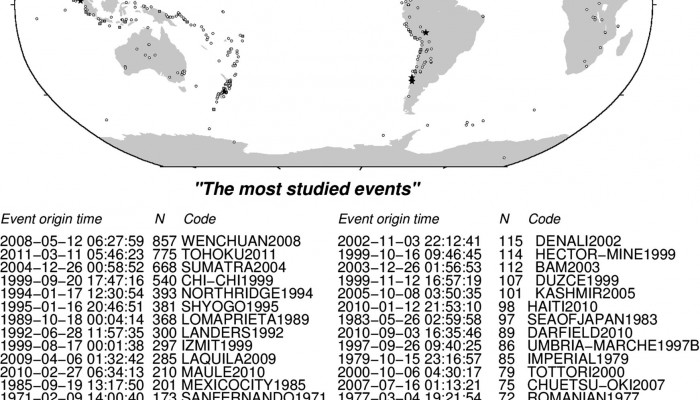
Search for previous scientific work is never an easy task. Thanks to the internet and good search engines such as Google Scholar this process has been made a bit more easier. (It makes young scientists wonder how searching was done in the pre-internet days!). Although searching nowadays seems to be a simple tasks, it still requires putting in the correct combination of search terms. Furthermore yo ...[Read More]
Earthquake lights (2)
The phenomena of earthquake lights, mysterious lights in the sky during seismic activity, is still not clearly understood (check out the previous post about Earthquake Lights). Now, new research reveals interesting discoveries that might give a better scientific explanation about the phenomena. A presented research at the Bulletin of the American Physical Society, APS March Meeting in Denver, Colo ...[Read More]
Sailors wake up call
A magnitude 6.6 earthquake shook the island of Okinawa Japan during the early hours of the morning on March 3rd this week. Sailors from Naval Mobile Construction Battalion were preparing to attend their morning physical training session when the tremor rocked Camp Shields. Read the full story here.
A primer and user’s guide of the Seismic Analysis Code
The Seismic Analysis Code (SAC) is one of the most widely used analysis packages for regional and teleseismic seismic data. For the first time, this book provides users at introductory and advanced levels with a complete guide to SAC. It leads new users of SAC through the steps of learning basic commands, describes the SAC processing philosophy, and presents its macro language in full, supported t ...[Read More]