GMPV
Geochemistry, Mineralogy, Petrology & Volcanology

Uncategorized

#EGU2020 Sessions in the Spotlight: Geochronology in hot and dynamic systems: approaches and tools to unravel the past
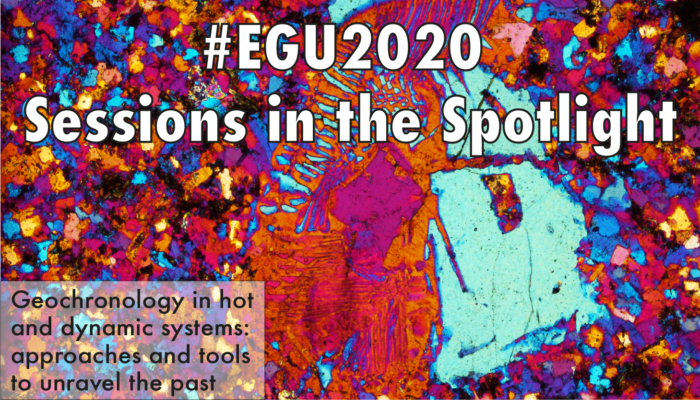
#EGU2020 Sessions in the Spotlight: Geochronology in hot and dynamic systems: approaches and tools to unravel the past
The EGU 2020 abstract submissions are now open for the next two months! Every few days, we will highlight a geochemistry, mineralogy, petrology and/or volcanology session right here – great news if you are paralysed by indecision or overwhelmed by the number of sessions. Today it’s the turn of GMPV1.7, “Geochronology in hot and dynamic systems: approaches and tools to unravel the ...[Read More]

#mineralmonday: tiptopite

#mineralmonday: tiptopite

#mineralmonday: your weekly* dose of obscure mineralogy, every Monday** [*not guaranteed; **or possibly Tuesday-Sunday] What is it? Tiptopite: K2Na1.5Ca0.5Li3Be6(PO4)6(OH)2•(H2O) What’s it made of?  Take a deep breath and recite after me: potassium, sodium, calcium, lithium, beryllium, phosphorus, oxygen and water (H2O). Is it pretty? Yes, it’s a beautiful fibrous mineral. You wouldn&# ...[Read More]

#mineralmonday : sengierite

#mineralmonday : sengierite

#mineralmonday: your weekly* dose of obscure mineralogy, every Monday** [*not guaranteed; **or possibly Tuesday-Sunday] What is it? Sengierite: Cu2(UO2)2V2O8.6(H2O) What’s it made of? A few useful metals – copper (Cu), vanadium (V), uranium (U), plus oxygen (O) and water (H2O). So by ‘useful’ you mean ‘radioactive’? Pretty much. The main reason people have been ...[Read More]

#mineralmonday : lithiophilite

#mineralmonday : lithiophilite

What is it? Lithiophilite, LiMnPO4 What’s it made of? Lithium (Li), manganese (Mn), phosphorus (P) and oxygen (O). The PO4 at the end of the formula makes this a phosphate mineral (phosphorus + oxygen = phosphate). What’s it’s structure? The way the different atoms are arranged in lithiophilite is described as orthorhombic, which means the crystal is built of lots of tiny cuboid- ...[Read More]

#mineralmonday: lazurite

#mineralmonday: lazurite

#mineralmonday: your weekly* dose of obscure mineralogy, every Monday** [*not guaranteed; **or possibly Tuesday-Sunday] What is it? Lazurite. Take a deep breath, the formula is Na3CaAl3Si3O12S.   That’s a lot of elements to digest, what does it mean? Well, the aluminium (Al) and silicon (Si) form tetrahedra (4-faced 3D triangular shapes), with oxygen (O) on the points. These are arrange ...[Read More]

Seven reasons why YOU should propose an EGU 2020 session

Seven reasons why YOU should propose an EGU 2020 session

Did you ever notice that the majority of convenors of the EGU conference sessions seem to be older than you? Have you ever despaired that none of the conference sessions are directly relevant to your work? Does your CV look conspicuously blank in the ‘Service’ section? Have you ever tried to sneak one of your friends into the EGU Friday night party only to be discovered, have your conf ...[Read More]

#mineralmonday : emmonsite

#mineralmonday : emmonsite

#mineralmonday: your weekly* dose of obscure mineralogy, every Monday** [*not guaranteed; **or possibly Tuesday-Sunday] What is it? emmonsite, Fe2Te3O9.2H2O What’s it made of? Iron (Fe), tellurium (Te), oxygen (O) and water (H2O) I think I remember tellurium from chemistry class – remind me what it is? We can more or less divide the elements into the metals and the non-metals – t ...[Read More]

#mineralmonday : gadolinite-(Y)

#mineralmonday : gadolinite-(Y)

#mineralmonday: your weekly* dose of obscure mineralogy, every Monday** [*not guaranteed; **or possibly Tuesday-Sunday] What is it? Gadolinite-(Y),Y2FeBe2Si2O10 What’s it made of?: It’s a silicate (a mineral containing silicon (Si) and oxygen (O)) also containing yttrium (Y), beryllium (Be) and iron (Fe). Yttrium is a rare earth element – somewhat of a misnomer as in general they ...[Read More]

How does a crystal become a mineral?

How does a crystal become a mineral?

There are some crystals that we are all familiar with. Look at an analogue clock (you may need a screwdriver and/or a hammer, and the watch owner might not be too happy) and you will probably find quartz – a crystal with silicon and oxygen arranged in a well-ordered three dimensional pattern. We can also describe quartz as silicon dioxide, which describes its chemistry – one silicon for every two ...[Read More]

Unseen but not unfelt: resilience to persistent volcanic emissions

Unseen but not unfelt: resilience to persistent volcanic emissions

The last decade has been inundated with reports of environmental disasters impacting the lives of billions of people around the world.  While news coverage of floods, hurricanes, earthquakes or wild fires are always accompanied with spectacular images of destruction that emphasise the speed at which they strike, a myriad of slow and latent hazards have been left in the shadow of the public attenti ...[Read More]