By Marine Poizat, PostDoc at the Geological Survey of Finland. Email: marine.poizat@gtk.fi, website: https://www.gtk.fi/en/experts/poizat-marine/.
Antarctica has dunes. And they are made of snow.
When people think of deserts, they usually picture vast expanses of sand beneath a blazing sun. Yet Antarctica is also a desert, receiving remarkably little precipitation, especially inland. And like other deserts, Antarctica has dunes… except here, they are made of snow!
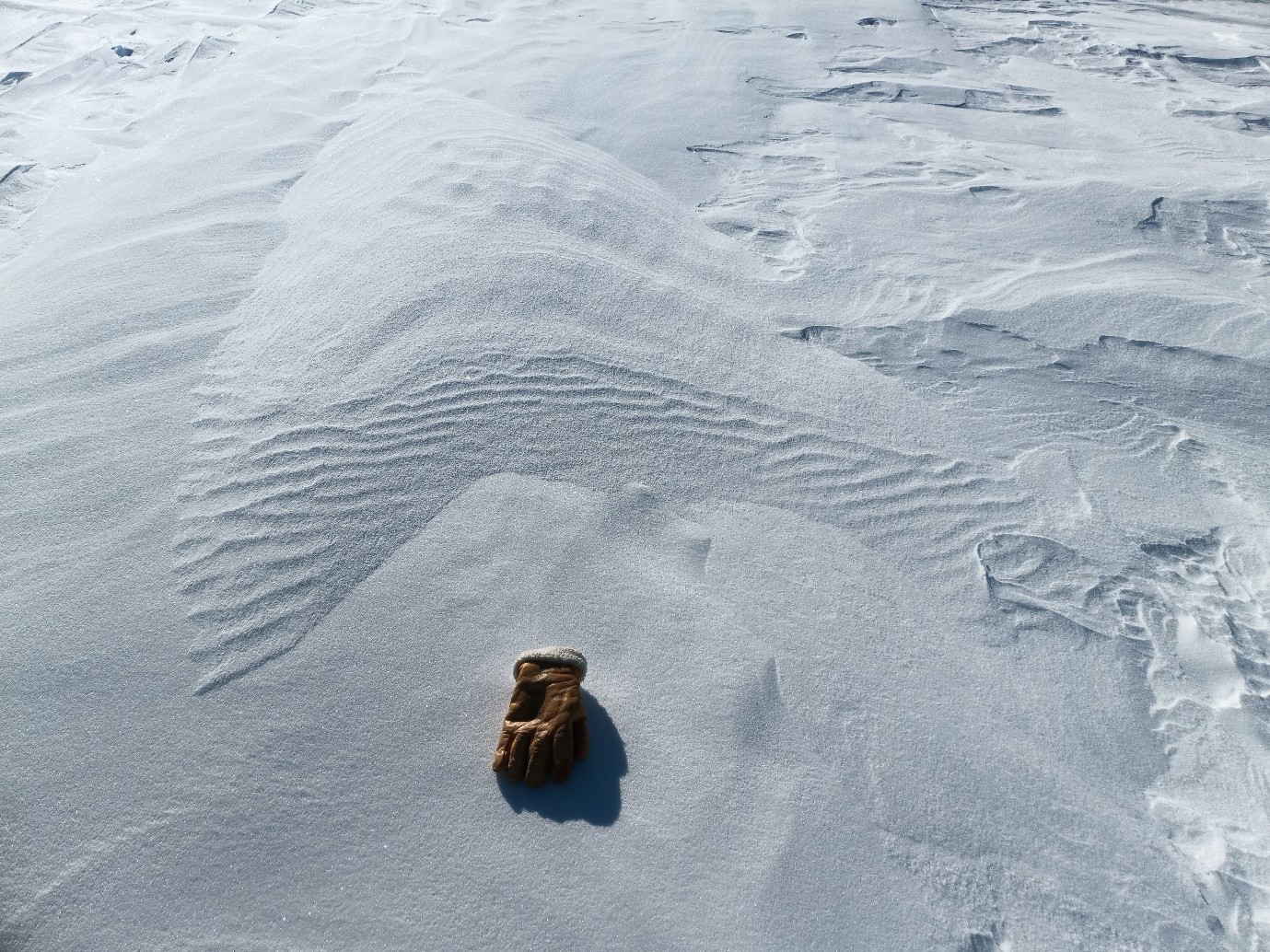
Although Antarctica is often imagined as a flat, featureless white landscape, a closer look reveals a surface shaped by wind into a remarkable diversity of bedforms. There are sastrugi (erosional bedforms), ripples, and even barchan dunes: the familiar crescent-shaped dunes found in sandy deserts around the world.
During our travels across Antarctica, we were repeatedly struck by how abundant these snow barchans can be. Their shape is immediately recognizable, yet their behaviour is very different from that of their sandy counterparts.
Credits: Marine Poizat.
Tiny dunes, surprisingly fast
Snow barchans are much smaller than typical sand dunes, which can reach tens of metres in height. Many snow barchans are only a few centimetres tall. At first glance, such tiny dunes might seem insignificant. But their small size is precisely what makes them fascinating. Because they contain so little material, snow barchans can respond rapidly to changes in wind conditions. Processes that take years to observe in large sand dunes can unfold over hours in the snow. This makes snow barchans a unique natural laboratory for studying how wind transports sediment and shapes landscapes.
Their small size is also deceptive. In some parts of Antarctica, individual snow barchans can exceed the amount of snow that accumulates locally over an entire year. They are therefore not simply tiny curiosities: they can represent an important component of the redistribution of snow across the Antarctic surface.
A surprisingly difficult landscape to observe
Despite their abundance, snow barchans are surprisingly difficult to study. They are generally too small to be detected reliably by satellite observations, while their rapid evolution makes repeated field measurements challenging. Photogrammetry can provide detailed measurements of snow surfaces, but blowing and saltating snow can reduce image contrast and make accurate surface reconstruction difficult.
So how can we watch these dunes evolve?
We turned to one of Antarctica’s few permanent research stations, where we installed a camera overlooking the snow surface. The camera cannot directly measure changes in elevation. Instead, it provides something valuable: a continuous visual record of the snow surface and its changing patterns. Over six austral summers, we monitored the landscape and documented 51 barchan events [3].
Dunes that move in hours
What did we see?
Snow barchans formed, migrated, changed shape, and sometimes completely reoriented themselves. Remarkably, these transformations could occur on timescales of hours rather than years.
The observations reveal a landscape that is far more dynamic than its apparently frozen surroundings suggest. The behaviour of these dunes is controlled not only by wind speed and direction, but also by the distinctive properties of snow, including its cohesion and the poorly understood process of snow sintering. Although snow barchans are highly dynamic, once the wind stops, sintering can effectively freeze them in place, preserving the shape they had at that moment.
Snow is not simply a lighter version of sand. Snow grains can bond together, change shape, and respond to temperature and environmental conditions. As a result, the relationship between wind and snow transport is much more complicated than the classic picture of sand being blown across a desert.
Snow barchans allow us to observe some of these processes in action.

Credits: Marine Poizat.
A natural laboratory for snow transport
By following individual barchan events, we can begin to investigate how snow is mobilised by the wind, how it is deposited, and how newly deposited snow changes over time. These processes matter beyond the dunes themselves.
Wind-driven redistribution of snow is an important component of Antarctic surface processes, yet many aspects of snow transport and sintering remain poorly understood. Understanding how small snow bedforms form and evolve can therefore help us understand how larger-scale snow surfaces develop.
And there may be an even broader lesson. Barchan dunes occur on many planetary surfaces, including Mars. Studying how dunes respond to their environment here on Earth gives us an opportunity to explore the fundamental processes that govern wind-shaped landscapes, even when the transported material is snow rather than sand.
What happens in winter?
Our six years of observations also revealed a major limitation. We can only see what happens when we can see.
For several months each year, the Antarctic winter plunges the landscape into darkness, making visual monitoring impossible. The camera goes blind during this hidden season, leaving a significant gap in our observations.
This raises an intriguing possibility: are snow barchans even more dynamic than we have observed?
The 51 events we documented may represent only a fraction of the activity taking place throughout the year. How frequently do snow barchans form? How do they evolve during the Antarctic winter? How important are they for redistributing snow across the surface?
We do not yet have all the answers.
But these tiny crescent-shaped dunes have given us an unexpected window into the dynamics of the Antarctic snow surface, revealing that what appears to be a frozen, static landscape can actually be changing before our eyes. Sometimes, you just need to look closely enough to see the dunes moving.
References:
[1] Poizat, M., Picard, G., Arnaud, L., Narteau, C., Amory, C., & Brun, F. (2024). Widespread longitudinal snow dunes in Antarctica shaped by sintering. Nature geoscience, 17(9), 889-895.
[2] Traversa, G., Fugazza, D., & Frezzotti, M. (2023). Megadunes in Antarctica: migration and characterization from remote and in situ observations. The Cryosphere, 17(1), 427-444.
[3] Poizat, M., Alkalla, J., Picard, G., Arnaud, L., Nowacki, D. J., Filhol, S., … & Narteau, C. (2026). Morphodynamics of snow barchans at Concordia Station, Antarctica. Geomorphica, 2(2).