
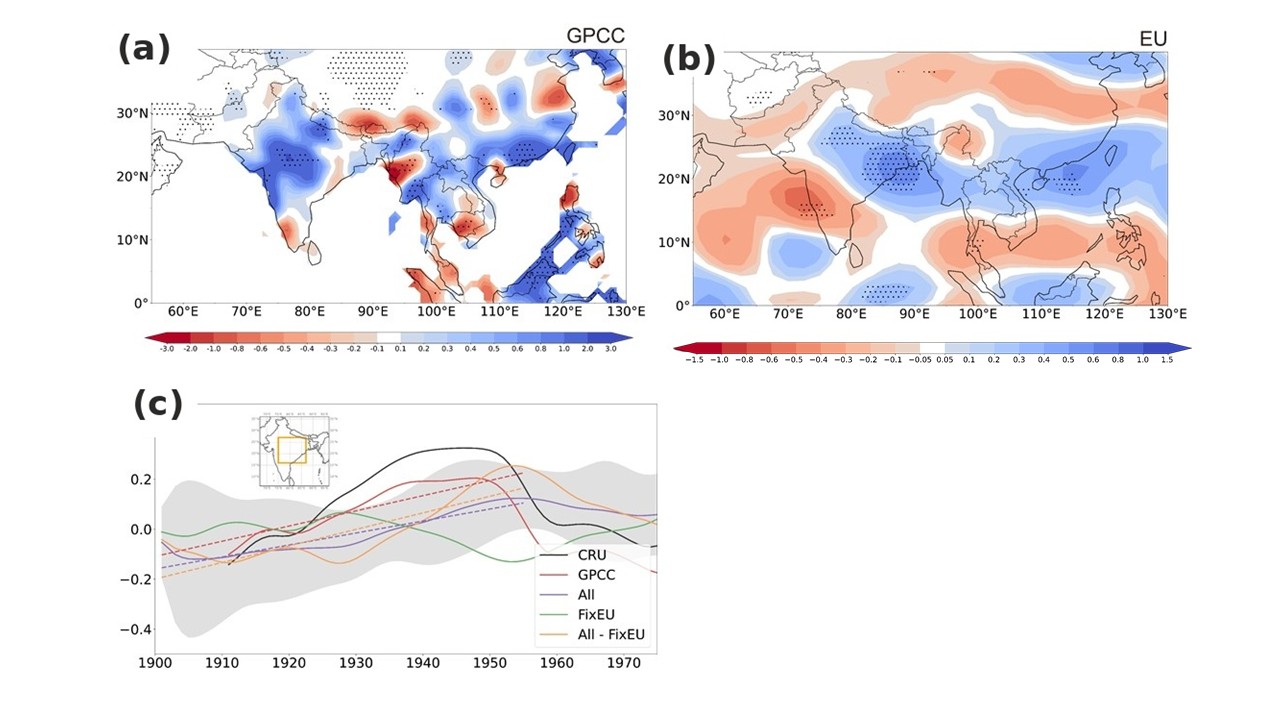
Figure 1. JJA precipitation changes across Asia in mm d-1 (55 yr)-1 for 1901-1955. Map (a) displays observed rainfall patterns, while (b) isolates the specific influence of European aerosols on these trends. (c) tracks rainfall anomalies in central-northern India from 1901 to 2000, comparing real-world observations (black/red) against climate model simulations (colors). Data is smoothed over 11-year periods to highlight long-term fluctuations, with dashed lines showing the overall trajectory and grey shading representing model uncertainty. This early-century intensification of the monsoon has received far less attention than the late-twentieth-century weakening. Yet understanding it is crucial. If we want to predict how the monsoon will respond to future pollution reductions and greenhouse gas emissions, we must understand how it responded in the past.
The Asian summer monsoon is one of the most powerful climate phenomena on Earth. Each year, it brings life-giving rainfall to billions of people across South and East Asia. Its arrival determines harvests, water supply, food security, and economic stability.
We often think of the monsoon as something driven locally: by the heating of the Indian subcontinent, by ocean temperatures, or by regional pollution. But what if part of its history was shaped thousands of kilometres away?
In our recent study (published in Atmospheric Chemistry and Physics, ACP), we show that air pollution from Europe helped shaping the Asian summer monsoon in the early twentieth century.
An overlooked shift in Asian rainfall
Rain gauge records reveal a striking pattern in the first half of the twentieth century. From about 1900 to the mid-1950s rainfall increased over central and northern India concurrent with a southward shift over China, creating wetter conditions in the south and drier conditions along the Yangtze River valley (Figure 1). These changes later reversed in the second half of the century.
This early-century intensification of the monsoon has received far less attention than the late-twentieth-century weakening. Yet understanding it is crucial. If we want to predict how the monsoon will respond to future pollution reductions and greenhouse gas emissions, we must understand how it responded in the past.
At the start of the twentieth century, industrial emissions in Asia were still relatively small. In contrast, Europe had already undergone decades of industrialisation. Coal burning released large amounts of sulphur dioxide, which forms sulphate particles in the atmosphere. These tiny particles reflect sunlight and brighten clouds, cooling the surface below.
Could European pollution have influenced rainfall in Asia?
Testing the idea with a climate model
To answer this question, we used a state-of-the-art global climate model. We ran two sets of historical simulations covering 1850 to 2005: a simulation including all known historical influences, such as greenhouse gases and aerosols, and an identical simulation, except that European sulphur emissions were fixed at pre-industrial levels.
By comparing the two, we could isolate the effect of European sulphate pollution. The result was striking.
When European sulphate emissions were allowed to increase, the model produced more rainfall over central and northern India, and a southward shift in rainfall over East Asia. These patterns closely resemble what is seen in historical observations (Figure 1). A clear pattern of large-scale circulation changes linking Europe to Asia was also evident.
In other words, European pollution was not just a regional phenomenon. It helped shape the behaviour of the Asian summer monsoon.
How can pollution in Europe affect rainfall in India and China?
The key lies in atmospheric circulation.
Sulphate particles over Europe reduced incoming sunlight and cooled the surface. The atmosphere responded by forming a region of higher pressure over central and eastern Europe. This surface change extended upward into the upper troposphere.
That upper-level disturbance did not stay local. It triggered a large-scale wave pattern in the atmosphere known as a Rossby wave. These waves are planetary-scale meanders that can transmit disturbances across continents.
In our simulations, the wave pattern propagated eastward from Europe across the Middle East into South Asia, and onward to East Asia and the Pacific.
As the wave travelled, it altered wind patterns at low levels over Asia. These wind changes redirected moisture transport. Moist air was steered toward central and northern India, increasing rainfall, while circulation shifts over East Asia reorganised rainfall bands, producing the observed north-south contrasts.
The monsoon changes were therefore not simply a matter of temperature differences between land and ocean. Instead, they were driven by a dynamical pathway linking European cooling, atmospheric wave response, altered Asian circulation, and redistributed rainfall (Figure 2).
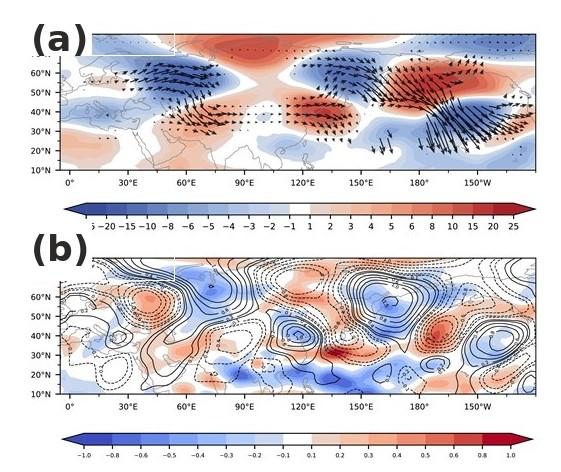
Figure 2. Spatial patterns of the 1901–1955 linear trends of the JJA average (a) 300 hPa wave activity flux (vectors; 10−4 m2 s−2(55 yr)−1) and streamfunction (shades; 105 m2 s−1 (55 yr)−1), and (b) 300 hPa meridional wind (contours; m s−1 (55 yr)−1) and 500 hPa vertical velocity (shades; 10−2 Pa s−1 (55 yr)−1) associated with increased European sulphate aerosols.
Why this matters today?
Sulphur emissions in Europe have declined sharply since the late twentieth century due to air quality regulations. At the same time, emissions in parts of Asia rose and are now also decreasing in many regions.
Our findings highlight an important lesson: air pollution does not respect national boundaries. Its climate effects can be remote and unexpected.
If European sulphate pollution once strengthened the South Asian monsoon, then its reduction may contribute to weakening it — potentially offsetting or interacting with the effects of Asian pollution changes and greenhouse gases.
Future monsoon behaviour will depend on a complex mix of greenhouse gas warming, regional aerosol reductions, remote aerosol changes, and internal climate variability.
Understanding these interacting influences requires looking beyond local forcing and considering the global atmospheric connections that tie continents together.
Looking back to see forward
The early twentieth century provides a natural experiment. Asian emissions were still modest, while European emissions were already substantial. This separation helps us identify cause and effect more clearly than in recent decades, when emissions have been widespread.
By revisiting this overlooked period, we gain insight into how regional pollution can trigger large-scale atmospheric adjustments. These dynamical pathways may also operate in the future as emission patterns continue to evolve.
The Asian summer monsoon supports more than half of the world’s population. Understanding its sensitivity to both local and remote human activities is therefore not only a scientific challenge, but a societal priority.
The story of European sulphate pollution and the Asian monsoon reminds us that Earth’s climate system is deeply interconnected. Actions in one region can reverberate across the planet — sometimes in ways we are only now beginning to understand.
Takeaway message
-
- Air pollution in Europe influenced Asian rainfall patterns in the early twentieth century.
- The connection occurred through large-scale atmospheric waves linking Europe and Asia.
- This highlights how regional emissions can have global climate impacts.
This post has been edited by the editorial board.
References

Sun, W., Bollasina, M. A., Colfescu, I., Wu, G., and Liu, Y.: European sulphate aerosols were a key driver of the early twentieth-century intensification of the Asian summer monsoon, Atmos. Chem. Phys., 26, 2027–2039, https://doi.org/10.5194/acp-26-2027-2026, 2026.