

Nitrous oxide (N2O), commonly known as laughing gas, is one of the most important greenhouse gases, and its rise in the Anthropocene significantly contributes to global warming and depletion of stratospheric ozone. The marine environment, especially coastal and marginal seas, is an important (about 25%) contributor to the global atmospheric source of N2O.
Nitrous oxide is primarily produced in marine systems by special microbes – the nitrifiers and the denitrifiers. In oxygenated waters, the nitrifiers produce N2O as a byproduct while trying to ammonia to nitrite. The denitrifiers produce N2O in low-oxygen environments as intermediate while reducing nitrate or nitrite. When the oxygen is completely used up, nitrous oxide is consumed by the denitriifers. When the deep waters are brought up to the surface by a process called upwelling, the N2O then escapes to the atmosphere. Surface waters can also produce N2O driven by sunlight although this is less understood than the microbial processes. The increase in N2O emissions is heavily influenced by human activities, for e.g., agricultural runoff and sewage.
While measuring the concentrations and air-sea fluxes are important to quantify N2O emissions, it is also crucial to separate and identify different microbial processes that happen at the same time. This helps scientists to track environmental shifts and assess climate impacts (like, if low-oxygen conditions are increasing). Isotopes of nitrous oxide – molecules with the same atoms but different arrangements of heavy isotopes of nitrogen (N) and oxygen (O) (like 15N or 18O) – act as chemical tracers or “fingerprints” to distinguish between N2O created by nitrifications versus denitrification. On account of the linear and asymmetric structure of the N2O molecule (N-N-O), there is a third source of information. Isotopomers of nitrous oxide molecules have the same number of each isotope but differ in their position (e.g. 15N in the center position vs. the end position). The difference between the N isotopic composition of the atoms at the central and terminal positions is known as site preference (SP).
We chose the Baltic Sea as our study site due its unique combination of wide-spread oxygen-deficient conditions and high sensitivity to climate change. As a semi-enclosed, brackish sea, subject to heavy eutrophication, the Baltic waters serve as an excellent natural laboratory to understand the cycling of N2O. There are a number of basins in the Baltic Sea that differ in their extent of oxygen levels and for our study we selected the Eastern Gotland Basin for most of our sample collection and one station in the neighbouring Bornholm basin. This basin located in the central Baltic has a permanently stratified water column with fresher surface waters and saline bottom waters. The bottom waters are devoid of oxygen and often have high levels of hydrogen sulfide (H2S). The latter gas, known for its ‘rotten egg’ smell, is unsuitable for most life forms. A very specialized cohort of organisms , e.g. chemosynthetic bateria, can tolelrate or tolerate these sulfidic environments.
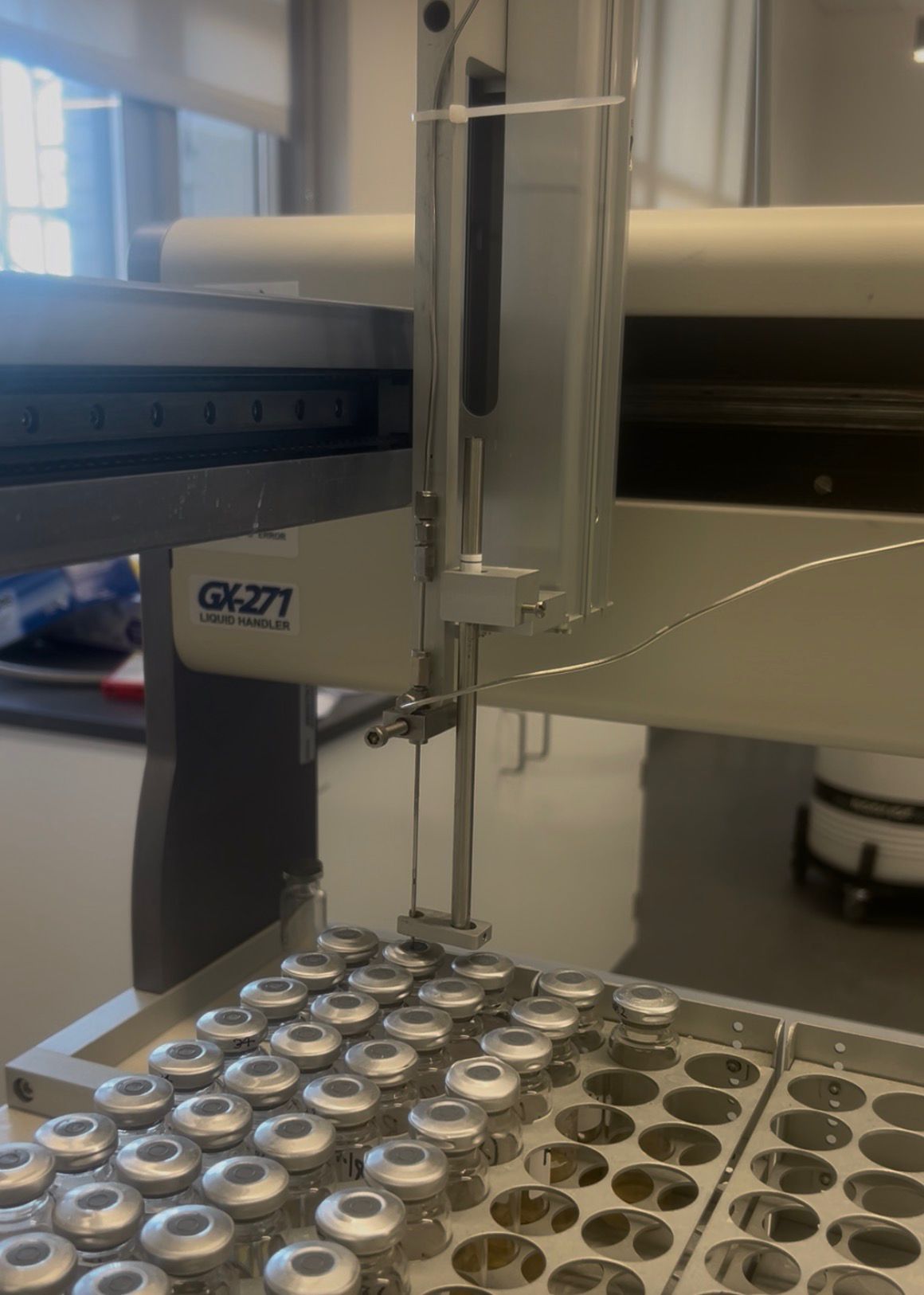
Image courtesy of the author. Used with permission.
The first set of samples were collected in 2019 and although we had plans for multi-year sampling the onset of the global Covid-19 pandemic altered that plan. All samples for dissolved gases were collected following “gastight” protocols, i.e. we ensured no bubbles were introduced during sample collection. Each sample was also treated with mercuric chloride which stops all biologic activity. A modified GC-IRMS (Gas Chromatography-Isotope Ratio Mass Spectrometer) was used to analyse the samples. Briefly, one needle was used to pressurize the sample vial with helium and purge the N2O . The extracted gases were then purified and concentrated before entering the GC-IRMS. The isotopomeric analyses were carried out at the University of Basel, Switzerland.
The surface water N2O concentrations were in equilibrium with the atmosphere. The isotopic composition was very similar to that of the N2O reported in the troposphere. In the zone where the oxygen concentrations start declining (aka the oxycline), we observed N2O was primarily produced via ammonia oxidation between the depths of 50 and 70 metres. As we went further down, the oxygen levels started dropping. Five out of the seven stations had sulfidic bottom waters. In these stations the N2O was nearly completely consumed which indicates to the occurrence of denitrification. In the stations where no sulfide was detected, we observed an accumulation of N2O produced likely by incomplete denitrification. Interestingly, the site preference values of this N2O was quite distinct from those reported for denitrification by bacteria. This led us to consider denitrification by fungi and iron-mediated chemodenitrification. The SP values from our study match these processes and further investigations are needed to rule out one over the other. The relationship between the N and O isotopes also pointed out that multiple processes are occurring at the same time.
Investigation of a system using “invisible” tracers like isotopomers is challenging but provides valuable insight nevertheless. Our results provided some answers but also raised questions and directions for future research. Currently, this dataset can be included in global and regional models to improve our understanding of N2O biogeochemistry.
To dive deeper into the research, you can read the full open-access article here.
This post has been edited by the editorial board.
References

Bardhan, P., Frey, C., Rehder, G., and Bange, H. W.: The distribution and isotopomeric characterization of nitrous oxide in the Eastern Gotland Basin (central Baltic Sea), EGUsphere [preprint], https://doi.org/10.5194/egusphere-2025-2518, 2025.