Tinted detail of a photo: Tops of billowing clouds seen from above at sunset, dark grey masses edged with glowing gold where the sun shines through, under an orange sky.
AS
Atmospheric Sciences
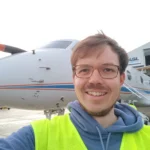
A smiling person wearing glasses, a blue hoodie, and a high-visibility yellow vest. Behind them is a white aircraft with orange and blue stripes, parked on a tarmac near a hangar.

Bastian Kirsch

Bastian Kirsch is a post-doctoral researcher and scientific coordinator of the North Atlantic Waveguide, Dry Intrusion, and Downstream Impact Campaign (NAWDIC) at the Karlsruhe Institute of Technology in Karlsruhe, Germany. In 2022, he has received his PhD from the University of Hamburg, where he studied the spatio-temporal variability of convective cold pools based on dense station observations during the FESSTVaL measurement campaign. In his current position, he is coordinating the international NAWDIC campaign in winter 2025/2026, which explores the multi-scale dynamics of high-impact winter storms in the midlatitudes using combined airborne and ground-based observations. He is also responsible for the dropsonde measurements from the HALO research aircraft during NAWDIC and the subsequent data processing and analysis.

The European University Radiosonde Partnership (EUROP) initiative: Bridging atmospheric research and student training across Europe
An aircraft wing extends into the frame, overlooking a vast expanse of white, fluffy clouds under a pale, hazy sky at sunset.

Radiosonde observations have been for many decades the primary source of upper-air data for numerical weather prediction models.  Several hundreds of balloons, released every day from ground stations and ships, register detailed profiles of the vertical structure of the atmosphere and inform meteorologists and models about air mass stability, temperature, and moisture gradients. The number …[Read More]