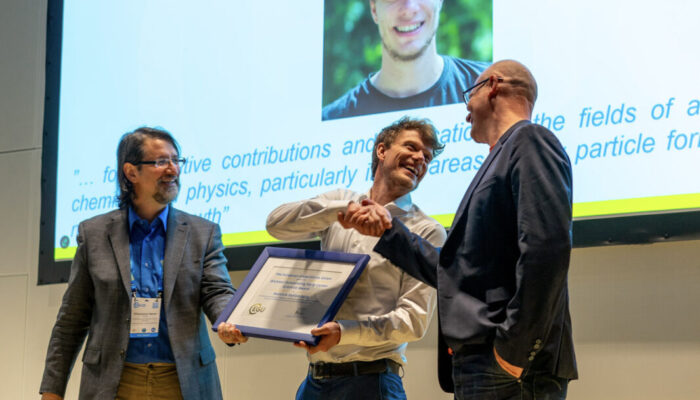
Dr. Dominik Stolzenburg is a chemist in atmospheric physics at TU Wien, specializing in aerosol science and air quality. His work focuses on how ultrafine particles form, transform, and affect both climate systems and human health — especially in cities. Through field measurements, modeling, and data analysis, he explores how human and natural emissions interact, helping policymakers shape cleaner, evidence-based environmental strategies.
Today, we’re speaking with Dr. Stolzenburg about the invisible but powerful role of aerosols in our atmosphere — and how science can help us all breathe a little easier.
From a Small Town to the World of Physics
“I come from southern Germany, from a small town called Rottweil, close to the Swiss border,” he begins. His path into science started long before university — perhaps before he even knew what science was. “It was my dad,” he recalls with a smile. “He was a geography teacher, not a physicist, but he had this infectious curiosity about nature. Once, while hiking, I asked him what physics was. He explained electricity using the electric fence we passed — and I thought, that’s cool!”
That spark stuck. When a teacher later asked his high-school class what they wanted to become, 16-year-old Dominik didn’t have an answer ready. “So out of desperation, I said, ‘I’m going to be a scientist.’ ” And somehow, he laughs, “it actually worked out.”
A surprising detouring at CERN
He studied physics at Heidelberg University, one of Germany’s top programs. “It wasn’t the closest to home, but it was one of the best places for physics,” he says. “I had great teachers.”
At first, Stolzenburg leaned toward particle physics, fascinated by the universe’s smallest building blocks. “I liked the idea of understanding things at the most basic level,” he says, “but I also wanted to do something where, when I tell people about it, they actually understand what I’m doing.”
That balance between the fundamental and the tangible arrived through an unexpected internet search. “I was looking for particle physics PhDs and found the CLOUD experiment at CERN,” he says. “It was the only experiment there not mainly about particle physics.”
CLOUD — short for Cosmics Leaving Outdoor Droplets — studies how cosmic rays influence cloud formation and how aerosols shape the climate. “It connected physics, chemistry, and atmospheric science — and I thought, that’s interesting,” he recalls. “So that’s how I ended up doing my PhD in Vienna.”
What began as a detour became a turning point. “It was my first step from particle physics to aerosol science,” he says. “It showed me that science doesn’t have to mean staying in one narrow lane — it can evolve.”
After earning his PhD at the University of Vienna, Stolzenburg moved to Helsinki, one of the global hubs of aerosol research. “It was a complicated time,” he admits. “My partner was still in Vienna, and we had a small child. The pandemic actually helped a bit — I could work remotely more often — but it was still a balancing act.”
After three years in Finland, he returned to Vienna; first as a postdoc, then with a City of Vienna grant that helped him secure a tenure-track position at TU Wien. “So now I’m an assistant professor,” he says modestly. “It’s been a fairly straightforward path — not too much moving, at least by scientist standards.”
Curiosity, Communication, and Compassion
Ask what makes a good scientist, and Stolzenburg doesn’t talk about equations or instruments. “Many young physicists underestimate how much science is about writing and reading,” he says. “If you don’t like working with text, it’s going to be hard. At some point, you’ll spend more time writing and editing than running experiments.” Equally important, he adds, is empathy: “You need to be good with people — open-minded, communicative, able to read situations. Science isn’t just about being clever; it’s teamwork, mentoring, listening.” These weren’t skills he naturally had, he admits, but he developed them intentionally through workshops on leadership and communication, which he found as crucial as scientific thinking for a lasting career. For early-career researchers, his advice is practical and grounded: look for opportunities when they come, but don’t be too stubborn about your field — sometimes the most interesting paths are the ones you didn’t plan. At the same time, have limits. “I always told myself: if by 35 I don’t see it going somewhere, I’ll re-evaluate. You need an exit strategy — otherwise it can get desperate.” And perhaps most usefully: “Don’t model your career after people 20 years older than you. The system changes. Look at those three to five years ahead — that’s who you can really learn from.”
Tiny Particles, Big Impact
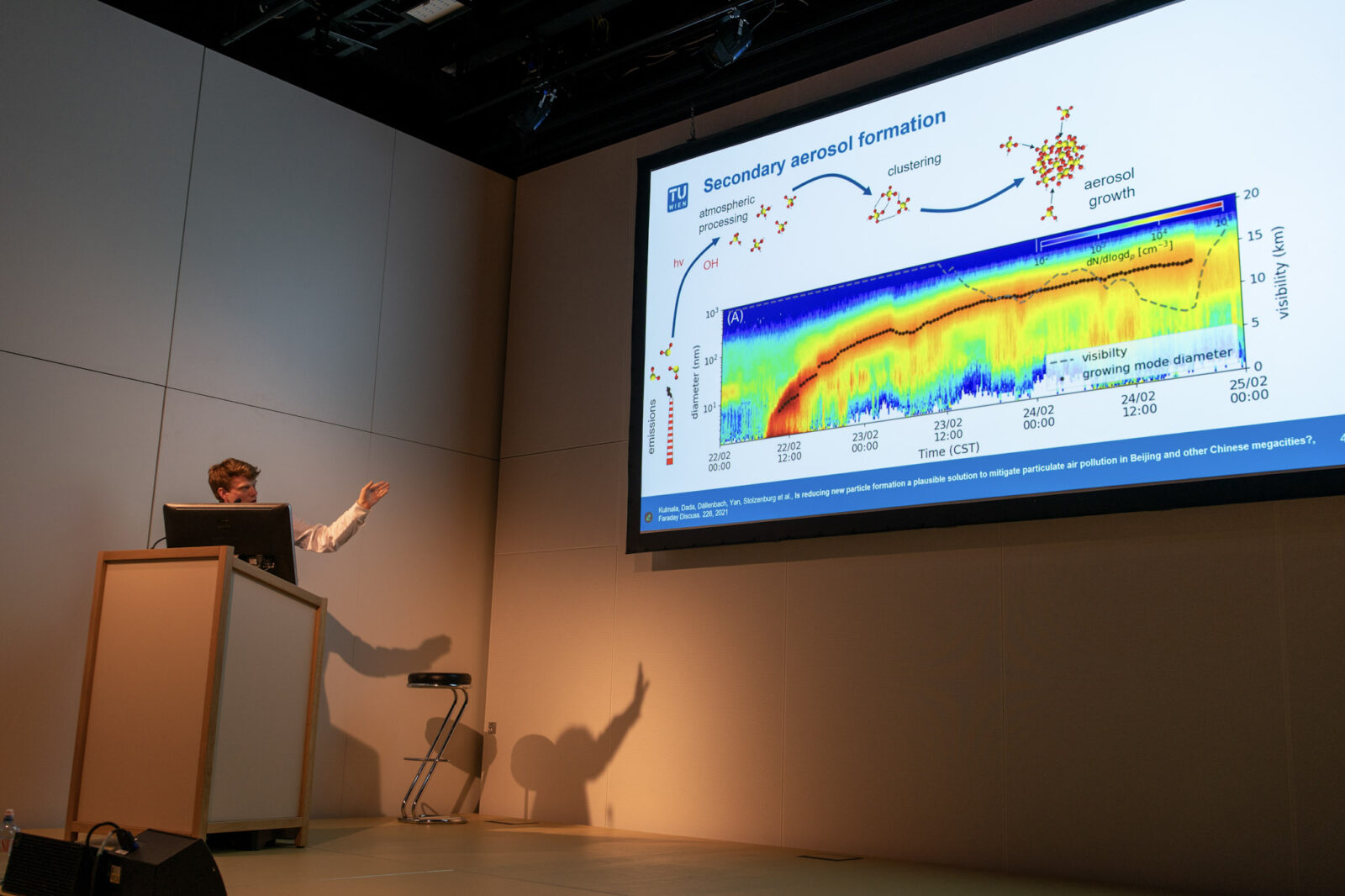
Today, Stolzenburg’s research centers on how ultrafine particles form and change in the atmosphere, especially in cities. “It’s a fascinating intersection between environmental science and physics,” he explains. “New particle formation starts with molecules clustering together — so at one level it’s chemistry and phase transitions; at another, it’s about air quality and climate.”
These particles, smaller than 100nm, play an outsized role in the environment. “They can act as cloud condensation nuclei, influencing how clouds form and how long they last,” he says. “So they affect climate. But they also affect health, and we’re just beginning to understand how.”
In 2024, the EU began requiring countries to monitor ultrafine particles as part of air-quality standards — a recognition of their potential health effects. “For decades, regulations focused on particle mass,” he explains. “But these tiny particles have almost no mass — so they were invisible to regulation. That’s changing now.”
The City of the Future
Much of Stolzenburg’s current work takes place in Vienna’s Seestadt district, a newly built neighborhood designed around sustainability and reduced traffic. “It’s one of the biggest urban development projects in Vienna,” he says. “Fewer cars, more green spaces, modern buildings. It’s a great testbed for studying what the city of the future might look like — and how aerosols behave there.”
His team is setting up semi-permanent measurement stations to track emissions from less obvious sources of modern life. “Even if we reduce car traffic, we still emit a lot — from personal care products, cleaning agents, building materials, glues, paints,” he says. “All these release volatile organic compounds that can affect air quality.”
By measuring these emissions, Stolzenburg hopes to understand how everyday activities — even applying sunscreen — shape the invisible chemistry of urban air. “In low-emission cities, we might find that things we once ignored become significant,” he says. “We want to know: can these compounds actually form new particles, or just stick to existing ones?”
From Concern to Hope
When asked whether his findings make him hopeful or worried, Stolzenburg laughs softly. “Honestly, I’m not very positive about the state of our atmosphere,” he admits. “We’re still putting so many unknown things into the air — microplastics, electronic waste, you name it.”
He recalls a study that shocked him. “Researchers detected molecules from electronic waste in Cyprus — and that waste came from Europe. It was supposed to be recycled, but somewhere down the line it ended up in open landfills. When sunlight hits it, chemicals evaporate and travel across the sea. It’s crazy.”
Still, he finds hope in progress. “Air quality has improved a lot in Europe and China over recent decades,” he notes. “We’ve shown that change is possible. But we need political will. These topics are falling off the priority list — and that worries me more than the science itself.”
A Clearer View from Afar
Despite the challenges, Stolzenburg believes research can make a real difference — not only in understanding pollution, but in holding polluters accountable. “If we get better at measuring and interpreting what’s in the air, we can identify sources even from a distance,” he says. “That’s powerful.”
“If you try to measure pollution right next to a refinery, you might not be allowed — the company might be too influential locally. But if your instruments are sensitive enough, you can study emissions from afar and still know where they came from. That’s something I’d like to contribute to — giving science a voice that’s independent and strong.”
For Stolzenburg, science remains what first drew him in on that childhood hike — a way of asking how the world works, one invisible layer at a time. Whether it’s cosmic rays at CERN or lemon-scented cleaning products shaping city air, he’s guided by curiosity — and a sense of responsibility for what we breathe.
“In the end,” he says, “it’s still about understanding nature. Just now, the particles I study happen to be the ones inside the air we all share.”
Check out Dominik’s award lecture How do the little ones grow? Solving the puzzling occurrence of new particle formation in megacities .