Many people think about air as a fixed mix of gases like nitrogen, oxygen, and carbon dioxide (CO2). But the main reason the composition of air changes—water vapour—tends to get overlooked. Scientists often remove it from atmospheric samples before analysing air composition, and this convenient habit can make us forget something surprising:
water vapour isn’t just “in” the air; it is air, and when it flourishes, it changes everything.
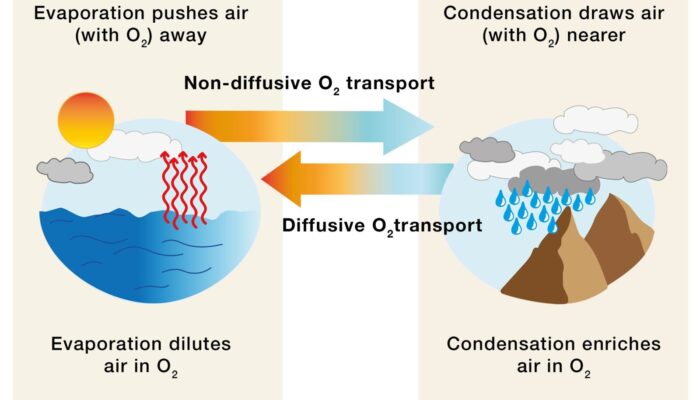
On hot, humid days, and in tropical environments, water vapour can make up a meaningful fraction of the atmosphere. Because all gases must share the same total air pressure, every extra bit of humidity crowds out some nitrogen, oxygen and CO2. These gases’ abundances drop significantly in very moist air, but our usual “dry-air” measurements completely hide this effect.
Water vapour moves in and out of the Earth’s surface massively, far more than any other gas. Oceans, soils and leaves absorb and release it all the time, creating gentle but important airflows that carry every gas along with them. With strong humidification, these flows can become a major force shaping how gases spread through the atmosphere. And the consequences reach right into the “lungs” of plants. The tiny spaces behind stomata—the leaf pores through which plants breathe—act like miniature steam rooms. At very high temperatures, their extreme humidity dilutes the CO2‚ that leaves need for photosynthesis while pushing moisture out.
This helps explain why, during heatwaves, plants often keep losing water even as their ability to take up carbon begins to collapse. Our study shows that simply accounting for water vapour as a true component of air—not something to be ignored or subtracted—helps make sense of these behaviours across climates, ecosystems, and biological scales. Measuring its fraction requires no fancy technology, just a thermometer, hygrometer and barometer.
Sometimes, key insights come from noticing something that was always right in front of us. In this case, it’s the invisible vapour that quietly shapes the air we breathe and the way life responds to heat.
Reference: Kowalski, A. S., Janssens, I. A., and Pérez-Priego, Ó.: Water vapour dynamics as a key determinant of atmospheric composition and transport mechanisms, EGUsphere [preprint], https://doi.org/10.5194/egusphere-2025-2695, 2025.