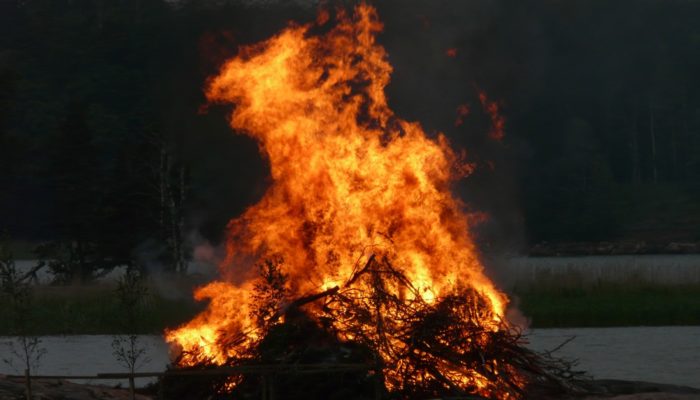
Many people think about air as a fixed mix of gases like nitrogen, oxygen, and carbon dioxide (CO2). But the main reason the composition of air changes—water vapour—tends to get overlooked. Scientists often remove it from atmospheric samples before analysing air composition, and this convenient habit can make us forget something surprising: water vapour isn’t just “in” the air; it is air, and when ...[Read More]
Biogeosciences
Writing for the BG blog
Thank you for your interest in writing for the Biogeoscience Blog! The BG blog is created for and by EGU’s biogeoscience community. Please do not hesitate to reach out with any ideas, feedback or questions. What we publish Broadly speaking anyone can write for the blog and all ideas are welcome. Since the main readership of the blog are EGU members, our focus is on content that is interesting to a ...[Read More]
Hydrological Sciences
Prevent before repair: What a new hydrology-based index reveals about river ecological status
When I first began analysing agricultural pressures in German river networks, I expected the familiar story of nutrient loads, pesticide traces and differences between landscapes. What I did not expect was how narrow the ecological safe operating space has become for many rivers. Even small increases in agricultural pressure, especially from pesticides, reduced the likelihood of achieving good eco ...[Read More]
Geodynamics
Mathematical closed-form solutions in Geodynamics: insightful or detrimental?
Mathematics is certainly not every scientist’s cup of tea. Despite the latter, they are, for the most part, very important, since most problems, regardless of their complexity, start and end with a mathematical equation (or set of equations). In this week’s blog, Dimitrios Papadomarkakis (student at the National Technical University of Athens), discusses the subject of closed-form (analytical) sol ...[Read More]
Hydrological Sciences
Last minute information for EGU26 abstract submission
If you have not yet submitted your abstract for this year’s General Assembly (GA2026), do not forget to submit as early as possible this week (instructions here), this avoids any last minute technical challenges. . You can submit only one abstract (except for invited speakers or if you submit to an EOS-session). For your hydrology-related research, the call-for-abstracts programme proposes t ...[Read More]
Climate: Past, Present & Future
When small-scale turbulence imprints on the global atmospheric circulation: Uncovering the Cause of the Double Intertropical Convergence Zone Bias in ICON
One feature stands out in any map of tropical rainfall from satellites: a narrow band of intense precipitation encircling the globe near the equator. This is the Intertropical Convergence Zone, a key feature of the global atmospheric circulation that imports moisture into the tropics and exports energy to higher latitudes. But for decades, climate models have struggled to simulate this feature cor ...[Read More]
Tectonics and Structural Geology
How Lava Domes Grow: Field Observations and Thermo-Mechanical Insights from the 1979 Soufrière Eruption
To kick off the New Year, we have invited a guest author, Takafumi Maruishi, a researcher in the Research Division for Volcanic Disasters / Center for Volcano Research Promotion, National Research Institute for Earth Science and Disaster Resilience, Japan. He explains the scaling law of lava dome growth and its physical insight. Effusive eruptions—when magma reaches the surface and is extruded as ...[Read More]
Geodynamics
Building the Earth in a sandbox
Building the Earth in a sandbox The Main Ethiopian Rift stretches for hundreds of kilometers through Ethiopia, a massive fracture where Africa is slowly tearing apart to birth a new ocean. However, the processes driving this continental breakup remain hidden deep beneath layers of volcanic rock and millions of years of geological history. Today, in a laboratory in the heart of the be ...[Read More]
Hydrological Sciences
Comparing Apples to Apples: Filtering Water Storage Compartments for GRACE
Have you ever heard that we can “weigh” water on Earth from space? Since 2002, the GRACE and GRACE-FO satellite missions have been mapping month-to-month variations of the Earth’s gravity field. Because gravity responds to mass, these data can reveal how water is redistributed at the surface and in the subsurface. The result is a global time series of terrestrial water storage anomalies (TWSA)—h ...[Read More]
Natural Hazards
Hunting for historical Adriatic meteotsunamis
Before modern instruments, our only clues about past sea events came from written records and folklore. Along the eastern Adriatic coast, stories of sudden floods and “tidal waves” (locally called šćiga) have been passed down for generations. These waves, described as rapid rises and falls of the sea that could flood or empty harbours within minutes, were carved into Adriatic coastal life as rare ...[Read More]