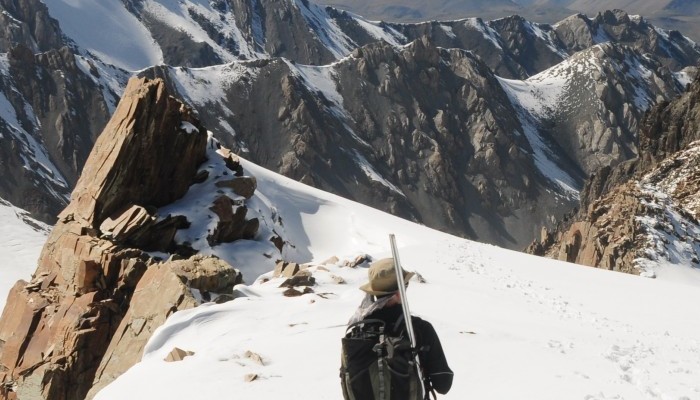
What a place to work: Spectacular views from the top of the rugged and icy peaks of Tien Shan mountain range. The desire to better understanding global climate change took Leo Sold to this remote area of Central Asia. The frozen slopes of ice and snow in today’s Imaggeo on Mondays photograph hold some of the keys to understanding how the glaciers in this remote region are being affected by a warmi ...[Read More]
Cryospheric Sciences
The bi-polar behaviour of surge-type glaciers – Heidi Sevestre
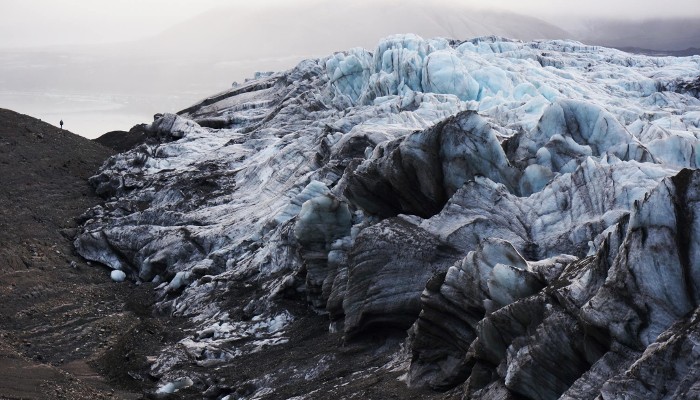
Surge-type glaciers are the bi-polar member of the family of glacier dynamics. Every now and then they go into a complete fury and nobody really understands why. What are surge-type glaciers? Surge-type glaciers typically go through what we call the “surge cycle”. It is divided into two phases; a long quiescent phase during which the glacier is more or less dormant, followed by much shorter phase ...[Read More]
Seismology
Contributors wanted
We are looking for individuals interested in helping with the running of this blog dedicated to the Seismology Division (SM) within EGU. Single contributions are also welcome. The aim of this blog is to share latest news, ideas, promote upcoming events/conferences, and other information that is relevant to the seismological community. The blog is run in conjunction with a dedicated Facebook Page f ...[Read More]
WaterUnderground
Are we in the age of postmodern groundwater?
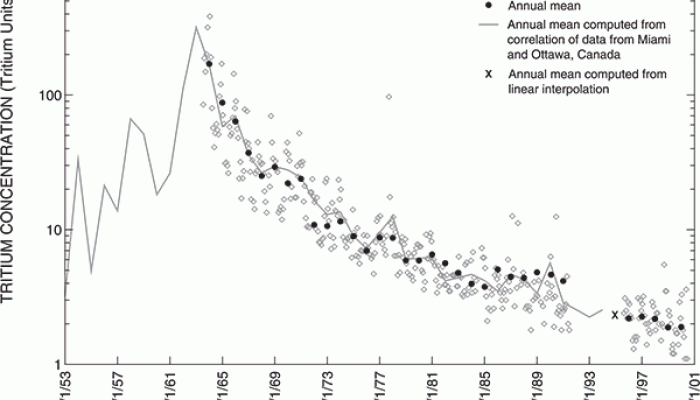
My humanities colleagues and friends are always talking about postmodernism or pomo for short (see this funny satire). I’ve been thinking a lot lately about ‘modern groundwater’ (stay tuned for a cool paper), so I started wondering if there is ‘postmodern groundwater’. Modern groundwater is groundwater recharged since the huge spike it tritium in the early 1960’s due to above ground th ...[Read More]
GeoLog
A brief history of science communication
Science communication has become a common focus of many aspects of academic research and teaching. Despite becoming more prevalent in recent years it has a long and deep rooted history, which goes hand in hand with scientific discovery. In this blog post, Sam Illingworth, gives a brief outline of the history of science communication. Science Communication is a phrase that seems to permeate into ma ...[Read More]
Geodesy
Should we, as session conveners, have an expiry date?
This is a guest post written by Jürgen Kusche, who has convened numerous sessions on various international conferences, and had the wonderful idea to use the geodesy division blog to initiate an open discussion on the topic session convening. For that reason, readers are encouraged to comment at the end of this post. Currently, Jürgen Kusche is professor at the Chair of Astronomical, Mathematical ...[Read More]
Energy, Resources and the Environment
Words on Wednesday: Effects of temperature and CO2 on the frictional behavior of simulated anhydrite fault rock
Words on Wednesday aims at promoting interesting/fun/exciting publications on topics related to Energy, Resources and the Environment. If you would like to be featured on WoW, please send us a link of the paper, or your own post, at ERE.Matters@gmail.com. *** Pluymakers, A. M. H., J. E. Samuelson, A. R. Niemeijer, and C. J. Spiers (2014), Effects of temperature and CO2 on the frictional behavior o ...[Read More]
Green Tea and Velociraptors
Welcome to the Open Glossary
At the London satellite event for Open Con earlier this year, myself and Ross Mounce were given some useful feedback after our joint talk on ‘Open Data’ by one of the attendees. Apparently, some of the terminology was too complex, or specialist, for the subject, and some of the talk was unable to be followed unless you were already an expert in the issue. Now obviously this is somethin ...[Read More]
GeoSphere
GeoPoll: What should we do with radioactive waste?
I don’t think it is any secret that the world is facing an imminent energy crisis. We are trying to generate more power than ever before, but at the same time, we now realize we have to do it in a sustainable way that does not harm the environment or exacerbate any existing issues such as climate change. The problem is these two goals are often mutually exclusive. Most of our power generatio ...[Read More]
GeoLog
Imaggeo on Mondays: Fly away, weather balloon
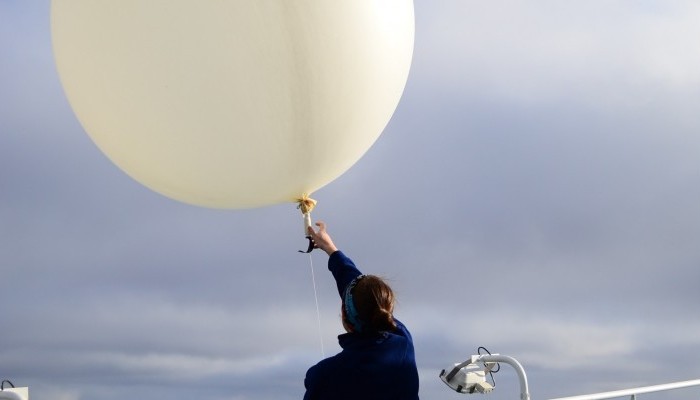
Some aspects of Earth Science are truly interdisciplinary and this week’s Imaggeo on Mondays photograph is testament to that. The maiden voyage of the research cruise SA Agulhas II offered the perfect opportunity to combine oceanographic research, as well as climate science studies. Raissa Philibert, a biogeochemistry PhD student, took this picture of the daily release of a weather balloon by mete ...[Read More]