
The 15th photo of the week is of an area of natural acid rock drainage (ARD) in Eagle Plains, Yukon. ARD is a phenomenon that most people associate with mine tailings and mine waste. However, it occurs naturally as well since the only criteria that need to be met are a source of oxidized water, such as rain, rocks or minerals that have a high sulphur content, and a very little carbonate in the roc ...[Read More]
If you didn't find what you was looking for try searching again.
GeoLog
Imaggeo on Mondays: The power of ice
There has been a lot of talk about Greenland lately in the context of global climate change. And for good reason. Over 80% of its total surface is covered by ice, the volume of which exceeds 2,850,000 km3 or enough to raise global sea levels by a staggering 7 m if fully melted. The Greenland ice sheet consists of layers of compressed snow from over 100,000 years of snowfall. As a result, ice cores ...[Read More]
Geology for Global Development
Reducing the Risk of Future Disasters
GfGD welcomes the release of the UK Government Office for Science Foresight Report into “Reducing the Risks of Future Disasters: Priorities for decision makers”. The report has been specially commissioned to recognise the growing need for good disaster and risk reduction (DRR) science. The report describes how the growing threat of natural hazards to increasingly vulnerable communities worldwide c ...[Read More]
GeoLog
Geosciences Column: Human-induced changes in the ocean’s salinity and temperature fields
In this month’s Geosciences column, Mona Behl discusses a recent paper on the effects of anthropogenically-induced climate change on the planet’s oceans. A recent study led by scientists at the Scripps Institute of Oceanography, University of California San Diego, suggests that observed changes in ocean salinity are inconsistent with natural climate variations and can be attributed to human ...[Read More]
GeoSphere
Geology Photo of the Week #14 – Dec 2-8
This week’s photo, which is posted mid-week instead of at the beginning is one that I only took this Monday. I was away all day at the Royal Military College SLOWPOKE-2 reactor doing some neutron activation of cesium and calcium. We were making minute quantities of Cs-134 and Ca-41 for research purposes on the accelerator mass spectrometer. This photo is one that I was able to take while we ...[Read More]
Geology for Global Development
What can we Learn from the Great Eastern Japan Tsunami?
Over a year and a half on from the Great Eastern Japan Tsunami, and there are still boats lying overturned at the side of roads. Recovering from such a major national catastrophe is a slow process. We hope to be able learn from this tragedy and use it to lower vulnerability to future disasters, both in Japan and around the world’s coastlines. The magnitude 9.0 earthquake on the 11th March 2011 was ...[Read More]
VolcanicDegassing
Santiaguito Volcano: Ninety Years and Counting.
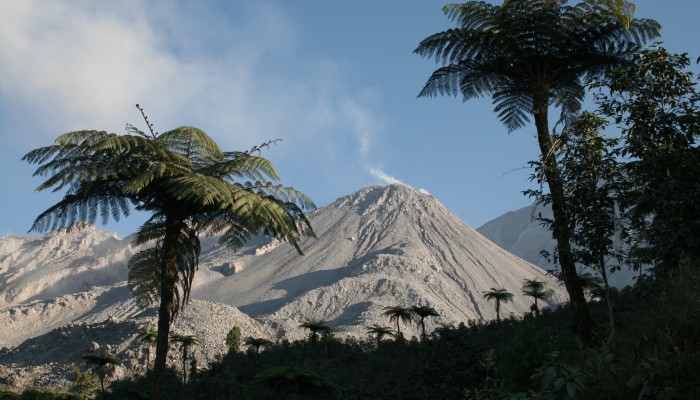
Santiaguito volcano, Guatemala, burst into life in 1922 and is now the second longest continuing eruption. It has outlasted both Stromboli (Italy) and Sangay (Ecuador), both erupting since 1934, and is only outdone by Yasur (Vanuatu), which has been erupting at least since 1774, when first visited by Captain Cook. These long-lived eruptions give us an unusual opportunity to use the slowly-extruded ...[Read More]
GeoLog
Imaggeo on Mondays: Blue haze
In this week’s Imaggeo on Mondays, brought to you by the photographer himself, Lukas Hörtnagl (University of Innsbruck, Austria) tells us about the ‘blue haze’ or ‘tule fog’ of California’s Sequoia National Park. I was visiting the United States to attend the Fall Meeting of the American Geophysical Union in December 2011 and decided to stay four more weeks to visit some of the National Parks in C ...[Read More]
Geology for Global Development
Going to This Year’s AGU Meeting?
The American Geophysical Union (AGU) convenes this week for their 45th annual fall meeting – the world’s largest international gathering of Earth scientists. Geoscientists from all around the world will be sharing their latest research and catching up with colleagues from other institutions. There will be plenty of talks relevant to GfGD. We’ve picked our highlights from the sche ...[Read More]
Green Tea and Velociraptors
Eat your greens, and you’ll grow up to be a big dinosaur
What comes to your mind when someone says ‘theropod dinosaurs’ to you? Does the mind conjour images of Tyrannosaurus rex noshing on lawyers, packs of voracious Deinonychus ambushing unsuspecting ornithopods, or perhaps you’re quite progressive and thought about flocks of birds migrating south for the winter. Sticking strictly to the Mesozoic (before 65.5 million years ago), most ...[Read More]