
Happy April Fools/Easter everyone! I know that I am a day late, but yesterday was a holiday in Canada. Spring is also in the air, not today actually since it is -7 currently, but we have no more snow, and we had a few nice days over the Easter weekend. It is therefore appropriate for the photo of the week to be something eggy. This photo is of a fragment of Pleistocene age emu egg shell that was f ...[Read More]
If you didn't find what you was looking for try searching again.
GeoLog
Imaggeo on Mondays: Grand Prismatic Spring
Yellowstone National Park, USA, is well known for its outstanding natural beauty. This is the Grand Prismatic Spring in the Midway Geyser Basin, Yellowstone National Park. It is the third largest hotspring in the world and the largest found in the United States, with a maximum diameter of about 90 m. It discharges roughly 2.5 cubic metres of mineral-rich water per minute, which flows down the rock ...[Read More]
Green Tea and Velociraptors
Panic mode, initiated?
It’s been 6 months now, and a while since I updated y’all with what it’s like in the world of a PhD-palaeontologist. In case you missed it, my intention was to open up PhD life and research a bit to expose what it’s like beyond the simple production of research papers. Which is probably a good thing, as I don’t have any papers out yet. Setting the cultural default wit ...[Read More]
GeoLog
EGU 2013 General Assembly: Venue location
The Austria Center Vienna (ACV), the Assembly venue, is not far from the city centre and can easily be reached from the airport and central train station. The ACV is located next to the Kaisermühlen/Vienna Int. Centre metro station (U1 line, direction Leopoldau from the city centre). Wiener Linien, Vienna’s public transport agency, provides a travel planner on their website, including inform ...[Read More]
Geology for Global Development
Friday Photo (72): Geologists in the Field – South African Canyon
Two undergraduates walk through a canyon in the Karoo, South Africa. The bedrock is a glacial diamictite formed during the Gondwana glaciation. (c) Geology for Global Development 2013
GeoLog
Get the Assembly mobile app!
The EGU 2013 mobile app is now available for iPhones and the app for Android smartphones is expected tomorrow afternoon. To download it, you can scan the QR code available at the General Assembly website or go directly to http://app.egu2013.eu/ on your mobile device. You will be directed to the version of the EGU 2013 app for your particular smartphone, which you can download for free. Once you op ...[Read More]
GeoSphere
It’s rainin’ isotopes…
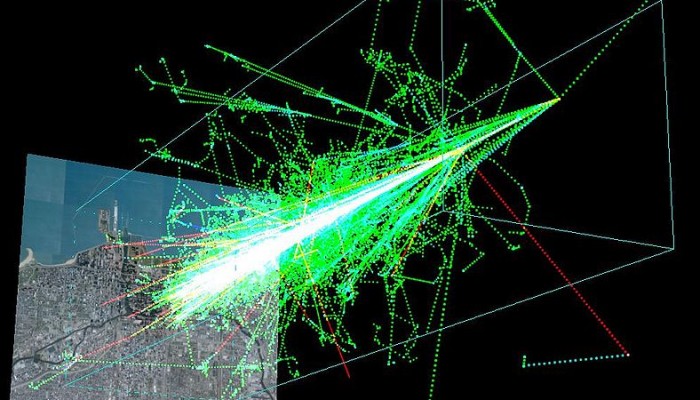
This post is kind of a continuation of Laura Roberts excellent guest post on the Solar Storms and the Earth’s Magnetic field. However, this is a bit of a different spin on it. I am not writing about what get’s kept out, but rather what slips by the shield and gets in. Of course, I am speaking about cosmic rays and the wonderfully useful isotopes they produce that rain down upon us. Yes ...[Read More]
GeoLog
Sci Comm at the 2013 General Assembly
Blogging GeoLog will be updated regularly throughout the General Assembly, highlighting some of the meeting’s most interesting sessions, workshops and lectures as well as featuring interviews with scientists attending the Assembly. Writers from the EGU Blog Network will also be posting about interesting research and sessions during the Assembly, so you can catch up on any sessions you’ve missed an ...[Read More]
GeoLog
PICO Presentations Explained
So you’re presenting with PICO? What does that mean exactly? Presenting Interactive COntent, or PICO, sessions highlight the essence of a particular research area – just enough to get excited about a topic without being overloaded with information. If a particular session piques your interest, you can look over the presentation in more detail at your leisure – straight after the session or at any ...[Read More]
GeoLog
Imaggeo on Mondays: Alas, allases are abound!
The Lena River flows throughout Russia from its source in the Baikal Mountains out into the Arctic Ocean, where the delta’s landscape is dominated by ice-rich Yedoma and thermokarst lakes. Thermokarst lakes have been identified as a source of carbon release to the atmosphere and Yedoma-like lake sediments are known to release more methane than any other sediment due to their incredibly high carbon ...[Read More]