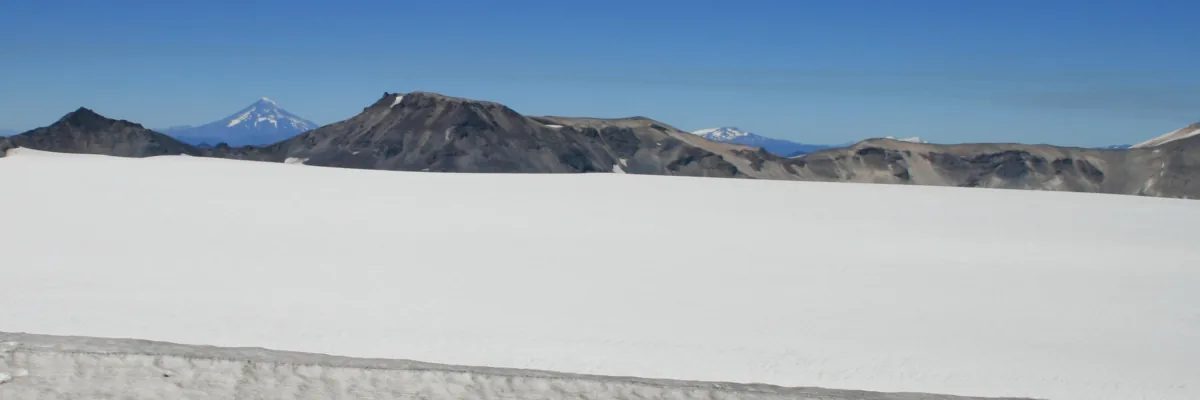
Looking across the ice-filled summit caldera of a volcano to distant peaks
VolcanicDegassing

About

About VolcanicDegassing

VolcanincDegassing blog is mainly about volcanoes and volcanic activity. Some of the posts relate to the author’s own field work, or are related to ongoing projects in Latin America, the Caribbean, Ethiopia and Europe. Other posts relate to historical or contemporary descriptions or other representations of volcanic activity.

About David

David Pyle is a volcanologist, and Professor of Earth Sciences at the University of Oxford. His first encounter with volcanoes was at the age of 7, when he visited Villarrica, Chile, shortly after an eruption. David studied geological sciences at the University of Cambridge, and later completed a PhD on the ‘older’ eruptions of Santorini, Greece. After a short post-doc at the California Institute of Technology, David returned to a lectureship in Cambridge. In 2006, he moved to his current post in Oxford. In 2017, David curated an exhibition on volcanoes in Oxford; the book accompanying the exhibition is available for sale through Bodleian Publishing, or the University of Chicago Press.

David tweets as @davidmpyle.

The opinions expressed in the VolcanicDegassing blog are those of the authors, whose views may differ from those of the European Geosciences Union.

About EGU

The European Geosciences Union (EGU) is the leading organisation for Earth, planetary and space science research in Europe. With our partner organisations worldwide, we foster fundamental geoscience research, alongside applied research that addresses key societal and environmental challenges. Our vision is to realise a sustainable and just future for humanity and for the planet.

It is a non-profit international union of scientists with about 23,500 members from all over the world. Membership is open to individuals who are professionally engaged in or associated with geosciences and planetary and space sciences and related studies, including students and retired seniors.

The EGU publishes a number of diverse scientific journals, which use an innovative open access format, and organises topical meetings, and education and outreach activities. It also honours scientists with a number of awards and medals. The annual EGU General Assembly is the largest and most prominent European geosciences event, attracting over 22,000 scientists from all over the world in the year 2026. The meeting’s sessions cover a wide range of topics, including volcanology, planetary exploration, the Earth’s internal structure and atmosphere, climate, as well as energy and resources.

The EGU was established in September 2002 as a merger of the European Geophysical Society (EGS) and the European Union of Geosciences (EUG), and has headquarters in Munich, Germany.