
Green Tea and Velociraptors

Green Tea and Velociraptors

New ‘fish lizard’ used to prowl the Scottish seas

New ‘fish lizard’ used to prowl the Scottish seas

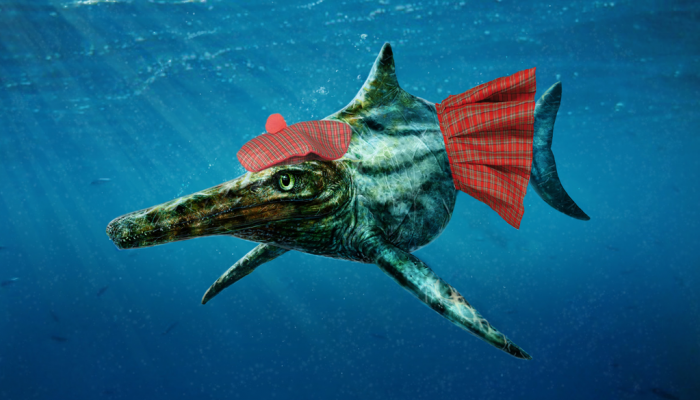
A cool new ichthyosaur – a type of marine reptile – has just been named in the Scottish Journal of Geology. I’ve written about it here, with some great comments from the lead author (Steve Brusatte). Most reports on the new beastie just focus on the finding, but we’ve gone for a different angle by delving into what it means for the evolution of ichthyosaurs during the Jurassic period. Enjoy!

In the mean time, enjoy this maybe-photoshopped reconstruction by James Lewis. Original artwork by Todd Marshall.
Top 10 dinosaur facts!

For those of you who may not have been aware, I was fortunate enough to recently publish a dinosaur book for kids, complete with build-it-yourself pop-out dinosaurs. I’ve recently published an article in The Guardian about it, which features much of the great artwork by Vladimir Nikolov. It’s all about some of the perhaps less well-known dinosaur facts that feature in the book, so enjoy!

The origin of a second wave of supreme-swimming crocodiles

The origin of a second wave of supreme-swimming crocodiles

Millions of years ago, crocodiles were far more diverse (and weird) than the ones we still have around today. They ranged from armoured, tank-like forms living on land and feeding on plants, to 9 metre long fully-fledged swimmers out in the open oceans.

In the Jurassic period, most of the crocs we know of were of this second kind, the whole marine forms. These comprised a group known as thalattosuchians, and they had long snouts for snapping up fish, salt glands, and even flipper-like arms and legs adapted for a swimming lifestyle. Let’s just call them fish-crocs for now.

These fish-crocs, although supreme hunters and generally awesome, went extinct at some point in the early Cretaceous, about 120 million years ago. The reasons for this are unknown, but it could be due to unfavourable environmental conditions, or perhaps they were out competed by other marine super-predators such as pliosaurs. It was a sad time for croc-kind.

[Read More]

Twitter logos for conference talks

Recently, there was a pretty massive discussion about the practice of live-tweeting at conference talk hosted on this blog. While the discussion is by no means over, or particularly conclusive, one idea to emerge was having an icon of some sort on slides during talks to indicate whether or not they could be live-tweeted. Sarah Werning has been kind enough to create and share some logos following this, and I strongly encourage academics to use these when presenting to avoid any future confusion or conflict over this. It only takes an extra couple of minutes to ‘twitter-proof’ a presentation. Of course, you can simply ask at the beginning for your audience not to tweet, rather than plastering these on every slide, if that’s how you choose to roll.