
This post is one inspired by the actions of Ethan White and a couple of other ecologists. Spurred on by their actions, I decided to write a letter to the Editor of a major journal in my field, the Zoological Journal of the Linnean Society. Ethan has performed similar actions too, and this letter draws quite a bit on what he has previously written. The theme revolves around requesting that the Linnean Socciety journals allow submission of manuscripts that have been previously published as a preprint (a non-peer-reviewed version of a manuscript), as the present policy is not supportive of open research and the rapid and free dissemination of research. Anyway, here’s the letter: [Read More]
Welcome to the Open Glossary
At the London satellite event for Open Con earlier this year, myself and Ross Mounce were given some useful feedback after our joint talk on ‘Open Data’ by one of the attendees. Apparently, some of the terminology was too complex, or specialist, for the subject, and some of the talk was unable to be followed unless you were already an expert in the issue.
Now obviously this is something that, as members of the ‘open community’, we do not want. As we progress to setting the default to open, I want it to be an open cultural movement, rather than an exclusive clique. For this, I believe it is important that the terminology we use is designed to be inclusive, rather than accidentally (or otherwise) creating rifts within academia.
To that end, afterwards in the pub, where all things science occur, we decided to create the Open Glossary. This is a resource designed to equip people with the terminology that is used within discussions about the general field of open scholarship. Additionally, it possesses numerous external resources that may be of use. This has been a crowd-sourced effort (original document), so thanks to everyone who has provided feedback, edits, and comments to date. I expect to update it every few months.
What I ask is for people to host this document, and share as broadly as possible with friends and colleagues. And not just those who are interested in science or already active researchers – awareness of this sort of thing is equally as important in being active about it, in many cases.
How fast was the demise of the dinosaurs?
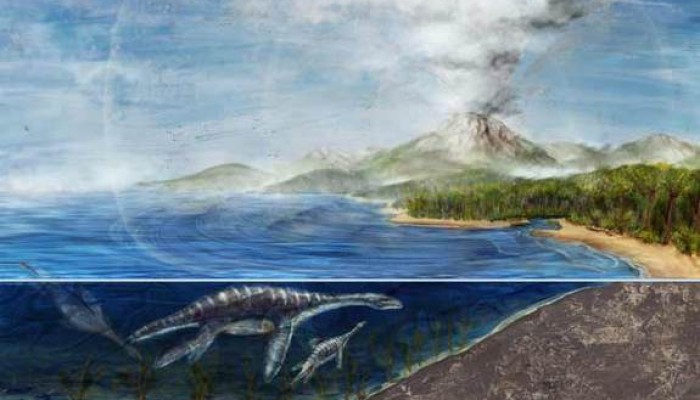
It’s dark. It’s always dark these days. Lights in the sky burn your eyes, so you keep your face to ground in the hopes that they’ll go away. But they don’t. The air is heavy. Heavy with poisons that make it difficult to breathe. Heavy with foreboding dread.
You, my unfortunate friend, are going through a mass extinction!
There have been five periods of mass extinction in the past. These represent major phases in the history of life where we see global reorganisations of ecosystems and their inhabitants.
It’s kind of like a turtle-fish-dolphin…
Close your eyes. Go back in time 250 million years, and the world would seems as strange to you as a different planet. On land, there was a whole host of bizarre and now extinct animals: strange, crocodile-like things, and the precursors of dinosaurs; weird mammal-like beasts, that looked like the lost offspring of a hippo and a monitor lizard.
In the seas, marine reptiles dominated. A whole range of unusual animals lived, such as the long-necked plesiosaurs, popularised with reference to the mythical Loch Ness monster. Alongside these were the equally unusual ichthyosaurs. At first glance, a typical one might look like to you much like a dolphin.