
Green Tea and Velociraptors

Green Tea and Velociraptors

New species of ‘river dolphin’ reveals their ancient marine origins

A new species of extinct dolphin closely related to modern Amazonian ‘river dolphins’, but which dwelled in ancient oceans, is helping to solve the mystery of how and when dolphins adapted for life away from the sea.

Freshwater dolphins are endangered, largely due to human activity. In modern ecosystems, only five or six species remain, and among these, the Yangtze ‘river dolphin’ was declared ‘functionally extinct’ in 2006.

These animals are truly remarkable, and show what scientists have interpreted as adaptations for helping to navigate the murky waters of the winding rivers they inhabit: broad, paddle-shaped flippers, and long narrow snouts – much longer than their modern, sea-dwelling cousins – and flexible necks for catching rapidly darting prey.
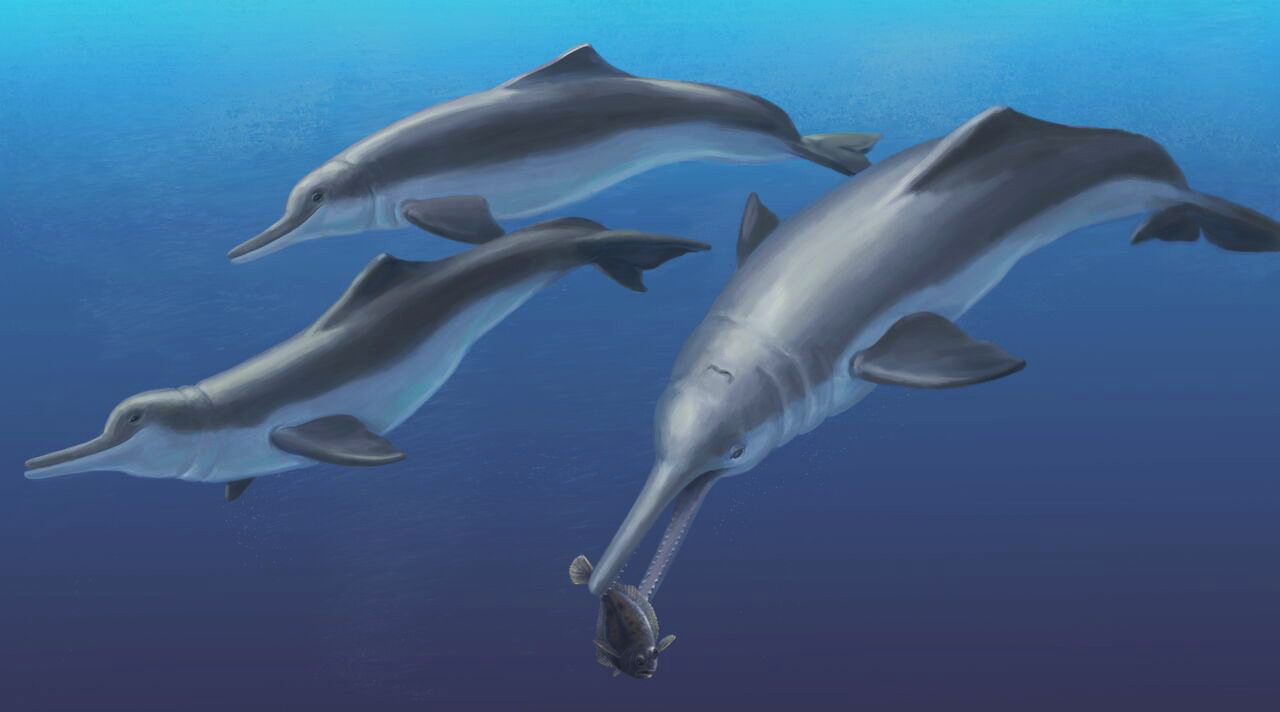
An artist's recreation of Isthminia panamensis feeding on a flatfish. Many features of this new species appear similar to today’s ocean dolphins, yet the new fossil species is more closely related to the living Amazon River dolphin. Image: Julia Molnar / Smithsonian Institution

An artist’s recreation of Isthminia panamensis feeding on a flatfish. Many features of this new species appear similar to today’s ocean dolphins, yet the new fossil species is more closely related to the living Amazon River dolphin. Image: Julia Molnar / Smithsonian Institution

Scientists from the Smithsonian discovered a new genus and species of extinct ‘river dolphin’, hailing from the Caribbean Coast of Panama 6 million years ago during a time known as the Miocene. Based on a skull and parts of the right flipper, they estimate it could grow to more than 9 feet in length, just slightly larger than its modern relatives. The new animal is named Isthminia panamensis, as a dedication to the people of the Republic of Panama, and the many scientists who’ve studied the biology and geology of the region.

[Read More]

New open science competition through ARCS

The ARCS (Advancing Research Communication and Scholarship) have launched a new ‘open scholarship’ competition. The aim is simple: describe your ‘open science story’, and you could win $1000! In particular, the competition is aimed at finding success stories – how has practicing any form of open science helped you advance or enhance your career in some way?

All submissions will be published and archived with The Winnower, an open access platform, and assigned a DOI for free so it will become citeable.

To submit your open success story, simply click HERE. Use ARCS2015 as a keyword, so your submission is included in the project collection and considered for a prize. Articles must be submitted before October 5th to be considered for a prize.

[Read More]

The rise of open research data

This was originally posted at: http://exchanges.wiley.com/blog/2015/08/26/the-rise-of-open-research-data/

As a junior researcher in the UK, it has given me great pleasure over the last few years to see the dramatic development of open access publishing. Most major research funders in the UK now require public access to published research articles in one form or another, and many other research intensive nations across the globe are following suit.

Along with this global increase in public access to papers, there has been a gear shift in demand for the availability of additional outputs of research, including code, videos, software, and raw data. One of the most recent steps in increasing access to these outputs has been the RECODE project for researchers in the EU, which seeks to develop an open data ecosystem through shifting research practices. With progress being made in the USA too, the wheels are truly in motion towards a global shift towards open access to all research outputs.

[Read More]

Dinosaur Britain airs tonight!

A fantastic new series on Dinosaurs of the British Isles airs tonight on ITV! It stars Dean Lomax, a professional palaeontologist based pretty much everywhere in the UK. It seems to be based off a book of his, published via Siri Press. I’ve seen a copy, and it’s pretty much the best illustrated guides to dinosaurs ever. Here’s a preview below, so at 9pm GMT, kick off your shoes, get the snacks ready and crack open a cold one, because it promises to be awesome!

Click here to display content from Vimeo.
Learn more in Vimeo’s privacy policy.