
Green Tea and Velociraptors

Green Tea and Velociraptors

Three-dimensions of palaeontological awesomeness

Scientific publishing is entering a new era, with digital content becoming more and more important in a world where data is openly and freely shared. In palaeontology, we’re not being left behind. Along with this shift, 3D fossils are adding a new breadth to the field, both in a scientific and educational context. A great example is the British Geological Survey’s immense 3D fossil project.

I thought it might be a nice idea to draw attention to a new article by Stephan Lautenschlager of the University of Bristol, discussing the role that 3D palaeontology has to play in the current publishing world, as well as ways of implementing it. He’s been cool enough to make the article open access (see link at the bottom), so I’d recommend heading over to check it out.
[Read More]

Was the diversity of feeding styles in giant turtles a key to their suckcess?

­Sometimes, it can be difficult to figure out how ancient organisms used to eat. Part of the problem is that we can never actually see extinct animals eating (until we invent time-travel.. *taps fingers impatiently at physicists*), and often it can be hard to work out how something ate based just on its anatomy.  Sometimes though, the fossil record chucks up something truly spectacular, and gives us amazing insight into the spectacular diversity of ancient life.

Let’s roll it back a bit.

[Read More]

A double-whammy of dinosaur awesomeness. Pun totally intended.

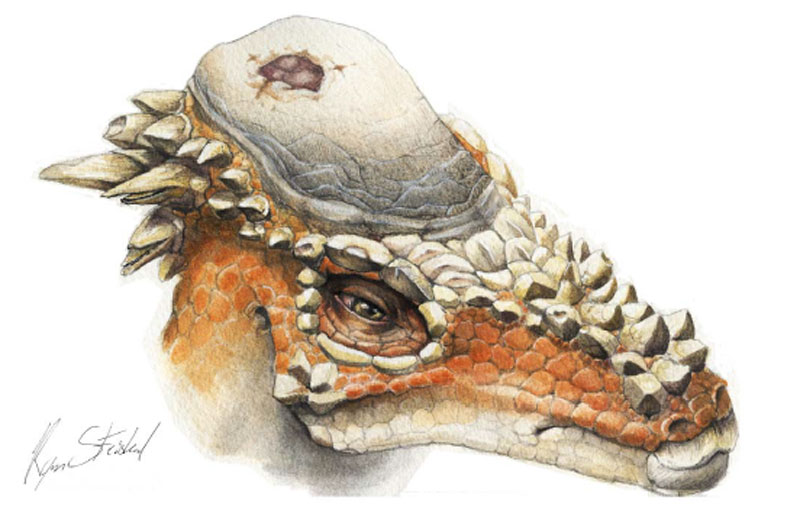
This is a post about pachycephalosaurs. It’s not a post about feathered dinosaurs, huge dinosaurs, or any of the ones which you may be more familiar with from popular media. Pachycephalosaurs were the dome-headed little scrappers of the Cretaceous, around 85 to 66 million years ago. Their name means ‘thick-skulled lizard’ (pachy: thick, cephalon: skull, saurus: lizard), and they were a small group within the larger herbivorous group of dinosaurs called ornithischians.

It’s probably fair to say that these dinosaurs are one of the least popular groups; they didn’t have razor sharp teeth and sickle-switchblade claws, they didn’t grow to the size of houses, and they didn’t have rows of armoured shields and spikes along their backs. What they did have, however, is an unusual behaviour that signifies them as unique, and pretty amazing, beasties.

Fig.1 – A pachycephalosaur suffering an ‘ouchie’, or cranial lesion (PLoS)

Fig.1 – A pachycephalosaur suffering an ‘ouchie’, or cranial lesion (PLoS)

[Read More]

SVP Day 3

OK, day 3, still alive.

The first session this morning was on saurischians dinosaurs, the major group that includes sauropods and theropods.

My supervisor, Phil Mannion, was the first talk I was awake enough for (*cough*), and gave us a run-through of sauropods from the infamous Late Jurassic (~150 million years old) Tendaguru formation from Tanzania. With new revisions, the sauropod fauna from here are remarkably similar in terms of higher taxa to sites known from Iberia, China, and the US, although only somphospondylans, a quite advanced group, are known from Tendaguru.

[Read More]