
I learnt this week the sad news of the death of Barry Dawson, Emeritus Professor in the School of Geosciences at the University of Edinburgh. I had the great fortune to accompany Barry into the field in 1988, while I was still studying for a PhD, and had the pleasure of spending many enjoyable moments with him subsequently, whether in the field, at meetings, or just in passing. This seems like an ...[Read More]
VolcanicDegassing
Time to move scientific debate into the open?
A few months ago, I got a routine request to review a paper about the fate of the plume formed during the 2011 eruption of Nabro volcano, Eritrea. The topic looked interesting, and so I agreed and duly reported. A few weeks later, the journal asked if I might write a commentary to introduce the paper, essentially as a bit of advertising. It wasn’t too hard to agree to that either; after all, ...[Read More]
Geology for Global Development
Friday Photo (66): Earthquake Preparedness training in Bangladesh
Children being prepared to deal with the aftermath of an earthquake at a school in Bangladesh. This is part of a project run by the charity Concern. Credit: Susanne Sargeant. (c) Geology for Global Development
GeoSphere
GeoSphere: In Review
After two years of regular geology blogging I was thinking it might be fun to highlight the posts that I think are my best work as well as the ones that have been the most popular…they are not necessarily the same. This just goes to show it is impossible to predict what the collective consciousness of the geoblogopshere or the geotwitterverse will like the best. Some of these posts come from ...[Read More]
Geology for Global Development
Top Travel Tips (7): Bangladesh, from Susanne Sargeant
Over the summer we published a very popular series of posts outlining some Top Travel Tips to help those undertaking mapping projects, fieldwork or research visits overseas. Good preparation is essential to get the most out of overseas work. It helps our work be more effective, more efficient and ultimately more sustainable. Today, Susanne Sargeant shares her insights from time spend in Dhaka. You ...[Read More]
GeoSphere
Geology Photo of the Week # 20 – Feb 3-9
This week we have a photo of the something that has been on my mind a lot for the last little while and will continue to be on my mind in the comings years months weeks. Of course I am speaking of lab work and particularly the new iodine extraction line that I have been developing. Over the past few months I have had a 0% success rate with this damn thing. However, thanks to the fresh ideas and ex ...[Read More]
Geology for Global Development
Save the Date – GfGD National Conference 23rd October 2013
On Wednesday 23rd October 2013, GfGD will be hosting their first National Conference in London. Aimed at students and recent graduates, this one day event will be a great opportunity to learn more about GfGD and their work, explore the role of geoscience in development, and meet people across the country with the same interest in applying their work to fight poverty and improve society. Put the d ...[Read More]
Geology for Global Development
Guest Blog: Managed aquifer recharge in coastal Bangladesh
Donald John MacAllister has a BSc in Geophysics from the University of Edinburgh and an MSc in Water Management from Cranfield University. He has spent three years working as a hydrologist and water engineer, both in the UK and in the international development sector. He is currently pursuing a PhD at Imperial College London researching the use of a naturally occurring geoelectric phenomenon to m ...[Read More]
Green Tea and Velociraptors
Gender confusion in Confuciusornis? Not any more!
Among the many issues with the fossil record is the case of gender identification. In modern organisms, it is usually pretty easy to tell which members of a particular species are the males and which are the females. This can either be through consistently perving on them to figure it out during copulation, or some aspect of their morphology, such as antlers, or you know, a penis or vagina. When i ...[Read More]
VolcanicDegassing
Sea-floor spreading, on land
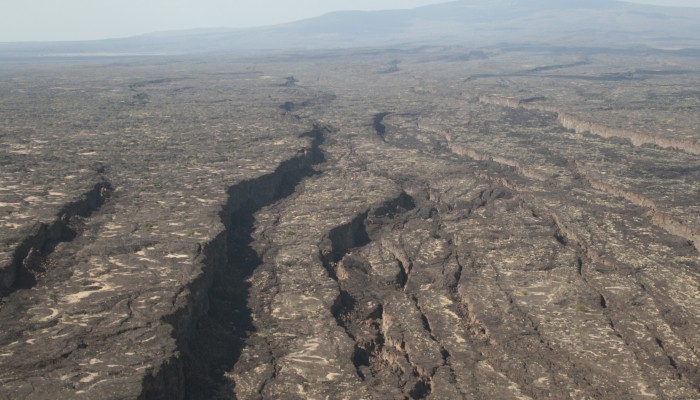
One piece of evidence that helped to establish the theory of Plate Tectonics in the early-1960’s was the recognition of patterns of magnetisation in the basalts of the seafloor that were symmetrical about the global oceanic ridge system. Fred Vine and Drummond Matthews recognised that this pattern had to be fixed in place as the lavas, that were erupted along the ocean ridge, cooled through ...[Read More]