
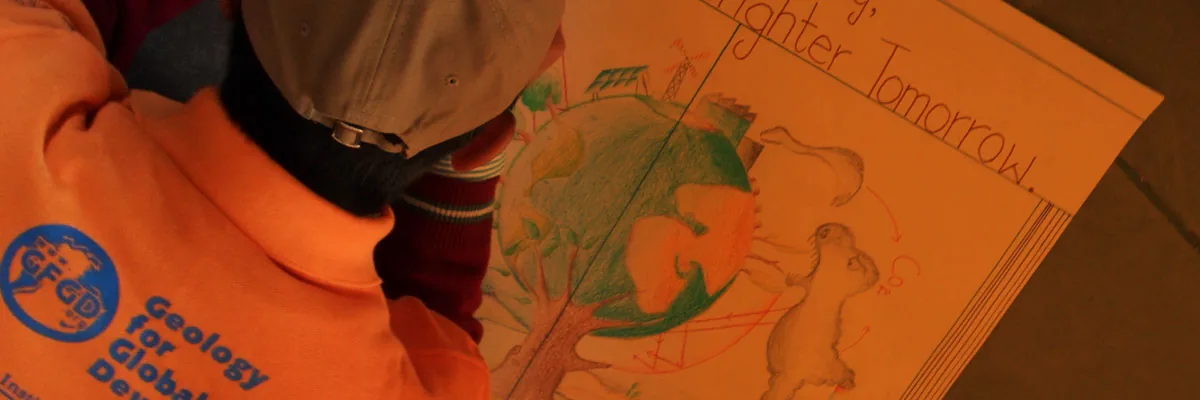
A quick reminder about a date that you should all put in your calendars… Following the success of our first National Conference in October 2013, we are very pleased to announce that Friday 19th September 2014 has now been booked for our next conference… On Friday 19th September we hope to again gather over 150 young geoscientists …[Read More]
Geology for Global Development
Blog Break
Due to widespread commitments in other areas of our work – we’ll be taking a two-week break from regular blogging (although may publish occasional articles). You can find a wide range of articles in our archives, and will be back publishing new articles from the week beginning 26th May.
#EGU2014: Cleaning with Coffee
We’re drinking an enormous amount of coffee in Vienna this week, but the residues at the bottom of the cafetière usually end up in the bin. Kalliopo Fotopoulou, from the University of Patras in Greece, has found a way to transform that residue into something far more useful. Baking coffee residues in an oven changes …[Read More]
#EGU2014: Bright Sparks in Dirty Thunderclouds
Lightning bolts formed in dirty thunderclouds could help geologists to detect explosive volcanic eruptions. Volcanic lightning is very poorly understood, but Corrado Cimarelli, from the University of München, has been able to reproduce the phenomena in his laboratory. Volcanic lightning is broadly similar to lightning in thunderclouds, but the addition of ash makes the process …[Read More]
GfGD at EGU 2014 – Splinter Meeting Reminder
If you are currently at the EGU General Assembly in Vienna, why not come and say hello to the GfGD team TOMORROW (Thursday 1st May 10:30-12:00) in Room R10. (Please feel free to copy and share this image via Twitter/Facebook)
#EGU2014: Google Research
Earth Engine is a tool produced by the developers at Google to help scientists process the numerous satellite images taken of the Earth over the past thirty years. Short videos are available online to give you some idea how this tool could be used. One shows the expansion of Las Vegas, and the accompanying …[Read More]
#EGU2014: The leaning towers of Shenzen
Flood events in coastal cities are on the increase. The trend is usually blamed on rising sea levels and extreme weather events, caused by anthropogenic climate change. While water levels are rising, some cities are also sinking. And human activity may partly be to blame. Urban subsidence can be caused by soil drainage, construction projects, …[Read More]
GfGD at EGU 2014 – ‘Hazards Education in the Himalaya’ Talk Reminder
In Session NH9.8 TOMORROW (Tuesday 29th April) Rosalie Tostevin will be talking about GfGD’s hazards education project in the Himalayan region of Ladakh, Northern India. (Please feel free to copy and share this image via Twitter/Facebook)
European Geosciences Union – General Assembly 2014 (Part 5) – Natural Hazards Discussion
If you’re coming to the EGU General Assembly, and interested in natural hazards, we highly recommend this opportunity to join a discussion session related to the broad theme of ‘Natural Hazards Education, Communications and the Science-Policy-Practice Interface.‘ You can register to give a 2 minute ‘pop-up’ talk and find out more information here.
European Geosciences Union – General Assembly 2014 (Part 4)
A couple of weeks ago we outlined the ways in which we will be participating in the EGU General Assembly taking place in Vienna next week. We’re currently asking a few of the GfGD team who are attending to give us an outline of the sessions that caught their eye and to tell us more about their roles at …[Read More]