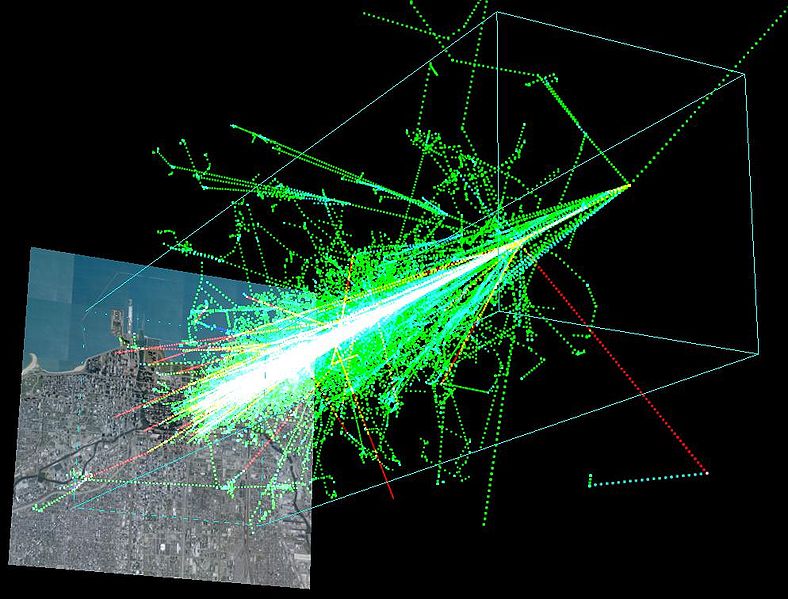
This post is kind of a continuation of Laura Roberts excellent guest post on the Solar Storms and the Earth’s Magnetic field. However, this is a bit of a different spin on it. I am not writing about what get’s kept out, but rather what slips by the shield and gets in. Of course, I am speaking about cosmic rays and the wonderfully useful isotopes they produce that rain down upon us. Yes ...[Read More]
GeoSphere
Photo of the Week #27 – Someone’s had a few too many
The photo of the week came to me this morning on my walk to school. Yes, it is now warm enough in Ottawa to comfortably walk to school! All the melting ice and the slight smell of spring and undergrad panic in the air got me thinking about permafrost degradation and nights out during my undergrad. An odd combination of thoughts, I grant you. Well, what do these two very separate things have in com ...[Read More]
Geology Photo of the Week #26
The photo of the week is another great example of Pleistocene giantism in mammals. In the photo you see a recent (very) leg bone from a kangaroo held next to the fossilized leg bone of a Pleistocene kangaroo, known as Procoptodon. HUGE DIFFERENCE! The bone from the ancient kangaroo is at least 10-15cm longer and much, much thicker. Procoptodon, stood around 2m tall and weighed in at a massive 230 ...[Read More]
Guest Post: Solar Storms and the Earth’s Protective Shield – Laura Roberts Artal
I am a PhD student at the University of Liverpool Geomagnetism Laboratory. My current research project is the palaeomagentic study of 3.5-3.2 billion year old rocks from South Africa. The aim of my research is to improve our understanding of the long term evolution of the Earth and the surface conditions under which the first forms of life originated through using palaeomagnetic records. The rock ...[Read More]
Geology Photo of the Week #25
The photo for this week is something a bit different. It is a piece from my personal collection that was self collected. Ok, full disclosure, my dad actually found it, but I was over on another rock pile in the quarry and finding jack at the time…so it is self collected….I did help extract it after he found it. I should also mention that they were repaired and enhanced by a professiona ...[Read More]
Geology Photo of the Week #24
The photo of the week is one that I took in November on my glacial sedimentology class trip to the Buckingham sand pit and at first glance it looks pretty boring. Nothing could be further from the truth though when you consider the implications of this lonely old block sitting al by itself in these sand beds. Also, my apologies for not including a scale. You’ll just have to take my word for ...[Read More]
Geology Photo of the Week #23
The incredibly colourful photo of the week is a picture that I took at the Canadian Museum of Nature. It shows what has to be one of the most spectacular pieces of ammolite that I have ever seen. Ammolite is a bit of a mysterious substance and it is found in only a few places on Earth, notably in the Canadian Rockies. Ammolite is actually considered a gemstone and it is one of the few official gem ...[Read More]
The Truth about Radon
There are few things on Earth that evoke more fear than radioactivity. Most people’s response to radioactivity is one of immediate fear and confusion and I can’t say I blame them. There is something very frightening about a substance that shoots off invisible rays that can kill you if you’re exposed to enough of them. However, most people really don’t need to worry about be ...[Read More]
Geology Photo of the Week #22
I have been posting a lot lately about the Yukon. So for a change of pace the photo for this week comes from Australia…about as far from the Yukon as it is possible to get. This is a photo looking down on a mat of stromatolites. They are the round shapes poking up through the limestone.
Fun with PHREEQ at Red Creek
Most freshwater on earth is not that highly saturated with dissolved metals or minerals. However, there are exceptions to be found all over the world from natural acid rock drainage to the alkali springs of Jordan. If the concentrations of dissolved metals are high enough the water can be toxic. For example, water draining from gold mines is often very high in arsenic and must be contained and cle ...[Read More]