
When the public think about natural hazards, space weather is not the first thing to come to mind. Yet, though uncommon, extreme space weather events can have an economic impact similar to that of large floods or earthquakes. Although there have been efforts across various sectors of society to communicate this topic, many people are still quite confused about it, having only a limited understandi ...[Read More]
Imaggeo on Mondays: A single beam in the dancing night lights
Research takes Earth scientists to the four corners of globe. So, if you happen to have a keen interest in photography and find yourself doing research at high latitudes, chances are you’ll get lucky and photograph the dancing night lights: aurora (or northern lights), arguably one of the planet’s most breath taking natural phenomenon. That is exactly the position Matias Takala, a researcher at th ...[Read More]
GeoTalk: Beate Humberset
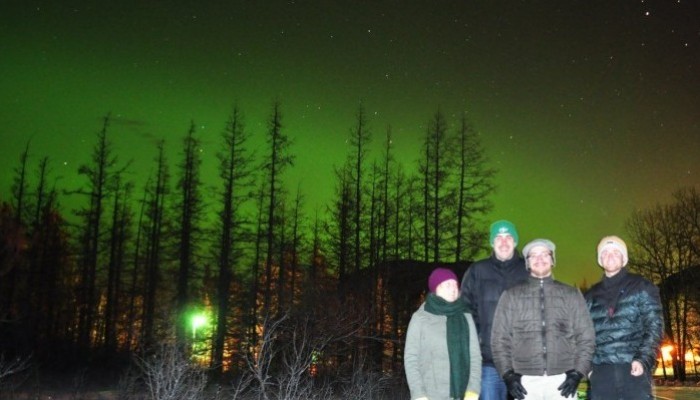
Beate and her colleagues during a PhD training course in Kananaskis, Canada. Aurora
are seen in the background of this photo.
In this edition of Geotalk, the regular feature were we highlight the work and achievements of early career researchers, we are talking to Beate Humberset, the winner of the Outstanding Student Poster (OSP) Award for the Solar- Terrestrial Sciences Division (ST) in 2013. In addition, Beate is the Young Scientist Representative for the ST Division so we will also touch upon her responsibilities in ...[Read More]
GeoCinema Online: What a difference technology can make.
Advances in technology mean research that was unthinkable some years ago is now possible. For instance, geographically remote areas which were once out of reach have become more accessible through better (not always easier) transportation, so what we understand by ‘remote areas’ has changed significantly over time. The films in this edition of GeoCinema online are fascinating because they showcase ...[Read More]