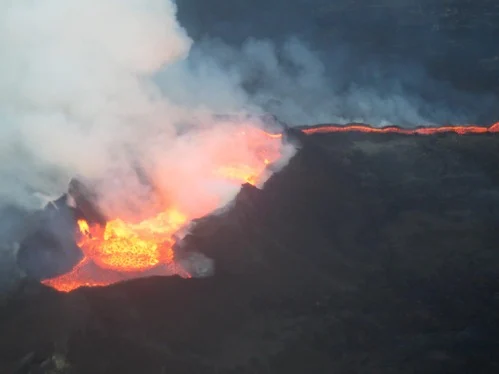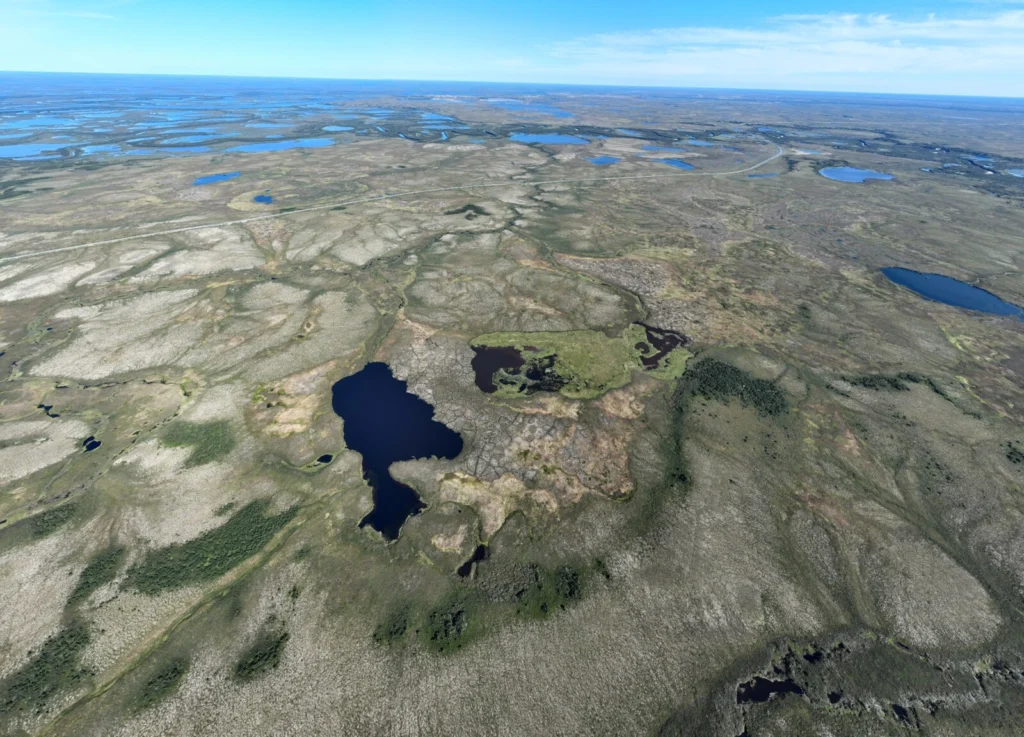
Across the Arctic lies evidence for a massive past volcanic event, called the High Arctic Large Igneous Province (HALIP). This ancient volcanic event is particularly unusual in that it appears to have lasted for over 50 million years. Could a single deep-seated mantle plume cause such wide-spread and long-lived volcanism? In a recent study …[Read More]
Division blogs
Cryospheric Sciences
Women of Cryo VII: Making Fieldwork More Inclusive
Women make up 50.8% of the world’s population, yet fewer than 30% of the world’s researchers are women. Of this percentage, women of colour comprise around 5%, with less than 1% represented in geoscience faculty positions. Women are published less, paid less, and do not progress as far in their careers as men. Even within our EGU community, women account …[Read More]
Hydrological Sciences
How to Convene an EGU Session in Hydrology
Have you ever thought about convening an EGU session instead of just attending them? Until September 9th you have the chance to do just that for the 2025 General Assembly, which will be taking place from April 27 to May 2 in Vienna, Austria. Convening a session can sound a bit intimidating, especially if you’ve …[Read More]
Geodynamics
Modeling the Early Earth: Idealization and its Aims I
The question of how we came to be is closely tied with how the Earth became what it now is. What was the early Earth like? How did it evolve to become a habitable world? Given a fragmentary rock record, how can we investigate the early Earth and its evolution? Dr. Junjie Dong from Caltech …[Read More]
Cryospheric Sciences
Cryobook review: The Quickening
Even before its publication, my partner stumbled over the book The Quickening by Elizabeth Rush on Twitter and send it to me. In this book, Rush describes her journey to Thwaites Glacier and – as I was very curious about it – I bought it immediately after its release. It is not only documentary work …[Read More]
Geochemistry, Mineralogy, Petrology & Volcanology
Volcanism, anthropogenic carbon dioxide emissions, and mass extinctions
Only a very small fraction of the energy produced by nuclear fusion in the Sun (3.82 x 10²³ kW) reaches the top of the Earth’s atmosphere (1.7 x 10¹⁴ kW), and then only about 50% of it reaches the Earth surface, where it is absorbed by the oceans and land. This energy is radiated back …[Read More]
Geodynamics
The uncertain tomographic lenses
Geodynamicists often try to answer scientific questions related to the Earth interior, but direct observations of such depths are rather limited–unless you are character in a Jules Verne’s novel or a prominent scientist in the movie The Core–. A way to deal with this issue is to rely on indirect methods, with seismic tomography being …[Read More]
Cryospheric Sciences
Climate Change & Cryosphere – Can the smallest ice make the greatest impact?
The cryosphere comprises all the ice on Earth, from glaciers in Antarctica, icebergs floating in the ocean, to millimetric ice found in the soils. Soil can hold ice wedges and ice lenses, but there are small ice reservoirs that are usually overlooked: the pore ice. Pore ice is an unknown compartment whose role regarding matter …[Read More]
Geodesy
Around the world with Professor Vening Meinesz onboard the submarine K-XVIII: The Origin of Flexure Modelling
In my previous blog post, I wrote about the famous voyage of Professor Vening Meinesz aboard the submarine K-XVIII. At 30 meters underneath the surface, Vening Meinesz would observe the gravity field of Earth with a pendulum apparatus called the Golden Calf. In this post, I would like to discuss a different voyage the professor …[Read More]
Geodynamics
The Sassy Scientist – Gotta Bake ‘Em All
Is it summer already? Have we come to the horrendous deadline period before the holidays? I know it’s impossible, but when you close your eyes, do you imagine the sea or the mountains? (Choose your fighter: Lapras or Machamp.) Luckily, we have a question that will give you a break from all this and act …[Read More]