Introduction
When people hear the word „volcano“, they usually think of a magmatic volcano with impressive pyroclastic eruptions or lava flows. However, mud volcanoes are different. Mud volcanoes erupt what we call mud breccias, a mixture of gas, water, and fine sediments. The eruptions generally occur due to deep generation of hydrocarbons and gravitational instability of rapidly buried, buoyant sediments. In Azerbaijan, where more than 400 kilometre-sized mud volcanoes exist, they literally shape the landscape. Mud volcanoes can, like their magmatic cousins, have massive eruptions and kilometre-long mud flows.
For a long time, geoscientists assumed that these extensive mud flows formed during rare, catastrophic eruptions that expelled enormous volumes of material in a short time. It seemed like the only reasonable explanation. After all, how else could a kilometre-long flow appear? There are even records for extensive mud flows during eruptions, the latest being on September 23rd, 2018 on the Otman Bozdag mud volcano. However, in 2019, this certitude started to crumble as our work at the Lokbatan mud volcano opened a new perspective.
A Puzzle at Lokbatan and Otman Bozdag
While working on my master thesis on mud volcano dynamics, I realised how many questions remain unanswered about the behaviour of large mud volcanoes, and the 2018 eruption of Otman Bozdag offered a rare window into these processes. In parallel, during an Azerbaijani summer school which took place at the same time, my future colleagues Petr Brož and Adriano Mazzini were investigating the Lokbatan mud volcano, one of the most active mud volcanoes on Earth. Historical records document numerous eruptions, and its western flank hosts a mud flow longer than a kilometre. Standing on top of the structure, the flow resembles a frozen river of grey sediment winding across the landscape.
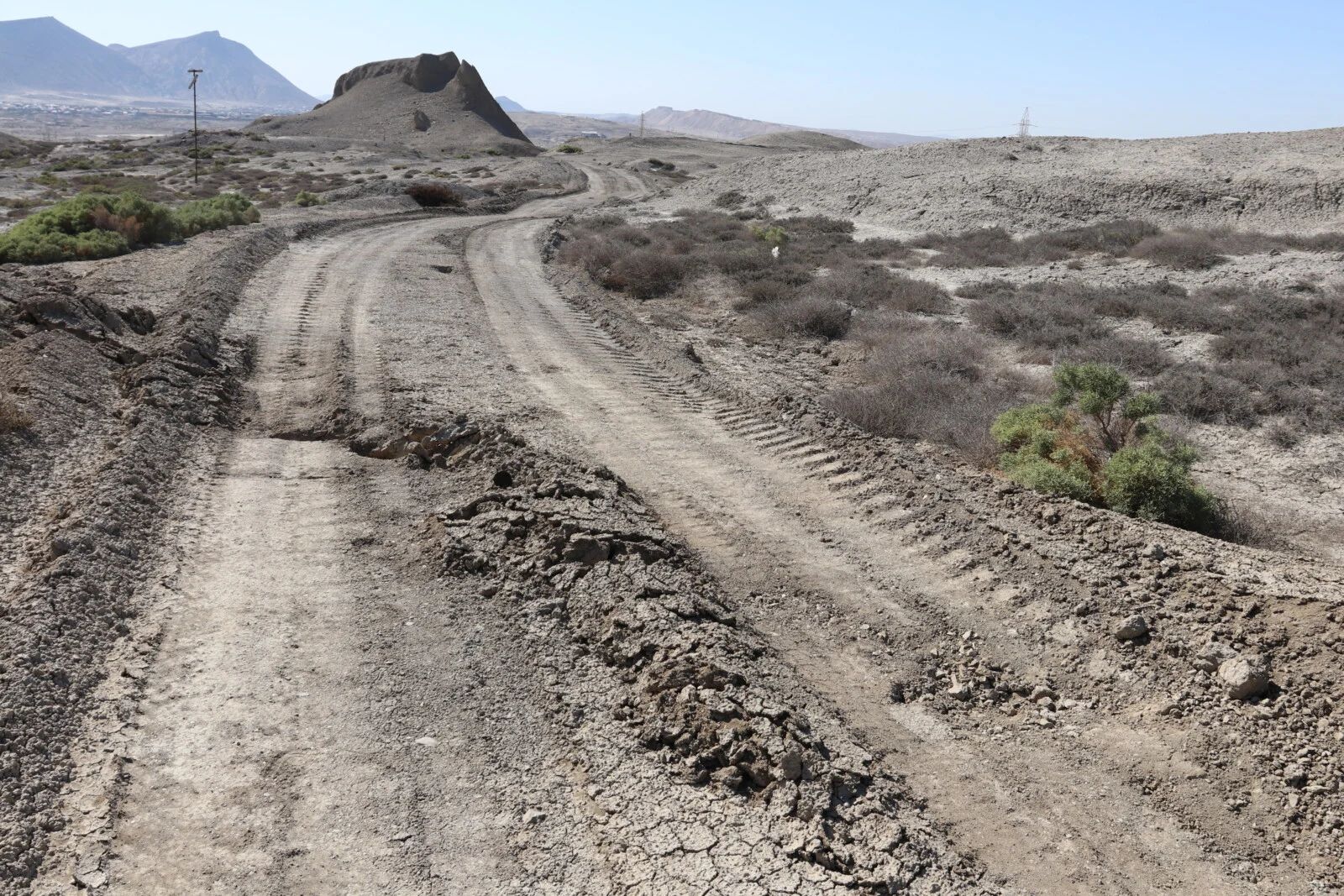
Field photo of the Lokbatan mud volcano flow crossing a road. PC: Petr Brož.
So, what began as a routine field investigation for my colleagues evolved into a surprising discovery. They found very recent fractures encircling the presumed paleo-flow, which suggests the largest mud flows may not be built during single eruptions at all! Instead, it seems like mud volcano flows can slowly creep downslope over many years. This realisation led us on a scientific journey from muddy field sites to satellite imagery and ultimately changed how we think about mud volcano dynamics.
Following eruptions in 2022, 2024, and 2025, our team visited the Lokbatan mud volcano, and what we found confirmed the first discovery. The eruptions themselves were relatively small. The volumes of newly erupted mud were nowhere near large enough to explain the existence of the enormous mud flow extending downslope. Yet, each time, fresh deformation had appeared across the surface. Walking along the margins of the paleo-flow, we encountered long cracks running parallel to the direction of movement, as well as roads that were cut and pipes that were bent. Near the crater, newly erupted material had piled up against older deposits, producing structures that looked as if the flow had been pushed from behind. The landscape was showing us something that did not fit the traditional model.
Watching a Mud Flow Move
Field observations provided important clues, but we needed to see what was happening on a bigger scale and find evidence that the entire flow was actually moving.
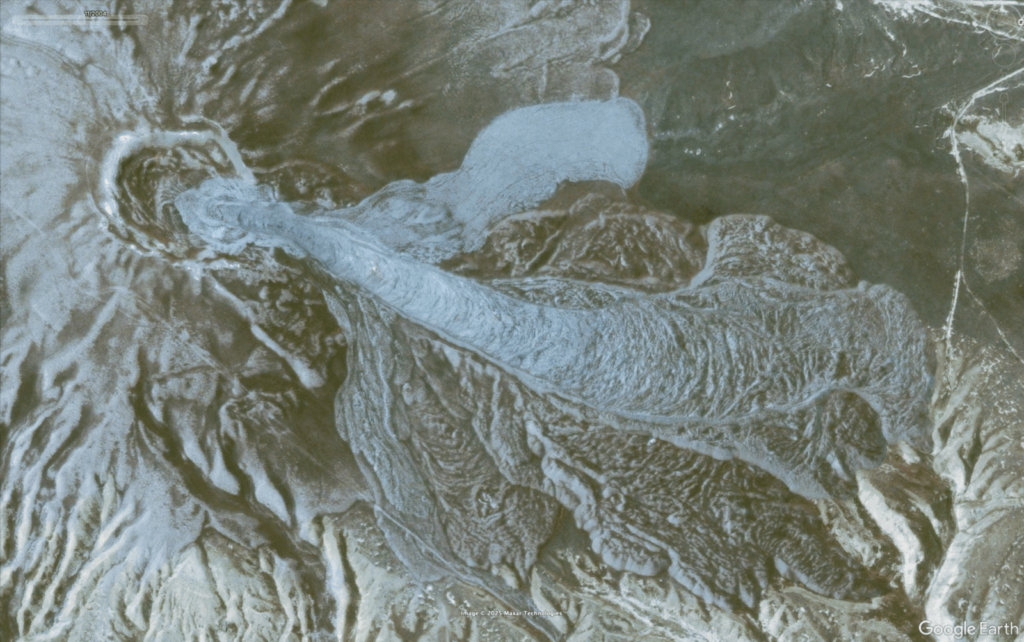
Back in the office, we turned to satellite imagery. Google Earth’s historical archive allowed us to compare images collected over the years. We selected Lokbatan first. As we inspected the historical images of the flow, distinctive surface features began to reveal something remarkable: they indeed had changed position. And not only small mud breccia, but blocks that are more than 10 m tall moved across the years. The movement was not dramatically fast. No sudden landslide or debris flow had occurred. Instead, the flow had gradually shifted downslope.
To verify this behaviour, we combined our observations with InSAR data, a remote-sensing technique detecting subtle ground deformation from space. Together, the datasets painted a consistent picture. The kilometre-scale mud flow was creeping downslope, year after year.
Just as temperate glaciers move through a combination of internal deformation and sliding over a lubricated base, the Lokbatan mud flow appeared to be advancing through a similar process. Newly erupted material accumulated near the crater, increasing the load on older deposits. Beneath the flow, a liquid-rich layer reduced friction and allowed the mass above to slowly slide downhill.
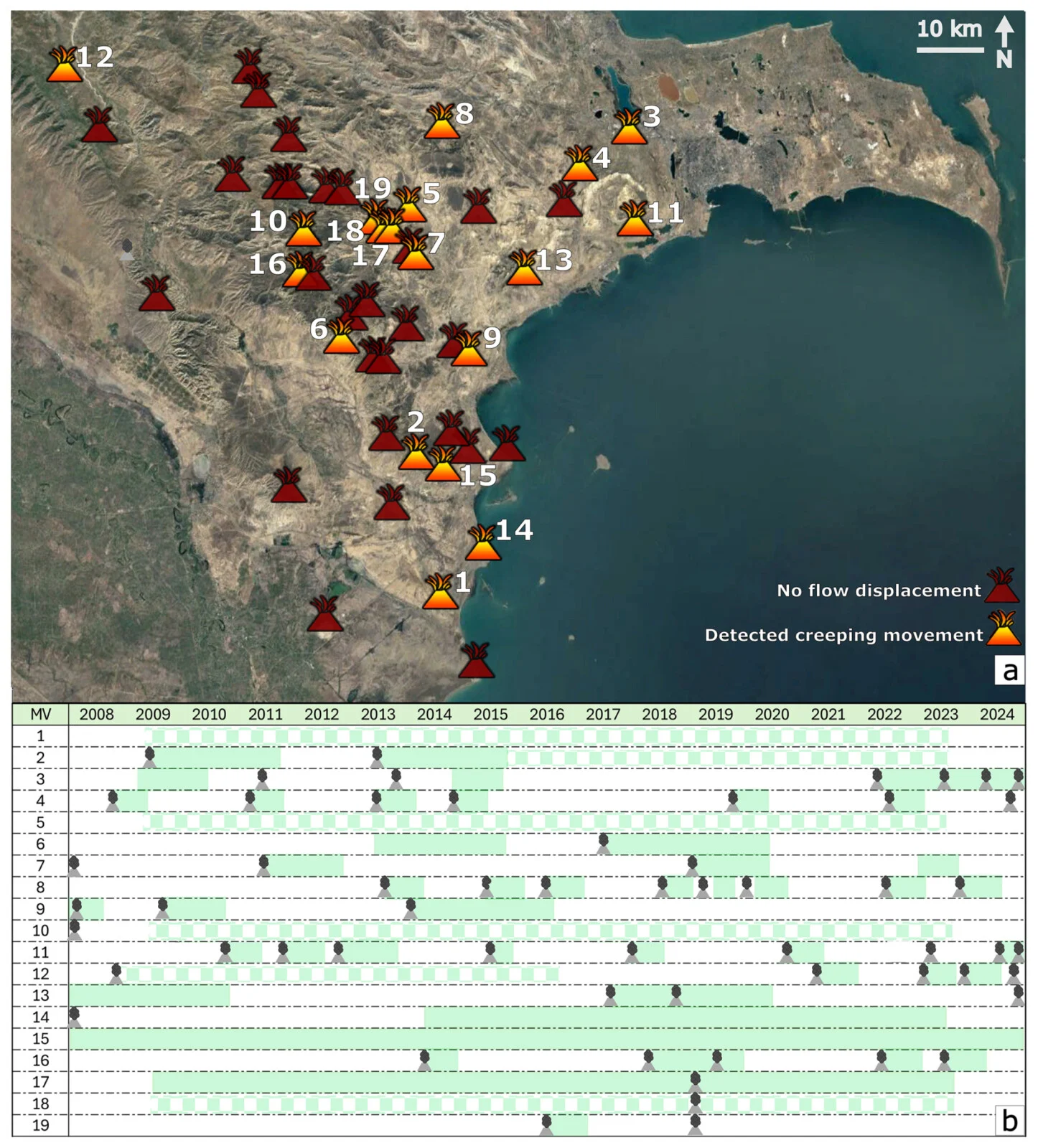
Satellite image with mud volcano locations and eruption timelines based on published data from Fenske et al., 2026 (https://doi.org/10.5194/esurf-14-433-2026).
Suddenly, the kilometre-long flow no longer required a gigantic eruption to explain its existence. It could grow incrementally through repeated episodes of slow movement. However, scientific discoveries often raise more questions than they answer: Was Lokbatan unique? Or had we overlooked a common process operating across Azerbaijan’s marvellous mud-volcano province?
To find out, we expanded our satellite investigation to dozens of mud volcanoes distributed throughout the Caspian Basin. It became an exercise in landscape detective work. We compared image after image across decades, searching for signs of movement. The results did not disappoint. Evidence of creeping mud flows was identified at 19 mud volcanoes, out of 47 randomly selected ones. Some moved only a few metres over a decade, while others displayed much more impressive displacement. At Goturdag mud volcano, for example, movement could be traced along the entire length of the flow for years. Field visits revealed sharp boundaries between active moving deposits and stable slopes, making the creeping process visible directly in the landscape. The creep displaced tens of metres of mud across a decade, burying valleys at the bottom of its slope.
However, not every mud volcano behaved the same way. Some appeared to move only after eruptions, while others showed nearly continuous deformation. Yet the overall pattern was clear: creeping mud flows are not an isolated curiosity. They represent an important geomorphic process shaping many Azerbaijani mud volcanoes.
Reading the Landscape Differently
One very rewarding aspect of geomorphology is learning to see familiar landscapes in new ways. Before this work, kilometre-scale mud flows were interpreted as products of rare, massive eruptions. Today, we understand that many may instead represent the cumulative result of small events acting over decades.
This shift in perspective also carries practical implications. Slow-moving mud flows can deform pipelines, roads, and other infrastructure. In some locations, they even threaten nearby settlements. A landscape that appears stable may still be moving centimetre by centimetre beneath our feet.
For us, the most exciting aspect of this discovery was how it emerged from combining field observations with modern monitoring techniques. A few unexpected fractures in the mud led to satellite investigations, geophysical surveys, and ultimately a new conceptual model for how these landforms evolve.
Closing Highlight
Geomorphology often advances when landscapes reveal behaviours we did not expect. At Azerbaijan’s mud volcanoes, a process hidden in plain sight turned out to be shaping entire landforms. By following clues from the field and combining them with satellite observations, we discovered that mud flows can behave much like glaciers, slowly creeping downslope long after eruptions have ended… It is a reminder that even familiar landscapes can still surprise us when we take the time to watch them carefully.
This work has been published recently at Esurf and Geology, so go take a look if you want to know more!
Thanks to my colleagues Petr Brož and Adriano Mazzini to make this collaboration and work happen!
References:
Mazzini, A., Brož, P., Lupi, M., Břežný, M., Jodry, C., Sfalcin, J., Fenske, C., Morelli, G., Fishanger, F., Huseynova, A., Huseynov, A. : Mud volcanism and creepy mud flows: A new model. Geology 2026; doi: https://doi.org/10.1130/G54583.1
Fenske, C., Brož, P., and Mazzini, A.: Mud volcano dynamics in Azerbaijan: the overlooked role of creeping mud flows in landscape evolution, Earth Surf. Dynam., 14, 433–442, 2026, https://doi.org/10.5194/esurf-14-433-2026